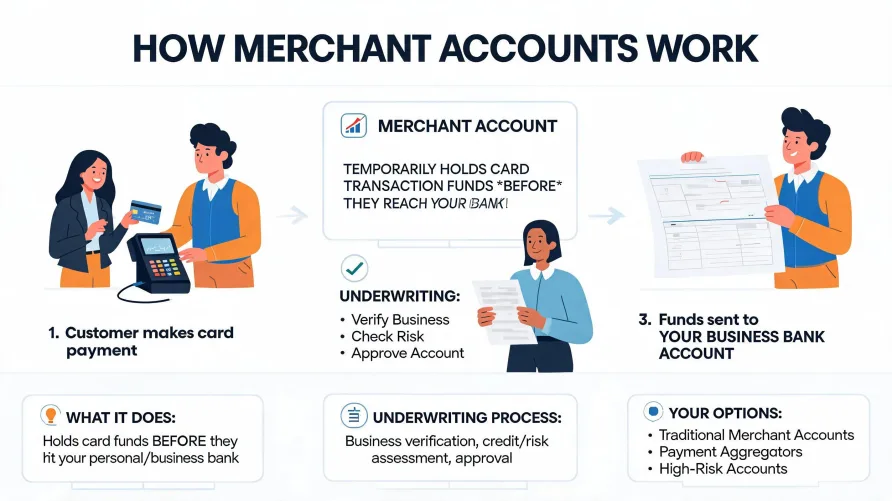
A merchant account is a special-purpose bank account that temporarily holds funds from credit and debit card transactions before they transfer to your business's operating account. It sits between the customer's payment and your bank, managed by an acquiring bank or payment institution under a formal agreement. Every business that accepts card payments uses a merchant account, whether they realize it or not. Some businesses hold their own dedicated merchant account directly. Others share one through an aggregator that bundles many businesses under a single master account. How Merchant Accounts Work When a customer swipes, taps, or enters a card number, the transaction doesn't move money directly into your checking account. It triggers a chain of steps involving multiple financial parties, and the merchant account is where funds land before reaching you. The card network routes the transaction from the customer's issuing bank to the acquiring bank that holds your merchant account. The acquiring bank deposits the approved transaction amount, minus processing fees, into the merchant account. Those funds typically sit there for one to two business days before the acquiring bank transfers the settled amount to your regular business bank account, usually through an ACH deposit. The merchant account itself isn't something you log into or manage like a checking account. It's a pass-through holding account governed by the terms of your merchant services agreement. That agreement spells out your processing rates, fee structure, chargeback responsibilities, reserve requirements, and the conditions under which the account can be frozen or terminated. One detail that catches business owners off guard: the acquiring bank assumes financial risk on every transaction you process. If a customer disputes a charge six months later and you can't cover the chargeback, the acquiring bank is liable. That risk is why merchant accounts require underwriting and why not every business gets approved on the same terms. Dedicated Merchant Accounts vs. Aggregators Not every business holds its own merchant account. The distinction between a dedicated account and an aggregator matters because it affects your pricing, your risk profile, and how much control you have over the relationship. A dedicated merchant account is issued directly to your business after an underwriting review. You get your own merchant identification number, your own processing history, and a direct contractual relationship with the acquiring bank or its authorized reseller. Rates are typically negotiated based on your business type, processing volume, and risk profile. You also have more control over dispute resolution and reserve terms. An aggregator, sometimes called a payment service provider, takes a different approach. Instead of underwriting each business individually, the aggregator holds one large merchant account and lets many businesses process transactions under it. You don't go through traditional underwriting. You sign up, sometimes in minutes, and start processing. The aggregator manages the risk internally and absorbs the underwriting cost across its entire portfolio. That speed comes with tradeoffs. Aggregators can freeze or terminate your processing privileges faster because you don't hold the account yourself. Your pricing is usually flat-rate rather than negotiated, which tends to cost more per transaction at higher volumes. And because you share the account with thousands of other businesses, a spike in fraud across the aggregator's portfolio can sometimes trigger holds that affect merchants who haven't done anything wrong. For a new business processing under $10,000 per month, an aggregator is often the practical choice. The speed and simplicity outweigh the control you give up. For established businesses with predictable volume and lower risk profiles, a dedicated merchant account usually delivers better long-term economics and more stable processing conditions. What Is the Merchant Account Underwriting Process Getting a dedicated merchant account requires underwriting, and it's more involved than opening a standard business bank account. The acquiring bank or processor evaluates your business to decide whether they're willing to assume the financial risk of processing your card transactions. Underwriting typically involves a review of your business type and industry classification, your projected monthly processing volume, your average transaction size, your personal and business credit history, your processing history if you've accepted cards before, and your chargeback rate from any prior account. High-risk industries, including those with high chargeback rates, recurring billing models, or regulated products, face stricter scrutiny and may need specialized providers. The timeline varies. Some processors approve applications within a day or two for low-risk businesses. Others take one to three weeks, particularly for businesses in higher-risk categories or those without processing history. During this period, the underwriter may request bank statements, tax returns, business licenses, or a review of your website and refund policy. Once approved, the acquiring bank assigns your business a merchant identification number and a merchant category code. MCC codes are four-digit classifications that identify your business type to the card networks and directly affect your interchange rates. They also influence how transactions are categorized for rewards programs on the cardholder side. For a closer look at how MCC codes work and why they matter to your bottom line, see our guide to merchant category codes. How Merchant Account Reserves Work Many merchant account agreements include a reserve requirement, especially for newer businesses or those in higher-risk industries. A reserve is a portion of your processing funds that the acquiring bank holds back as a financial cushion against future chargebacks, refunds, or account losses. Reserves typically come in three forms. A rolling reserve withholds a percentage of each transaction for a set period, usually six months, then releases those funds on a rolling basis. An upfront reserve requires a lump sum deposit before you begin processing. A capped reserve withholds funds until the reserve reaches a specified dollar amount, then stops collecting. The reserve isn't a fee. It's your money, held temporarily. But it affects your cash flow directly, and business owners who don't anticipate it can find themselves short on working capital during the early months of a new processing relationship. We cover reserve structures, negotiation strategies, and what to expect in our detailed guide to credit card processing reserves. Do You Need a Merchant Account to Accept Credit Cards Yes. Every credit card transaction runs through a merchant account somewhere in the chain. The real question is whether you hold one yourself or access one indirectly through an aggregator. If you sign up with an aggregator, you're processing under their merchant account. You don't need to apply for your own. If you work with a traditional processor or acquiring bank directly, you'll hold a dedicated merchant account in your business's name. Either path requires a merchant account to exist. There's no way to accept card payments without one. What Is the Difference Between a Merchant Account and a Payment Processor This is one of the most common points of confusion for business owners entering the card payments space, and the distinction matters when you're evaluating agreements and comparing fee structures. A merchant account is the bank account where transaction funds are held during settlement. A payment processor is the technology and service layer that routes transaction data between the cardholder's bank, the card network, and your merchant account. The processor handles authorization, capture, and settlement messaging. The merchant account holds the money. The processor moves the data. The merchant account holds the funds. You need both to accept card payments, but they serve different functions. Some companies bundle both into a single service, which is why the terms get used interchangeably in conversation. But they aren't the same thing. For a full breakdown of how processors, gateways, and acquiring banks connect, see our guide to how credit card processing works. How to Get a Merchant Account The process depends on which path fits your business. For an aggregator, you typically complete an online application, verify your identity, connect a bank account, and start processing within hours. No underwriting interview, no extended document review. For a dedicated merchant account, the process is more formal. Start by gathering your business documentation: your EIN or tax identification number, business license, recent bank statements, and processing history if available. Submit an application through a processor, acquiring bank, or independent sales organization. Respond to any underwriting requests promptly, since delays on your end extend the timeline. Review the proposed merchant services agreement carefully before signing, paying particular attention to rate structures, reserve terms, early termination fees, and chargeback thresholds. The approval timeline scales with your risk profile. A retail store with two years of clean processing history won't face the same level of scrutiny as an online subscription business launching its first merchant account. When a Dedicated Merchant Account Is Worth It The convenience of an aggregator is real, and for many small businesses it's the right starting point. But as volume grows and your processing history stabilizes, the economics shift. A dedicated merchant account typically offers interchange-plus pricing, which separates the card network's base interchange rate from the processor's markup. That transparency lets you see exactly what you're paying at each layer and gives you room to negotiate. Flat-rate pricing from an aggregator is simpler to understand but usually costs more per transaction once you're processing consistent volume above $15,000 to $20,000 per month. Beyond pricing, a dedicated account gives you a direct relationship with the acquiring bank, more predictable reserve terms, greater stability during volume spikes, and less exposure to account freezes caused by other merchants on a shared platform. The application process takes more time and documentation than signing up with an aggregator, but the long-term savings and operational stability often justify it. For businesses evaluating their options, our credit card processing reviews cover providers across both dedicated and aggregator models.
What Is a Merchant Account