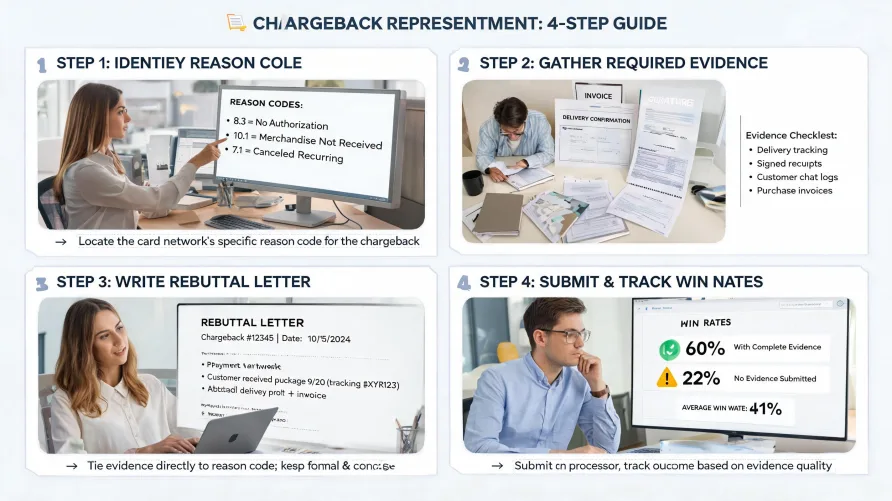
Merchants can dispute chargebacks through a process called representment, where you submit evidence to your acquiring bank proving the original transaction was valid. Knowing how to dispute a chargeback as a merchant starts with reading the reason code, gathering the right documentation, writing a focused rebuttal, and submitting everything within your processor's deadline. The process isn't fast and it isn't guaranteed, but merchants who follow a structured approach win more often than those who skip the details. This guide breaks down each step so you can build a stronger case the next time a chargeback hits your account. What Chargeback Representment Actually Means Representment is the formal name for a merchant's response to a chargeback. When a cardholder's bank initiates a chargeback, your acquiring bank debits the disputed amount from your account and notifies you. You then have a limited window to challenge the chargeback by presenting evidence that the transaction was legitimate. The dispute flows through a structured chain. The cardholder contacts their issuing bank, which files the chargeback with the card network. The card network passes it to your acquiring bank, which passes it to you. Your response travels the same chain in reverse. If the issuing bank doesn't accept your evidence, the dispute can escalate to arbitration through the card network, though arbitration carries additional fees and is rarely worth pursuing for smaller transactions. Understanding the reason code attached to your chargeback determines everything that follows. The evidence you need, the arguments you make, and even whether the dispute is worth fighting all depend on that code. Step 1: Read and Decode the Reason Code Every chargeback arrives with a reason code assigned by the card network. These codes tell you exactly why the cardholder's bank reversed the transaction. The major card networks each maintain their own code systems, but they generally fall into four broad categories. Fraud claims are the most common and indicate the cardholder says they didn't authorize the transaction. Authorization errors mean there was a technical problem with how the transaction was processed. Consumer disputes cover situations where the cardholder received the product but claims it was defective, not as described, or never delivered. Processing errors involve duplicate charges, incorrect amounts, or expired authorizations. Your processor's chargeback notification should include the specific reason code, and you should look it up in the card network's published dispute rules to understand what evidence the issuing bank expects. Don't guess. Each code has specific documentation requirements, and submitting the wrong evidence wastes your limited response window. Step 2: Evaluate Whether the Dispute Is Worth Fighting Not every chargeback deserves a response. Before investing time in evidence gathering, look at the transaction amount versus the cost of your time. Small transactions may not justify the hours required to build a case. Check the reason code against your records, and if the cardholder's complaint is legitimate, accepting the chargeback and fixing the underlying problem is smarter than fighting a losing battle. Review your evidence availability, because if you can't produce the specific documentation the reason code requires, your chances of winning drop significantly. Merchants also need to consider their chargeback ratio, since card networks monitor the percentage of transactions that result in chargebacks. Exceeding the threshold, typically around 1% of transactions, can land you in a monitoring program with higher fees and additional requirements. Sometimes accepting a chargeback on a borderline case makes more sense than winning the dispute but drawing attention to an elevated ratio. Step 3: Gather Evidence by Reason Code Category The evidence that wins chargeback disputes varies by reason code. Here's what to collect for each major category. Evidence for Fraud-Related Chargebacks Fraud claims require proof that the legitimate cardholder authorized the transaction. Collect the AVS (Address Verification Service) match results showing the billing address matched the card's address on file. Pull the CVV verification results confirming the cardholder entered the correct security code. If you use 3D Secure authentication, include the authentication record showing the cardholder completed the verification step. For online transactions, gather the customer's IP address and geolocation data, and pull records of any previous successful transactions from the same customer using the same card, shipping address, or device fingerprint. A pattern of legitimate purchases undermines the claim that this particular transaction was fraudulent. For in-person transactions, include the chip read receipt or signature capture. EMV chip transactions carry a liability shift, meaning the issuing bank typically bears fraud liability when the chip was properly read. Evidence for Non-Receipt Claims When a cardholder claims they never received their order, your shipping documentation becomes the centerpiece. Collect the tracking number and carrier delivery confirmation showing the package was delivered to the correct address. Signed delivery confirmation is stronger than basic tracking, and for high-value shipments, signature confirmation is worth the extra cost precisely because it provides near-bulletproof evidence against non-receipt claims. Include a copy of the order details showing the shipping address the customer provided, and if the delivery address matches the billing address on file, note that explicitly. Screenshots from the carrier's tracking system showing delivery date, time, and location add credibility. For digital goods or services, gather download logs, access records, or login activity showing the customer used the product after purchase. IP addresses and timestamps from these records help establish that the cardholder received and used what they paid for. Evidence for Product or Service Disputes When the cardholder received the item but claims it was defective, not as described, or the service was substandard, your evidence needs to prove you delivered what was promised. Start with the product description or service agreement the customer saw at the time of purchase. Screenshots of the product listing, terms of service, or signed contracts establish what was promised. Collect any communication between you and the customer, including emails, chat transcripts, or support tickets, because these records can show that the customer didn't report a problem before filing the chargeback, or that you offered a resolution they rejected. If you have a return or refund policy, include it. Card networks generally expect merchants to have clear policies and to honor them. If the customer didn't follow your return process before filing a chargeback, that works in your favor. A copy of your published return policy alongside the purchase date and chargeback date establishes the timeline. Evidence for Processing Errors Duplicate charge claims require your transaction records showing only one charge was processed, or if a duplicate did occur, proof that you already issued a credit. Pull your batch settlement records and the authorization logs for the transaction date. For incorrect amount claims, provide the signed receipt, invoice, or order confirmation showing the correct amount. If a tip was added at a restaurant or service business, include the signed tip line. For subscription charges, include the enrollment agreement showing the recurring billing terms the customer agreed to. Step 4: Write the Rebuttal Letter The rebuttal letter is your narrative tying the evidence together. It doesn't need to be long. It needs to be organized, specific, and directly responsive to the reason code. Open with the transaction details: merchant name, transaction date, amount, and the last four digits of the card number. State the reason code and explain why the chargeback is invalid. Reference each piece of evidence by name so the reviewer can find it in your submission package. Keep the tone professional and factual. Emotional appeals don't work. The person reviewing your case is processing dozens of disputes daily and wants clear facts, not complaints about unfair treatment. Avoid lengthy backgrounds about your business or the customer relationship. Stick to what happened, what you can prove, and why the evidence contradicts the cardholder's claim. A strong rebuttal letter for a fraud claim might read: "Transaction [number] on [date] for [amount] was authorized by the cardholder. AVS verification confirmed a full match on billing address. CVV verification confirmed a match. The customer had three previous successful transactions using the same card and shipping address over the preceding six months with no disputes. Attached are the AVS/CVV results, order history, and delivery confirmation." That's direct, specific, and easy to verify against the attached documentation. It doesn't waste the reviewer's time. Step 5: Submit Within the Representment Window Every processor and card network sets a deadline for chargeback responses, and missing this deadline forfeits your right to dispute regardless of how strong your evidence is. The response window varies by card network, with current published rules generally allowing between 20 and 45 days from the date the chargeback is filed, though your acquiring bank may set a shorter internal deadline. Check with your processor to confirm the exact timeframe for your account. Don't wait until the last day. Build your case early, even if you submit it a week before the deadline, because last-minute submissions leave no room for technical problems with uploads, missing documents you didn't realize you needed, or questions from your processor about your response. Organize your submission clearly and label each document so the reviewer can match it to the evidence referenced in your rebuttal letter. A disorganized submission with unlabeled attachments hurts your case even if the evidence itself is strong. What Happens After You Submit Once you submit your representment, your acquiring bank forwards it to the issuing bank. The issuing bank reviews your evidence and decides whether to reverse the chargeback or uphold it. If the issuing bank accepts your evidence, the disputed funds return to your account. If they reject your response, you can escalate to arbitration through the card network. Arbitration involves additional fees, often several hundred dollars, and the card network's decision is final. For most disputes, arbitration only makes financial sense on high-value transactions where you have strong evidence that was overlooked. The entire process from initial chargeback to final resolution can take 60 to 90 days, sometimes longer if the case goes to arbitration. Can You Win a Chargeback Dispute? Yes, but expectations should be realistic. Industry data suggests merchants win somewhere between 20% and 40% of disputed chargebacks, depending on the reason code, the quality of evidence, and the industry. Fraud-related chargebacks tend to have lower win rates because the burden of proof is high. Non-receipt claims where you have delivery confirmation tend to have higher win rates because the evidence is concrete and easy to verify. The biggest factor in win rates isn't the strength of your case. It's whether you submitted the right evidence for the specific reason code. Merchants who treat every chargeback the same, submitting a generic package of transaction records, lose far more often than those who tailor their response to what the reason code demands. What Is the Chargeback Deadline for Merchants? The deadline to respond depends on your processor and the card network involved. As a general rule, most networks give merchants between 20 and 45 days. Your processor may impose a shorter window. The clock starts when you're notified of the chargeback, not when the cardholder filed it. Check your processor agreement or contact their support team to confirm the exact timeline for your account. Some processors send notifications by email, others through an online dashboard, and some still use postal mail. If you're relying on mail notifications, you've already lost days before the letter arrives. Moving to electronic notifications, if your processor offers them, gives you more working time. Preventing Chargebacks Before They Happen Disputing chargebacks is necessary, but prevention costs less and protects your chargeback ratio. Use clear billing descriptors so customers recognize your business name on their statement. Vague or abbreviated descriptors are one of the most common triggers for "I don't recognize this charge" disputes. Respond to customer complaints and refund requests quickly, because many chargebacks start when a customer tries to resolve the issue with the merchant and can't get a response. Make your contact information easy to find on your website, receipts, and confirmation emails. For subscription businesses, send billing reminders before each charge. Customers who forgot they signed up for a recurring service often file chargebacks instead of canceling. A reminder email three to five days before the charge gives them a chance to cancel through your normal process instead. Card network alert services can also notify you when a customer initiates a dispute before it becomes a formal chargeback, giving you the option to issue a refund preemptively and keep your ratio clean. Building a Repeatable Dispute Process The merchants who win chargebacks consistently aren't doing anything extraordinary. They have a repeatable process. Every transaction generates a record. Every shipment gets tracked. Every customer interaction is documented. When a chargeback arrives, the evidence already exists and just needs to be assembled. Build your record-keeping with chargebacks in mind. Save email confirmations, keep delivery receipts accessible, and log customer service interactions with dates and outcomes. The time to prepare for a chargeback dispute is before the chargeback happens. If you're evaluating payment processors and want to understand how different providers handle chargeback support, dispute tools, and merchant protections, we cover those details in our credit card processing reviews.
How to Dispute a Chargeback as a Merchant