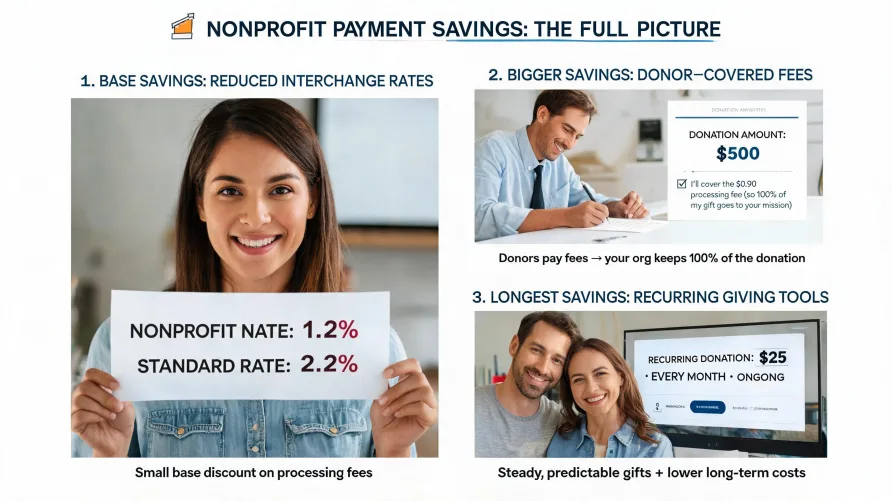
Credit card processing for nonprofits operates under a different economic structure than standard merchant processing, but the savings aren't as dramatic as many organizations expect. Card networks publish lower interchange rates for registered charities, typically reducing per-transaction costs by 0.4% to 0.8% compared to standard retail categories. Qualifying for those rates requires verified 501(c)(3) status, a processor willing to register the organization under the correct merchant category code, and an understanding of which transaction types actually receive the discount. The gap between advertised "nonprofit rates" and what an organization actually pays on a monthly statement often surprises finance directors who assumed the discount applied universally. How Nonprofit Interchange Rates Actually Work Visa and Mastercard both maintain separate interchange categories for charities and nonprofits. Visa's designations include a "Charity" tier and related classifications for card-present versus card-not-present transactions. Mastercard maintains similar reduced-rate categories under its Merit program. These rates apply at the interchange level, which is the base cost that every processor pays to the card-issuing bank on each transaction. The discount matters more than it sounds. On a $100 online donation processed with a standard consumer credit card, the interchange difference between a regular card-not-present rate and a charity rate might be $0.40 to $0.80. Scale that across thousands of transactions and the annual savings become material for organizations operating on tight program budgets. A nonprofit processing $300,000 in annual online donations could save $1,200 to $2,400 at the interchange level alone, money that goes directly back to program delivery. But the interchange reduction only covers one layer of processing cost. The processor's markup, network assessment fees, and any gateway charges sit on top of interchange regardless of nonprofit status. A nonprofit paying interchange-plus pricing will see the charity rate reflected clearly on its statement, line by line. One using flat-rate or tiered pricing may not see the benefit at all, because the processor has already bundled interchange into a single blended rate that obscures the underlying discount. Not every transaction qualifies for the reduced rate. Debit card transactions often carry flat regulated rates under the Durbin Amendment that don't change based on merchant category. Corporate cards and rewards cards carry their own interchange tiers that may not include a charity discount. The result is that a nonprofit processing a mix of card types will see the reduced rate on some transactions but not all, and the effective discount across a full month of processing is usually smaller than the headline rate suggests. 501(c)(3) Verification and the Underwriting Process Processors that offer nonprofit pricing require proof of tax-exempt status during underwriting. The standard documentation is the IRS determination letter confirming 501(c)(3) status, though some processors also request the organization's EIN, articles of incorporation, and recent financial statements or Form 990 filings. The merchant category code is where the rate reduction lives. A processor must register the nonprofit under MCC 8398 (Charitable and Social Service Organizations) or a related charity-specific code for the interchange discount to apply. If the organization gets coded under a general services MCC instead, it processes at standard rates regardless of its tax status. This is a common oversight that costs nonprofits real money. Organizations should confirm their assigned MCC after account setup and verify it appears correctly on their first processing statement. Smaller nonprofits sometimes face friction at traditional processors. Organizations with limited processing history, volunteer-run boards, or annual revenue below certain thresholds may encounter longer approval timelines or higher reserve requirements. Aggregator-model processors that pool merchants under a master account tend to offer faster activation, but they may not register individual nonprofit MCCs. That means the organization gets the speed of a quick setup but misses the interchange discount entirely, which over a year of processing can cost more than any monthly fee savings. Do Processors Offer Nonprofit Discounts Beyond Interchange? Yes, but the scope varies widely. The interchange reduction from the card networks is the baseline, and it applies regardless of which processor you use as long as the MCC is correctly assigned. Beyond interchange, some processors voluntarily reduce their markup for 501(c)(3) organizations, waive monthly platform fees, or provide free gateway access for donation pages. These processor-level discounts aren't standardized across the industry. One processor might waive a $10 monthly fee. Another might cut its per-transaction markup by 0.05%. A third might offer free virtual terminal access for phone-based donations. The savings are real but modest in most cases, and they vary enough that organizations should compare total effective cost across a realistic monthly volume rather than fixating on which processor advertises the most nonprofit-friendly branding. The most meaningful cost reduction for credit card processing for nonprofits almost always comes from correct MCC assignment and interchange optimization, not from processor-level courtesy discounts alone. Donor-Covered Processing Fees: The Checkbox That Changes the Math The donor-covered fee model has become one of the most significant developments in nonprofit payment processing. The concept is simple: a checkbox on the donation form lets the donor add the estimated processing cost to their gift, so a $100 donation becomes roughly $103 to $104 and the organization receives the full intended amount. Adoption rates for this feature have climbed steadily. Data from multiple fundraising platform providers suggests that when the option is presented clearly and without pre-selection, 60% to 80% of online donors choose to cover the fee. That range depends on presentation design, donor relationship strength, and gift size. Smaller donations tend to see higher opt-in rates because the added amount feels trivial. A donor already giving $25 rarely hesitates at an extra $0.75. The donation lift is real. For a nonprofit processing $500,000 in annual online donations with a blended processing cost around 2.9% plus $0.30 per transaction, donor fee coverage at a 70% opt-in rate recovers roughly $10,500 in fees that would otherwise reduce program funding. That's not a rounding error for a mid-size nonprofit running on thin margins. Do Donor-Covered Fees Actually Increase Donations? They don't increase the number of donations, but they increase the net revenue per donation. The distinction matters. A donor who was going to give $100 still gives $100. The fee coverage is additive, not a substitute for the original gift amount. Organizations that implement donor-covered fees typically see immediate improvement in net donation revenue without any measurable decline in donation completion rates. The donor experience question deserves careful thought, though. The checkbox introduces a transactional element into what donors perceive as a charitable act. Some organizations report that major gift prospects or long-time supporters react negatively to the prompt, viewing it as the organization asking them to subsidize operational costs rather than managing them internally. Annual fund campaigns and end-of-year giving drives, where donors are already making deliberate financial decisions, tend to see the highest opt-in rates with the least friction. Event-based donations and emergency appeals show more mixed results, possibly because the emotional urgency of those gifts makes a fee prompt feel like an interruption. The best implementations make the option clearly voluntary, use neutral language like "I'd like to cover the processing fee," and don't pre-check the box. Pre-checked boxes in particular have drawn regulatory attention in e-commerce under FTC negative option marketing guidelines, and while enforcement around charitable giving pages differs from commercial subscriptions, the reputational risk of an aggressive default isn't worth the incremental revenue. One mechanical detail organizations often overlook: the fee estimate shown to the donor is just that, an estimate. Actual interchange rates vary by card type, and the organization may collect slightly more or less than the true processing cost on any given transaction. Most nonprofits set the coverage at a flat percentage like 3% and accept the small variance rather than building real-time interchange calculation into their donation forms. Recurring Donation Infrastructure Recurring giving is where credit card processing for nonprofits diverges most sharply from standard retail payment processing. A retail merchant wants to complete a single transaction and move on. A nonprofit wants to initiate a giving relationship that generates monthly revenue for years. The infrastructure requirements reflect that difference. Tokenized card storage lets organizations charge donors monthly without requiring them to re-enter payment details each cycle. Account updater services, offered by Visa and Mastercard through participating processors, automatically refresh expired or replaced card numbers when a bank reissues a card. These services carry a small per-update fee, but the cost of maintaining a recurring donor is far lower than the cost of acquiring a new one. Failed payment recovery matters more than most development teams realize. Industry estimates suggest that 5% to 10% of recurring charges fail each month due to expired cards, insufficient funds, or issuing bank declines. Without automated retry logic and donor notification workflows, those failures translate directly into lost recurring revenue that compounds month over month. A nonprofit with 1,000 monthly donors at $50 average and a 7% monthly failure rate loses $3,500 per month in at-risk revenue. The difference between a processor with strong dunning management tools and one without can represent tens of thousands of dollars in annual donor retention. PCI compliance adds another operational layer. Any organization storing or transmitting donor payment credentials must maintain PCI DSS compliance as defined by the PCI Security Standards Council. These requirements apply regardless of organization size, transaction volume, or nonprofit status. Most nonprofits satisfy compliance by using a processor's hosted payment page or embedded payment form rather than handling card data on their own servers, which shifts the majority of PCI scope to the processor and reduces the organization's compliance burden to a self-assessment questionnaire. Chargeback Patterns in Nonprofit Giving Chargebacks in nonprofit processing follow different patterns than retail chargebacks. Fraud rates on donation pages tend to be lower than on e-commerce sites because there's no physical product to intercept or resell, which reduces the economic incentive for card-testing fraud. That said, nonprofits face their own specific chargeback risks. Spousal disputes are one recognized pattern. A donor makes a gift without their partner's knowledge or agreement, the partner sees the charge on a shared account, and a dispute gets filed. Recurring donations create similar exposure when a donor forgets about an ongoing commitment and disputes charges that appear months after the initial signup. Both scenarios are preventable with clear communication. The good news is that chargeback ratios for most nonprofits remain well below the card network thresholds that trigger monitoring programs. Visa's dispute monitoring program activates at 0.9% of transactions, and most nonprofits operate at a small fraction of that rate. Organizations that do face elevated chargebacks typically trace the problem to one of three causes: unclear donation page language that doesn't confirm the charge amount, missing or delayed receipt emails, or recurring charges where the organization's name doesn't appear in the billing descriptor. Clear billing descriptors are an underrated prevention tool. When a donor sees "COMMUNITY FOOD BANK" on their card statement instead of a cryptic processor code or abbreviated gateway name, dispute rates drop. Organizations should confirm their billing descriptor during account setup and test it by running a small transaction to verify how it appears on a statement. Credit Card Processing for Nonprofits: What to Prioritize The best approach for a nonprofit to accept card-based donations starts with understanding which cost factors actually move the needle. Correct MCC assignment matters more than processor-level discounts. Donor-covered fee capability can offset more processing cost than any rate negotiation. Recurring infrastructure with account updater services and failed payment recovery protects the long-term revenue that sustains programs. PCI compliance scope should be minimized through hosted payment solutions rather than managed internally. Organizations should also prioritize transparent reporting that separates interchange costs from processor markup. Interchange-plus pricing models give nonprofits the clearest view of what they're paying and make it easier to verify that charity interchange rates are being applied to qualifying transactions. For organizations researching specific providers that serve the nonprofit space, our credit card processing reviews cover several processors with dedicated nonprofit programs and transparent pricing structures.
Nonprofit Credit Card Processing: Donor-Covered Fees and Reduced Rates Reality