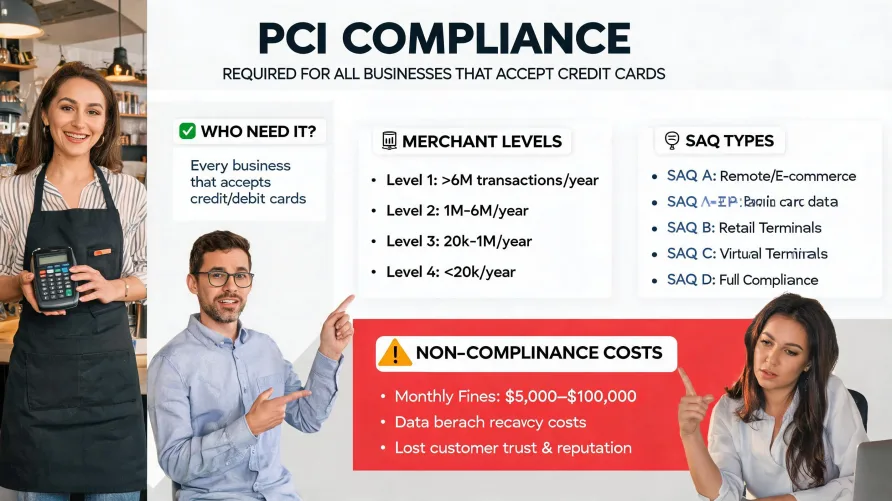
PCI compliance applies to every business that accepts, processes, stores, or transmits credit card data, regardless of size. If your company takes card payments, even a single transaction per year, you're required to meet the Payment Card Industry Data Security Standard (PCI DSS). For a small business handling a few hundred transactions per month, the requirements are more accessible than most owners expect. But ignoring them creates real financial risk. PCI compliance for small businesses isn't optional, and the consequences of non-compliance go well beyond theoretical. Do All Businesses Need PCI Compliance? Yes. The PCI Security Standards Council makes this unambiguous: any organization that handles cardholder data must comply with PCI DSS. There's no revenue threshold, no employee count minimum, and no exemption for businesses that process low volumes. A sole proprietor selling handmade goods at a farmers market with a mobile card reader has the same fundamental obligation as a national retail chain. The confusion often comes from the word "compliance" itself. Many small business owners assume PCI compliance means passing a formal audit conducted by a third-party assessor. For the vast majority of small businesses, it doesn't. Most merchants validate compliance by completing a Self-Assessment Questionnaire (SAQ), a structured checklist rather than an external examination. Your merchant level, determined by annual transaction volume, dictates exactly how much work is involved. A Level 4 merchant completing SAQ A might spend two or three hours on the process once a year. A Level 1 merchant needs a full on-site assessment by a certified auditor, a process that can take weeks and cost tens of thousands of dollars. The gap between those two experiences is enormous, which is why understanding where your business falls matters before anything else. What does vary is enforcement. PCI DSS is maintained by the PCI Security Standards Council, but it's enforced through the card networks (Visa, Mastercard, American Express, Discover) and, in practice, through your payment processor. Your processor is the one that will charge non-compliance fees or terminate your merchant account if you fail to validate. The Four PCI Merchant Levels The card networks assign every merchant to one of four levels based on annual transaction volume. Visa's thresholds, which most processors follow, break down like this. Level 1 covers merchants processing more than 6 million Visa transactions per year. This level requires an annual on-site assessment by a Qualified Security Assessor (QSA) and quarterly network vulnerability scans by an Approved Scanning Vendor (ASV). Level 2 applies to merchants processing 1 million to 6 million Visa transactions per year. An annual SAQ and quarterly ASV scans are required. Some acquirers may require an on-site assessment at their discretion. Level 3 targets e-commerce merchants processing 20,000 to 1 million Visa transactions per year. Like Level 2, it requires an annual SAQ and quarterly ASV scans. Level 4 is for merchants with fewer than 20,000 Visa e-commerce transactions per year, or up to 1 million total Visa transactions through other channels. An annual SAQ is required, and in many cases, quarterly ASV scans as well, depending on your processing environment. Most small businesses fall into Level 4. That's the lightest compliance tier. One detail that catches merchants off guard: these thresholds apply per card network. A business processing 800,000 Visa transactions and 300,000 Mastercard transactions is Level 4 for Visa but may be classified differently by Mastercard under its own thresholds. In practice, most processors apply the highest applicable level across all networks, but the classification technically sits with each network independently. SAQ Types: Which Questionnaire Your Small Business Needs The SAQ you need depends on how your business handles card data, not just transaction volume. The PCI Security Standards Council publishes several SAQ versions, each designed for a specific payment environment. SAQ A is for merchants who fully outsource all cardholder data functions. If your customers enter their card information on a payment page hosted entirely by a third party, and your systems never touch card data, this is the shortest questionnaire with the fewest requirements. E-commerce businesses using hosted checkout pages commonly qualify. SAQ A-EP applies to e-commerce merchants who partially outsource payment processing. Your website doesn't directly handle card data, but elements of your site (like JavaScript) could be compromised to intercept data before it reaches the third-party processor. This SAQ is substantially more involved than SAQ A. SAQ B covers merchants using only imprint machines or standalone dial-up terminals with no electronic cardholder data storage. These are increasingly rare. SAQ B-IP is for merchants using standalone IP-connected payment terminals, like a countertop device connected to your network. The terminal handles the card data, and your other systems don't store or process it. Many brick-and-mortar small businesses fall here. SAQ C applies to merchants with payment application systems connected to the internet but no electronic cardholder data storage. This typically covers businesses running point-of-sale software on networked systems where the application handles card data directly. SAQ C-VT is for merchants who manually enter transactions one at a time through a virtual terminal provided by a third party, accessed via a web browser. The virtual terminal must be the only payment channel, and the computer running it can't be used for other purposes simultaneously. Small businesses that take phone orders and key them into a browser-based payment page often qualify. SAQ D is the catch-all. If your environment doesn't fit any of the more specific types, you complete SAQ D, which covers the full set of PCI DSS requirements. It has two versions: one for merchants and one for service providers. This is the most demanding self-assessment, with hundreds of questions. Businesses that store card data on their own servers or process payments through custom-built applications typically land here. Choosing the wrong SAQ is a common mistake. Selecting a questionnaire that doesn't match your actual processing environment means your validation is invalid even if you answer every question correctly. If you aren't sure which applies, your payment processor can usually help determine the right classification. The Practical Workload of PCI Compliance for Small Businesses For a Level 4 merchant completing SAQ A or SAQ B-IP, the annual compliance workload is manageable. The SAQ itself can take a few hours to complete. It walks through security requirements in yes-or-no format, covering topics like whether you restrict physical access to cardholder data, whether you use firewalls, and whether default passwords have been changed on your systems. Quarterly ASV scans, if required for your SAQ type, involve an approved vendor running automated external vulnerability scans against your internet-facing systems. For a small business with a simple web presence, these scans typically cost between $100 and $500 per year and take minutes to run. Failed scans require remediation before a passing result can be submitted. The workload increases sharply at SAQ D. Merchants completing the full questionnaire face hundreds of requirements covering network segmentation, encryption, access controls, logging, incident response planning, and regular penetration testing. For businesses at this level, many hire a consultant or managed security provider to assist. That adds cost but reduces the risk of gaps. What Happens If You're Not PCI Compliant Non-compliance consequences come from two directions. The distinction matters. Your payment processor can act immediately and unilaterally. Most processing agreements include PCI compliance as a contractual obligation. If you don't validate compliance, your processor can impose monthly non-compliance fees, typically $10 to $100 per month depending on the provider. Some processors escalate these fees over time. In extreme cases, a processor can terminate your merchant account entirely, which disrupts your ability to accept cards from any customer. The card networks impose a different, more severe set of penalties, but these usually come into play only after a data breach. If your business suffers a breach and you weren't PCI compliant at the time, the acquiring bank (and by extension, you) can face fines from the card networks ranging from $5,000 to $100,000 per month, according to published Visa and Mastercard program guidelines. You're also liable for the cost of forensic investigation, card reissuing, and fraud losses on compromised accounts. The card networks can also place your business on the Terminated Merchant File (TMF, sometimes called the MATCH list), which effectively prevents you from obtaining a new merchant account with any processor for up to five years. For a business that depends on card payments, that's an existential threat. The financial exposure after a breach without PCI compliance can be devastating for a small business. According to IBM's Cost of a Data Breach Report, organizations with fewer than 500 employees face an average breach cost exceeding $3 million globally, though costs vary widely based on scope and industry. Even a fraction of that figure can threaten a small merchant's survival. There's also a less visible consequence. Customers whose card data was compromised through your business aren't likely to return. That reputational damage compounds the financial hit. Keeping Your Business PCI Compliant Year-Round PCI compliance isn't a one-time certification. It's an ongoing obligation that requires attention throughout the year, not just when the annual SAQ is due. Keep your systems patched and updated. PCI DSS requires that security patches be applied within a defined timeframe after release. Running outdated software on systems that interact with card data, even indirectly, creates both a compliance gap and a real vulnerability. Review access controls regularly. Employees who leave the company should have their credentials revoked immediately. Shared logins should be eliminated. Each person with access to cardholder data or payment systems needs a unique identifier. Monitor your processing environment for changes. If you switch from a hosted checkout to an integrated payment form on your own website, your SAQ type likely changes. Adding a new sales channel, like phone orders keyed into a virtual terminal, may change your classification as well. Failing to re-evaluate after an environmental change leaves you validating against the wrong standard. Work with your payment processor on this. Most processors provide PCI compliance portals that walk merchants through the correct SAQ, store completed questionnaires, and track quarterly scan results. These tools exist specifically because processors have a financial incentive to keep their merchants compliant. PCI compliance for small businesses doesn't have to be overwhelming. For the majority of merchants using modern processing setups that keep card data off their own systems, the annual workload is a few hours of focused attention and a modest scan fee. The cost of compliance is a fraction of the cost of a breach. Treat it as routine, not an afterthought, and it stays manageable.
What PCI Compliance Means for Your Business