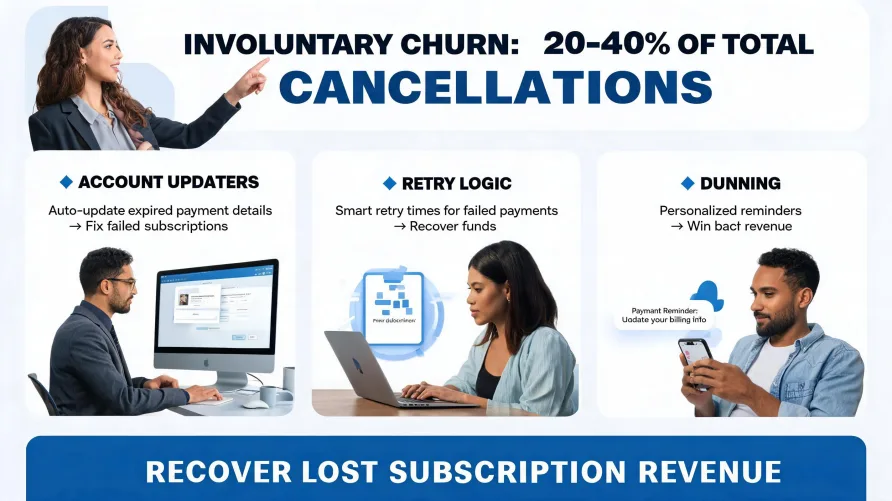
Involuntary churn occurs when a subscription ends not because the customer chose to leave, but because a payment failed. For any subscription business, payment processing reliability directly determines how much revenue walks out the door each month without a single cancellation request. Industry data suggests that 20% to 40% of all subscription churn is involuntary, driven by expired cards, insufficient funds, temporary fraud flags, and card reissuances. Most of it is recoverable with the right payment infrastructure. What Causes Recurring Billing Failures Failed recurring charges trace back to a handful of predictable causes. The most common is an expired card. Visa and Mastercard each reissue roughly 30% of their active cards annually due to expiration dates alone, and that figure doesn't include mid-cycle reissuances triggered by data breaches or lost cards. When a card number changes and the merchant's billing system still holds the old credentials, the next charge attempt returns a decline. Insufficient funds account for a large share of recurring billing failures as well. Unlike one-time purchases where the buyer checks their balance before clicking "buy," recurring charges fire on a fixed schedule. If the charge lands the day before payday or after an unexpected expense, it fails. These declines are often temporary, which makes retry timing critical. Fraud blocks create another category of failure entirely. Card-issuing banks use automated detection systems that can flag a legitimate recurring charge as suspicious, especially after the cardholder travels, changes spending patterns, or when the merchant's billing descriptor doesn't clearly match what the customer expects. These holds typically resolve within hours or days, but a single poorly timed retry can push the customer into a cancellation workflow before the issue clears. Card network reissuances round out the list. When a bank migrates its portfolio to a new BIN range, merges with another institution, or responds to a large-scale data breach, millions of cards can change at once. These events create spikes in decline rates that have nothing to do with individual customer intent. Account Updater: The First Line of Defense in Subscription Business Payment Processing Account updater services are the most effective passive recovery tool available to subscription businesses. These services operate through the card networks directly. Visa Account Updater and Mastercard Automatic Billing Updater allow merchants to submit their stored card credentials in batch, and the networks return updated card numbers, expiration dates, or status flags for any cards that have changed. The process runs on a regular cycle, typically daily or weekly depending on how the processor implements it. When a customer's card is reissued with a new number or expiration date, the account updater returns the new credentials before the next billing attempt even fires. The merchant's system updates the card on file silently, and the customer never sees a disruption. No email, no failed charge, no friction. Recovery rates from account updater alone typically range from 15% to 25% of what would otherwise be failed transactions caused by card changes. For a subscription business processing $500,000 in monthly recurring revenue, even a 20% recovery rate on card-change declines can represent $10,000 to $30,000 in saved revenue per month, depending on churn volume. That adds up. Not all processors offer account updater access, and those that do may charge per-query fees or bundle the service into higher-tier plans. The pricing model matters, so it's worth comparing the per-query cost against the projected recovery value before treating the ROI as automatic. Intelligent Subscription Payment Retry Strategies When a first charge attempt fails, the retry strategy determines whether the payment eventually succeeds or the customer falls into a cancellation funnel. A basic approach where the system simply tries again at fixed intervals recovers some revenue but leaves a significant amount unrecovered. Intelligent retry logic improves results by adjusting timing, frequency, and approach based on the reason the charge failed in the first place. Card network decline codes carry useful information. A "do not honor" response from the issuer means something different from "insufficient funds," which means something different from "card expired." A well-designed retry engine reads these codes and adjusts its behavior accordingly. For insufficient funds declines, the best strategy is to retry within 24 to 72 hours, often at the beginning of a new business day or early in the week when consumer bank balances tend to be higher. Payment industry data suggests that retrying an insufficient funds decline on day 3 or day 5 recovers at a higher rate than retrying on day 1 or day 7. The cardholder's cash flow cycle matters more than how quickly you can resubmit. For "do not honor" codes, the picture is murkier. These are catch-all responses from issuers, and the underlying cause could be anything from a temporary risk flag to a permanent block. A single retry after 24 to 48 hours is reasonable. Repeated retries against this code tend to produce diminishing returns and can trigger rate-limiting or blocklist entries from the issuing bank. Expired card declines don't respond to retries at all. The card number or expiration date needs to change before any subsequent attempt can succeed. This is where account updater services and dunning workflows take over. Both Visa and Mastercard publish rules restricting how many times and how quickly a merchant can retry a declined transaction. Visa's current rules, documented in their Core Rules and Visa Product and Service Rules, cap retry attempts and impose compliance assessments on merchants who exceed the limits. This isn't just about wasted authorization fees. Exceeding retry caps can result in fines, increased monitoring, or loss of processing privileges. Any retry strategy needs to respect these boundaries. Dunning Management: The Human Side of Recovery Dunning is the process of communicating with customers about failed payments and guiding them to resolve the issue. The term originates in debt collection, but in subscription billing, effective dunning is closer to customer service than collections. The goal isn't to demand payment. It's to help a customer who probably doesn't even know their card was declined. A strong dunning sequence typically includes three to five emails spread over 7 to 14 days. The first message should go out within hours of the initial decline, framed as a helpful notification rather than a warning. A subject line along the lines of "We had trouble processing your payment" performs significantly better than "Your account is past due." Tone matters here more than urgency. The second email, sent two to three days later, can introduce mild urgency by noting that access to the service may be interrupted if the payment method isn't updated. The third and final emails, spaced at wider intervals, should be direct about the consequence: the subscription will be canceled on a specific date if payment isn't resolved. Each message needs a clear, one-click path to update the card on file. Industry benchmarks suggest that a well-designed three-to-five email sequence recovers 10% to 30% of involuntary churners who weren't saved by automatic retries or account updater. The first email in the sequence typically drives 40% to 50% of total dunning recoveries, which is why getting that first message right carries disproportionate weight. One detail that often gets overlooked: the payment update link in a dunning email needs to work flawlessly on mobile devices. The majority of these emails are opened on phones. If the card update flow requires a desktop browser, a complicated login process, or a multi-step form, recovery rates drop sharply. Proactive Card Management and Pre-Expiration Outreach Beyond reactive dunning after a failure, proactive outreach can prevent failures from happening at all. The simplest version: notify customers 15 to 30 days before their card on file expires and give them a direct path to update their payment method. Pre-expiration emails have high open rates because they're clearly useful to the recipient. The customer knows their card is expiring. They probably just haven't considered which subscriptions are still attached to the old number. A clear, friendly reminder with a direct link catches a meaningful percentage of expirations before they ever produce a decline. The self-service payment update portal itself should be as simple as possible. Log in, see the current card on file, enter a new card, done. Every additional step, whether it's a forced password reset, a multi-page form, or a confusing account settings layout, costs recoveries. Subscription businesses that reduce their card update flow to three clicks or fewer consistently report higher voluntary update rates than those with longer processes. For businesses processing payments through a gateway that supports it, network tokenization can also reduce the update burden. Network tokens are maintained at the card network level and update automatically when underlying cards change. They function similarly to account updater but operate at the transaction layer rather than through batch queries, providing real-time credential freshness. What Good Recovery Looks Like Benchmarking involuntary churn recovery requires knowing your baseline. Most subscription businesses experience initial decline rates between 5% and 15% on recurring charges, depending on industry, price point, and customer demographics. Higher-ticket B2B subscriptions tend to have lower decline rates. Consumer subscriptions billed to debit cards tend to have higher ones. A mature recovery stack that combines account updater, intelligent retry logic, dunning, and proactive outreach should recover 50% to 70% of initially declined transactions. That figure breaks down roughly as follows: account updater recovers 15% to 25%, smart retries recover another 15% to 25%, and dunning combined with self-service card updates recovers 10% to 30%. Each layer catches what the previous one missed. The compounding effect matters. Account updater handles card changes silently. Retries catch temporary balance and fraud flag issues. Dunning catches everything else by putting the resolution in the customer's hands. Remove any one layer, and the layers downstream carry a heavier burden they weren't designed to bear alone. If your overall recovery rate sits below 40%, the most likely cause is a missing layer. Many subscription businesses rely on basic retry logic alone and don't realize how much revenue they're losing to preventable churn. A business recovering 30% of declined transactions instead of 60% on $100,000 in monthly declines is leaving $30,000 on the table every month. Over a year, that's $360,000 in revenue that could have been saved with infrastructure changes, not marketing spend. Building the Right Subscription Business Payment Processing Infrastructure Reducing involuntary churn isn't a single tactic or a quick fix. It's a payment infrastructure question that touches your processor selection, your billing platform configuration, your customer communication strategy, and the self-service tools you build around all of it. The processor you choose determines whether account updater is available, what retry logic the platform supports natively, and how much flexibility you have to customize retry schedules by decline code. Your billing platform determines whether dunning sequences can be triggered automatically and personalized based on customer attributes. Your self-service portal determines whether a customer who receives a dunning email can actually resolve the issue in under sixty seconds on a phone. Each of these decisions compounds. Get all of them right, and you can recover the majority of involuntary churn before it becomes permanent revenue loss. Miss one, and the gap in your recovery stack leaks revenue every billing cycle. For a closer look at how different credit card processing providers handle subscription billing tools, account updater access, and retry capabilities, see our credit card processing reviews and comparisons.
Subscription Businesses: Reducing Involuntary Churn