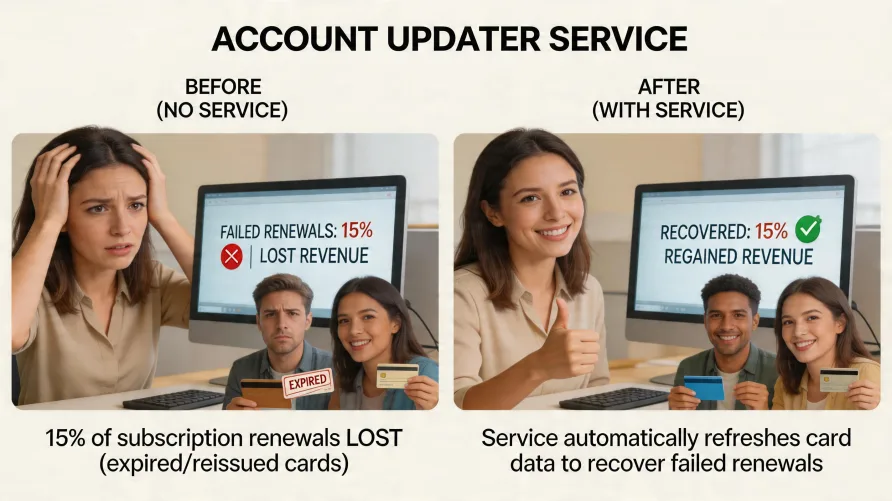
Account updater services are the closest thing subscription businesses have to a free recovery tool against involuntary churn. They're automated programs run by the card networks that push refreshed card numbers, expiration dates, and account changes to participating merchants when a customer's card is reissued. I've watched the same pattern repeat across every recurring-billing operation I've worked with: roughly 5 to 10 percent of monthly transactions fail on cards the customer would happily keep paying with, if only the merchant had the new number. An account updater service closes most of that gap automatically. The two services that matter most for U.S. merchants are Visa Account Updater and Mastercard Automatic Billing Updater. American Express runs Cardrefresher and Discover runs its own equivalent. Most recovered transactions in U.S. portfolios still come from Visa and Mastercard because those brands dominate domestic card volume. Each network operates its service independently, with its own enrollment process, update cadence, and pricing. How Account Updater Services Work The mechanism is simple in concept and involved in practice. A merchant enrolls cards into the network's update program, usually through their processor or gateway. When an issuing bank reports a card change to the network, the network matches that change against its file of enrolled cards and sends the updated information back through the processor to the merchant. The merchant's billing system then uses the new card data on the next transaction attempt. What gets reported isn't only new card numbers. Each network publishes its own list of update types, but in practice you'll see four common events flow through the system. The first is expiration date changes, when an issuer prints a new card with the same number but a later expiration. The second is account number changes, when an issuer reissues a card with new digits after a breach, theft, or routine portfolio refresh. The third is account closures, which let you stop billing a card that's been canceled rather than retrying it and racking up decline fees. The fourth is contact-issuer responses, which signal that you should reach the customer directly because the card has moved to a state the network can't update on its own. What Triggers an Update Issuers don't push every change to the networks. The events that consistently trigger updates are card expirations, lost or stolen card reissues, fraud-related account number replacements, portfolio conversions when one bank acquires another, and product upgrades like a customer moving from a basic card to a premium tier. Issuers participate voluntarily, and not every U.S. issuer participates fully. Coverage is high among the major banks and the largest credit unions. Smaller community banks and some prepaid issuers don't always submit their changes to the network files. That's the single biggest reason these services don't recover 100 percent of expired cards. How Much Churn an Account Updater Recovers The real answer is that recovery rates depend on your card mix, your billing cycle, and how recently the cards in your file were issued. Across the subscription businesses I've evaluated, recovery on expired or reissued cards typically lands somewhere between 10 and 20 percent of the failed-renewal pool when account updaters are running well. That's not a marketing number. That's what's left after you account for the cards the issuer didn't submit, the cards the customer canceled deliberately, and the cards the customer wants to replace with a different payment method. For a recurring-billing operation processing significant monthly volume, that recovery range translates into real money. If your involuntary churn rate sits at 7 percent monthly and you recover 15 percent of it through account updates, you've reduced effective churn by roughly a percentage point without touching your retention emails, win-back offers, or dunning logic. That's why I treat account updater enrollment as table stakes for any subscription operation, not a nice-to-have. Is the Account Updater Service Automatic? Mostly, but not entirely. Once you've enrolled with your processor or gateway and the cards in your vault are in the update pool, the matching and delivery happen without human involvement. Your billing system receives the updates and applies them to the next charge attempt automatically, assuming your gateway supports the inbound feed. The parts that aren't automatic are the parts most merchants underestimate. You have to enroll, and not every processor supports both networks out of the box. You have to keep cards in the update pool, which usually means tokenizing them with the gateway running the service rather than a separate vault. You have to handle the response codes correctly, including the contact-issuer flag that tells you to reach out to the customer manually. And you have to actually retry the transaction with the new card, which sounds obvious but isn't always wired up correctly in older billing systems. How Often to Run Updates The card networks publish update files on different schedules. Visa Account Updater runs daily inquiries and returns updates as issuers submit them. Mastercard Automatic Billing Updater operates on a similar daily cadence. For subscription businesses with monthly billing, running updates within seven days before the renewal attempt captures most of the value, since you want the freshest possible card data at the moment of the charge. For weekly or daily billing, near-continuous updates work better. Some merchants run a full vault refresh monthly and rely on the daily file for new updates between refreshes. That cadence works for most recurring-billing operations. The mistake I see most often is merchants who enroll once, never check the inbound feed again, and assume the system is working. It usually is. But the time to discover a broken integration isn't six months after a quiet failure. What It Costs Pricing varies by processor and gateway, but the cost structure tends to fall into a small handful of patterns. Most processors charge a per-update fee in the range of $0.25 to $1.00 per successful card refresh, with no charge when there's no update to deliver. Some processors bundle the card updater subscription service into their card-on-file or tokenization product at a flat monthly fee. A smaller number include it as a value-add on certain merchant tiers without a separate line item. The math almost always works in favor of enabling the service. If you recover one $30 monthly subscription that would have churned, you've covered the per-update fee dozens of times over for that customer. The cases where it doesn't pay are usually low-ticket subscriptions with very high volume where the per-update fee compounds. Even then the lifetime-value math typically still favors enabling the service. Gateway and Processor Support Account updater services aren't universally supported, though coverage has expanded significantly in the last several years. Most major processors offer the service through their own card vault or through a partnered tokenization product. Most independent gateways support at least Visa Account Updater and Mastercard Automatic Billing Updater, with American Express Cardrefresher available on a more limited basis. Integration depth matters more than the marketing checkbox. When evaluating a processor or gateway for account updater support, I look at four things in particular. First, does the gateway return inbound update response codes inside its normal transaction reporting, or does it bury them in a separate file you have to pull manually? The first option lets you see what's happening without extra engineering work, while the second tends to mean nobody actually checks. Second, how does the gateway handle contact-issuer responses, where the network tells you to reach the customer directly rather than retry? A good integration surfaces those responses to your billing logic so you can trigger an email or in-app notification, while a poor integration silently logs them and lets the customer churn anyway. Third, can you trigger an inquiry on demand, or only on the network's standard schedule? On-demand inquiries are useful before high-value renewals or when reactivating dormant subscribers. Fourth, what's the processor's policy on account closure responses, since Visa and Mastercard both expect merchants to honor closures rather than continuing to attempt charges on a dead account. Network Rules and Operational Considerations The card networks publish operating rules that govern how merchants must use account updater data, and those rules carry real consequences for non-compliance. Account closure responses must be honored. Once the network tells you a card is closed, retrying it can trigger fines or merchant-level penalties depending on how the processor enforces network rules. Updated card data must be used promptly, not stored indefinitely without applying it. And cards in the update pool generally must be associated with an active customer relationship, not a stale or dormant file you're refreshing speculatively. There's also a tokenization angle that catches subscription operators off guard. If you switch processors, the card updater subscription enrollment doesn't automatically follow you to the new processor. The new processor has to re-enroll your cards into the network programs, and depending on how cards were tokenized at the old processor, you may or may not be able to migrate the underlying card data without re-collecting it from customers. That's worth confirming before a processor switch, not after. What These Services Don't Catch Account updaters aren't a complete solution to involuntary churn. They don't help when a customer's bank declines for insufficient funds, when a fraud filter on the issuer side blocks the transaction, when the cardholder has actively canceled the card and intends to switch payment methods, or when the issuer simply doesn't participate in the network's update program. They also don't replace good dunning logic, retry strategy, or proactive customer outreach for cards that are about to expire. They reduce involuntary churn within the bounds of what the card networks can actually see. Treat them as one layer in a stack, not the whole stack. Where to Look Among Account Updater Providers For subscription operations that haven't enabled an account updater service yet, this is one of the highest-ROI changes available. The setup work is real but bounded. The recovered revenue compounds over the lifetime of every customer the service rescues. For a closer look at the providers in this market and how they compare on account updater support, gateway integration, and recurring-billing tooling, see the credit card processing ranking on this site.
Account Updater Services: Fighting Subscription Churn