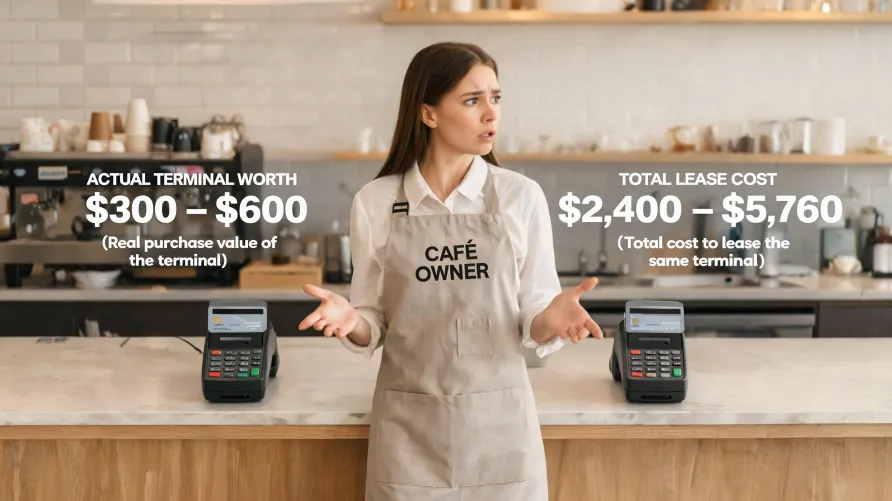
A merchant services equipment lease is one of the most expensive ways to get a credit card terminal, and most business owners don't realize it until they're locked into a contract they can't cancel. A standard POS terminal costs between $200 and $600 to purchase outright. That same terminal, leased through a processing agreement, typically costs $2,400 to $5,760 over a 48-month term. The math isn't close, and the gap between leasing and buying payment equipment is one of the least understood costs in the merchant services industry. This article breaks down the real cost difference between leasing and buying credit card terminals, explains why these leases are so difficult to escape, and covers what you should know before signing any equipment agreement tied to a processing contract. The Real Math Behind a Merchant Services Equipment Lease Most merchant services equipment leases run 48 months with monthly payments between $50 and $120. At the low end, that's $2,400 for a device you could have purchased for $300. At the high end, you're paying $5,760 for equipment that might retail for $500 to $600. That's a markup of 400% to 1,000% over the purchase price. The monthly payment looks manageable in isolation. Fifty dollars a month doesn't raise alarms when you're also evaluating processing rates, gateway fees, and PCI compliance costs. Sales representatives understand this dynamic well. The lease payment gets bundled into a larger conversation about your overall processing costs, and many business owners approve the lease without ever doing the full-term multiplication. A $59 monthly payment sounds minor next to a 2.6% processing rate discussion, but it adds $2,832 to your four-year cost of accepting credit cards. Here's what those numbers look like across three common scenarios. A countertop terminal that retails for $300 leased at $59 per month over 48 months costs $2,832. A wireless terminal that retails for $400 leased at $79 per month costs $3,792. A full POS station that retails for $600 at $120 per month costs $5,760. In every case, buying the same equipment outright saves you thousands of dollars over the contract term. The lease also doesn't end with ownership in most cases. Many merchant services equipment leases are structured as operating leases, not lease-to-own agreements. When the 48 months are up, you return the equipment or continue paying. You've spent thousands and still own nothing. Why Most Terminal Leases Are Non-Cancellable The most common complaint about POS terminal lease agreements isn't the price itself. It's the discovery that the lease can't be cancelled early. Most merchant services equipment leases include non-cancellable language that makes you responsible for the full remaining balance if you try to terminate before the term ends. If you're 12 months into a 48-month lease at $79 per month, your early termination obligation is $2,844: the remaining 36 payments owed in full. That isn't a penalty in the traditional sense. It's the contract working exactly as written. Under the Uniform Commercial Code, which governs commercial equipment leases across all 50 states, a non-cancellable lease is a binding obligation for the entire term. Courts have consistently upheld these provisions when the lessee is a business entity, because commercial parties are presumed to understand the agreements they sign. Consumer protection statutes that might help an individual renter typically don't apply to business-to-business equipment leases, though some state attorneys general have pursued enforcement actions against particularly deceptive sales practices in the merchant services space. The non-cancellable structure exists because the leasing company purchased the equipment on your behalf and expects to recover its investment plus a return over the full lease term. Allowing early exit would mean absorbing a loss on equipment with limited resale value. That financial reality is why the full balance accelerates upon early termination, and it's why reading the lease terms before signing matters more here than in almost any other part of a merchant services agreement. How the Finance Company Separation Complicates a Merchant Services Equipment Lease This is where things get particularly complicated for small business owners, and where the most costly misunderstandings happen. The company processing your credit card transactions and the company holding your equipment lease are usually not the same entity. Your processing sales representative may have presented the lease as part of your merchant services package, but the lease contract itself was assigned to a third-party finance company at signing. That separation creates a critical problem: cancelling your processing agreement doesn't cancel your equipment lease. These are two legally distinct contracts with two separate companies, and one has no obligation to honor the terms or promises of the other. The finance company has no relationship with your processor. It doesn't care whether you're satisfied with your processing rates, whether the sales representative made verbal promises about cancellation flexibility, or whether the terminal even works with your new provider. The finance company purchased a receivable, your 48-month payment stream, and it will collect regardless of what happens with your processing relationship. The Federal Trade Commission has documented this pattern in multiple enforcement actions against merchant services operations. Complaints frequently involve business owners who believed they could cancel everything by switching processors, only to discover the lease obligation continuing independently for years. The Consumer Financial Protection Bureau has also received complaints about this separation issue, particularly from small businesses that weren't clearly told the lease was held by a different company. Despite these enforcement efforts, the underlying contract structure remains legal in most states when proper disclosures are made at signing. What Owning Your Terminal Actually Changes Owning your payment terminal changes the power dynamics of your entire processing relationship. A terminal you've purchased outright can typically be reprogrammed to work with a different processor. Most modern terminals support multiple processing platforms, and switching processors with owned equipment is usually a matter of downloading new configuration software or having the new processor set up the device remotely. The process takes minutes in most cases, and it costs nothing beyond whatever the new processor charges for activation. That flexibility carries real financial weight. When you lease your terminal, your processor knows you can't leave without paying thousands in remaining lease obligations, even if the processing contract itself allows termination. The lease becomes a de facto lock-in mechanism for the processing relationship. You're less likely to negotiate better rates, less likely to shop competing offers seriously, and less likely to push back on fee increases when the cost of switching includes a four-figure lease buyout on top of any processing termination fees. Owned equipment also eliminates monthly overhead entirely. Once you've paid $300 to $600 for a terminal, your only ongoing equipment costs are occasional maintenance or eventual replacement when the device reaches end of life. Most terminals last five to seven years with normal commercial use, which means you could go through two full lease cycles of payments in the time a single purchased terminal serves your business. The one legitimate consideration with purchasing is technology turnover. Payment technology does evolve, and a terminal purchased today may not support newer payment methods or updated security standards five years from now. But replacing an owned terminal every three to four years at $300 to $500 per replacement is still dramatically cheaper than continuous leasing. Even two full replacement cycles over eight years cost less than a single 48-month lease in most scenarios. Why "Free" Terminal Offers Deserve Extra Scrutiny "Free equipment" is one of the most common phrases in merchant services sales pitches. It deserves the most scrutiny. Free terminal programs typically follow one of three structures. The first is a terminal provided at no upfront cost but tied to a long-term processing agreement with a substantial early termination fee. The terminal isn't free. Its cost is recovered through higher processing rates over the life of the contract, or clawed back through the termination penalty if you leave before the term expires. A 2023 FTC staff report on negative option practices highlighted that bundled service agreements with embedded equipment costs are among the most common sources of small business billing complaints in the payments industry. The second structure is a loaner or placement program where the processor retains ownership and you return the equipment when the relationship ends. This arrangement can be reasonable if the processing rates are competitive and the agreement terms are fair. The risk is that "return the equipment" language sometimes comes with damage assessment fees, non-return charges that exceed the equipment's value, or valuation disputes about the terminal's condition. The third is the most problematic. Some free terminal offers are actually lease agreements structured so the monthly payments appear as line items on your processing statement rather than on a separate invoice. Business owners may not realize they've entered a non-cancellable lease until they try to cancel and discover they owe thousands in remaining payments to a finance company they've never contacted directly. This structure obscures the true nature of the obligation by blending it into processing costs. How to Evaluate Any Equipment Agreement Before signing any equipment arrangement tied to a merchant services contract, work through several specific questions. Get the total cost in writing first. Multiply the monthly payment by the total number of months. Compare that figure to the retail purchase price of the same terminal model. If the total lease cost exceeds double the purchase price, you're paying a steep financing premium that almost certainly isn't justified by the convenience of monthly payments. Confirm whether the lease is cancellable. Ask for the specific contract language, not a verbal summary from the sales representative. If the agreement includes the phrase "non-cancellable" or references UCC Article 2A, you're committing to the full payment term regardless of what happens with your processing relationship. Get this in writing before you sign. Identify the leasing company. Ask who holds the lease obligation. If it's a separate finance company rather than your processor, understand that your lease payments will continue independently even if you terminate your processing agreement. Get the finance company's name and contact information before signing. Check whether you own the equipment at the end. Ask whether the lease includes a $1 buyout option, a fair-market-value purchase clause, or no ownership transfer at all. An operating lease with no ownership path means you'll have paid thousands over four years and will return the equipment with nothing to show for it. If offered free equipment, ask what happens if you cancel within the first year, within three years, and at any point during the contract. The answers reveal whether the equipment is truly free or whether its cost has been structured as an exit barrier designed to keep you locked into the processing relationship. The difference between a $300 terminal purchase and a $4,000 lease isn't just about the money, though the money alone should give any business owner pause. It's the difference between controlling your processing relationship and being trapped in one. For most small businesses accepting credit card payments, buying equipment outright is the better financial decision by a wide margin.
Equipment Leasing vs Buying: The Real Cost Difference