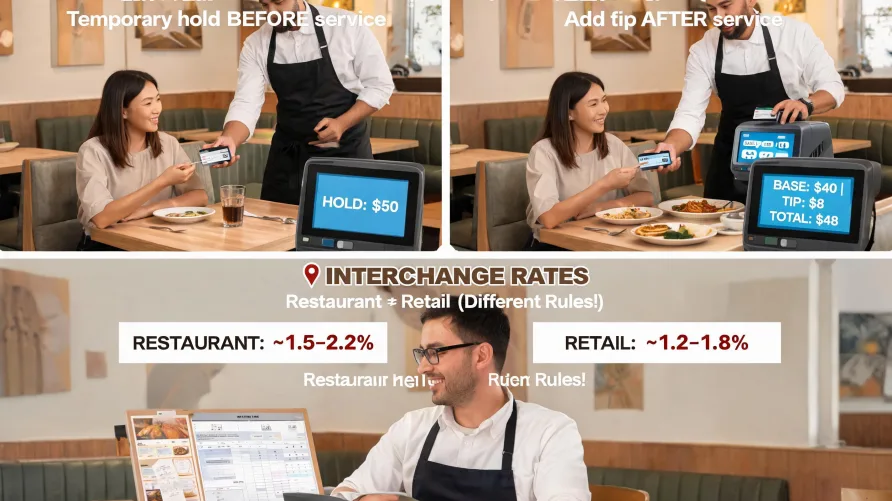
Restaurant credit card processing follows a different transaction cycle than standard retail because the final charge amount isn't known when the card is first authorized. When a customer opens a tab, adds a tip, or splits a check, the payment moves through pre-authorization, adjustment, and settlement steps that don't exist in a typical swipe-and-go purchase. These differences affect interchange rates, processing fees, and compliance requirements in ways that directly hit a restaurant's bottom line. Why Restaurant Credit Card Processing Follows Different Rules The core difference is timing. In retail, the amount charged at the terminal is the final amount. The card is authorized, the transaction settles, and the numbers match. In a restaurant, the initial charge is almost never the final charge. A customer's card is authorized for the pre-tip amount when the check is presented, but the actual settlement amount changes once a tip is added. This gap between authorization and settlement creates a distinct transaction flow that card networks and processors handle through specific hospitality protocols. Card networks also classify restaurant transactions differently at the interchange level, with Visa and Mastercard both maintaining separate interchange categories for restaurants and bars that reflect the higher risk profile of delayed settlement and tip-adjusted transactions. These restaurant interchange rates are typically a few basis points higher than standard retail rates for the same card type, and processors pass that cost through to the merchant regardless of pricing model. How Pre-Authorization Works in Restaurants Pre-authorization is the hold placed on a customer's card before the final transaction amount is known. In a full-service restaurant, this typically happens when a server runs the card at the end of the meal but before the customer writes in a tip. The server presents the check for $85, the customer hands over a credit card, and the POS system sends an authorization request to the card issuer for that amount, placing a hold on $85. Then the customer adds a $17 tip, bringing the total to $102. At settlement, usually during the nightly batch close, the restaurant submits the adjusted $102 amount to the processor for final clearing. The hold amount and the settlement amount don't match, and that's expected. Card networks allow restaurants to settle for more than the original authorization within defined tolerances. Visa's rules permit restaurants to settle up to 20% above the authorized amount to accommodate tips, and Mastercard has similar allowances. If the tip pushes the total beyond that tolerance, the transaction may be flagged or declined at settlement, which creates a real operational problem for the restaurant. This tolerance is also why some customers see a temporary charge on their statement that differs from the final posted amount. The initial hold drops off and the adjusted amount posts, but the timing varies by issuing bank. It isn't a processing error, it's how hospitality transactions are designed to work. Tip Adjustment at Settlement Tip adjustment is the process of modifying the authorized transaction amount to include the gratuity before submitting the batch for settlement. In most restaurant POS systems, this happens either as servers close individual checks or during a batch process at the end of the night. The timing matters more than most restaurant operators realize, because if a restaurant doesn't close its batch within the window defined by its processor, typically 24 to 48 hours, the transaction may downgrade to a higher interchange category. Downgrades mean higher fees, and they compound quickly across hundreds of daily transactions. Two scenarios cause the most problems with tip adjustment. The first is when tips aren't entered before batch close, and the POS submits the original pre-tip amount, causing the restaurant to lose the tip revenue on that transaction. Some systems prevent this with alerts or forced tip entry before close, but not all do. The second is when tip amounts are entered incorrectly through manual keying errors or misread handwriting on signed receipts. Chargebacks on disputed tip amounts are common and almost always decided in the customer's favor. The IRS has its own interest in tip adjustment data. Restaurants are required to report allocated tips when total tips fall below 8% of gross receipts under Section 6053(c) of the Internal Revenue Code. The tip data flowing through your processing system feeds directly into this reporting obligation, which is why POS integration with your processor isn't just a convenience factor but a compliance requirement. Incremental Authorization for Bar Tabs Bar tabs introduce a different authorization model. When a customer opens a tab with a credit card, the system places an initial hold, often a fixed amount like $25 or $50, without a corresponding order total. As the customer orders additional rounds, the tab grows beyond the original authorization. Incremental authorization addresses this by sending additional authorization requests as the tab increases rather than placing a single large hold upfront that ties up more of the customer's available credit than necessary. Each increment adds to the total hold without releasing the previous one, and when the tab is closed and a tip is added, the final settlement amount reflects the full total. Not all processors and POS systems support incremental authorization cleanly, and some use a single large pre-authorization instead, which can trigger fraud alerts on the customer's card or temporarily reduce their available credit by more than the actual tab warrants. For high-volume bars, the difference between true incremental authorization and oversized pre-holds affects both customer experience and dispute rates. Operators running busy bar programs should confirm their system supports true incremental auth before signing a processing agreement. Restaurant Interchange Rates and What They Actually Cost Interchange is the fee paid by the merchant's acquiring bank to the cardholder's issuing bank on every transaction. Card networks publish their interchange rate schedules, and restaurant transactions fall into hospitality-specific categories that carry distinct pricing. Visa's published interchange schedule includes a "Restaurant" category with rates that differ from standard retail, card-not-present, and supermarket categories. As of the most recently published schedules, Visa's restaurant interchange for a standard consumer credit card runs approximately 1.54% plus $0.10, compared to roughly 1.51% plus $0.10 for standard retail. The gap widens significantly for rewards cards and premium card tiers, and Mastercard's hospitality rates follow a similar structure with slightly different breakpoints. These rates matter because interchange represents the largest component of processing cost for most merchants, typically 70% to 80% of the total fee on a given transaction. The processor's markup sits on top of interchange, but the interchange itself is non-negotiable and flows directly to the issuing bank per the card network's published schedule. Restaurant operators on interchange-plus pricing can see these hospitality rates itemized on their monthly statements, while those on flat-rate or tiered pricing pay a blended rate that absorbs the interchange variance. That often means they're paying more than they would on interchange-plus without realizing it. A restaurant processing $50,000 per month where the effective rate difference is just 15 basis points is paying an extra $75 monthly, or $900 per year, on the spread alone. For a multi-location restaurant group processing several hundred thousand dollars monthly, the pricing model choice can represent a five-figure annual difference. That cost is invisible on a flat-rate statement. POS Integration Requirements for Hospitality Payment Processing A restaurant's POS system and its payment processor need to communicate in ways that go beyond basic transaction authorization. The POS must support pre-authorization with tip adjustment, batch management with configurable close times, and ideally incremental authorization for bar operations. Integration depth varies widely across the market: some POS platforms include built-in payment processing that handles all hospitality-specific flows natively, while others rely on third-party processor integrations where the POS sends transaction data through an API or gateway connection. The quality of that integration determines whether tip adjustments happen automatically, whether batch close is reliable, and whether reporting data flows correctly into back-office accounting systems. Three integration capabilities matter most for restaurants that process at volume. First, real-time tip adjustment within the POS workflow so servers can enter tips and close checks without switching between systems or screens. Second, automatic batch reconciliation that matches POS sales data against processor settlement reports, catching discrepancies before they become accounting problems. Third, EMV and contactless acceptance at the table or counter, which affects both interchange qualification and customer throughput during peak service hours. Restaurants that use separate systems for ordering, payment, and reporting often discover gaps where hospitality-specific transaction flows break down, and a POS that can't pass tip data to the processor at the individual transaction level creates problems for tip allocation reporting that may require hours of manual reconciliation each week. Tip Pooling, Reporting, and Compliance Tip handling has a compliance dimension that connects directly to how restaurant merchant services process and report transaction data. The Department of Labor's regulations under the Fair Labor Standards Act govern who can participate in tip pools, and the tip data captured by your processing system is the foundation for calculating those distributions. Under current federal rules, employers can require tip pools that include servers, bartenders, bussers, and back-of-house employees like cooks and dishwashers, provided the employer doesn't take a tip credit. Requirements vary significantly by state, though: some states prohibit tip pooling with back-of-house staff entirely, while others have their own minimum wage structures that change the tip credit calculation. Restaurant operators should verify their state's current rules rather than relying on federal minimums alone. From a processing standpoint, the data you need for compliant tip distribution depends on how granular your system captures tip information. If your POS records tips per server per transaction, pooling calculations can be automated or semi-automated through your payroll process. If it only records tips at the batch level, you're stuck doing the math manually, and manual tip allocation is where compliance errors typically start. The IRS Form 8027 requirement applies to restaurants that employ more than 10 people on a typical business day, reporting total charged tips, total cash sales, and total charge receipts on an annual basis. Your processing statements provide the charge-side data, but you need POS reporting to capture the full picture. Making sure these systems produce compatible, exportable data isn't optional for any restaurant above the reporting threshold. What to Evaluate in a Restaurant Payment Setup Choosing how to process payments in a restaurant comes down to questions that don't apply in most other retail environments. The hospitality transaction cycle is different enough that general-purpose evaluation criteria miss what actually matters for day-to-day operations. Does the processor support hospitality interchange qualification? If your transactions aren't coding to the correct restaurant MCC (Merchant Category Code), you may be paying standard retail interchange instead of the lower hospitality rates on every single transaction. This is a setup and configuration issue, not a pricing negotiation, and it should be verified during onboarding. Does the POS handle pre-auth and tip adjustment natively? If these workflows require workarounds or manual steps, your staff will make errors and your batch will have discrepancies. Can the system produce the tip reporting data you need? Between IRS requirements, state tip pooling rules, and your own payroll obligations, tip data has to be accurate, granular, and exportable in formats your accountant or payroll provider can use. What's the effective processing rate after interchange, markup, and per-transaction fees? Restaurant margins are thin. The difference between a 2.4% and 2.9% effective rate on $600,000 in annual card volume is $3,000 per year. That matters. Hospitality payment processing has mechanical requirements that general-purpose retail solutions don't always address well, and operators who evaluate processing providers against these specific hospitality criteria rather than headline rates alone consistently find better long-term fits. For a closer look at how individual processors handle these restaurant-specific requirements, our credit card processing reviews cover the operational details across multiple providers in this market.
Restaurant Credit Card Processing: Tips, Pre-Auths, and Hospitality Interchange