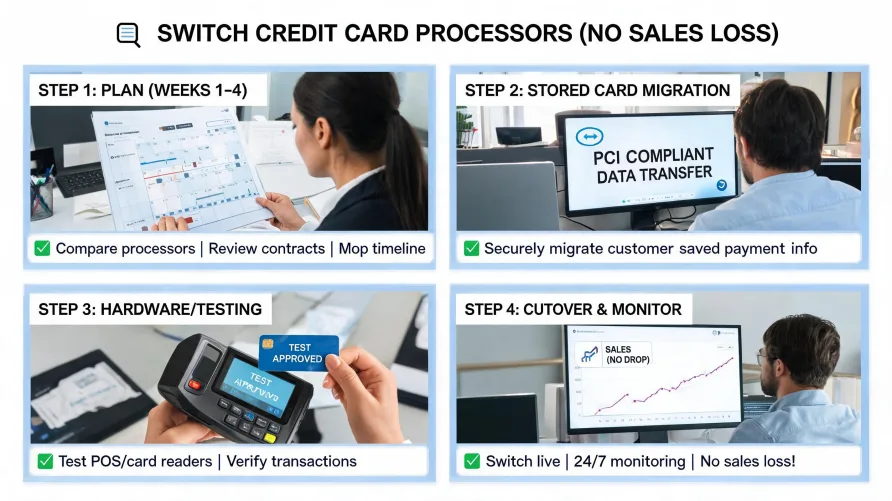
How to Switch Payment Processors Without Disrupting Your Business Switching credit card processors doesn't have to mean lost revenue or days of downtime. Most businesses complete a full processor migration in two to four weeks by following a structured sequence: secure approval at the new provider first, configure the payment gateway, migrate stored card data, handle terminal hardware, run both processors in parallel briefly, then close out the old account. The goal is overlapping each phase so there's never a gap in your ability to accept payments. This guide covers each step of how to switch credit card processor accounts with timing benchmarks, so you can plan a clean transition from start to finish. What to Do Before You Switch Credit Card Processors Before you apply anywhere new, spend a few days documenting your current setup. Pull your last three months of processing statements and note your effective rate, monthly volume, average transaction size, and chargeback ratio. Your new processor will request all of this during underwriting, and having it organized in advance speeds up approval by days. Check your existing contract for two things: the termination clause and the notice requirement. Many processing agreements include an early termination fee that typically ranges from $250 to $500 for flat-fee contracts, though some calculate the penalty as projected lost revenue over the remaining term. Contracts often auto-renew annually with a 30 to 90 day cancellation window, and the specific notice period varies by provider and state. If you're inside that window, you can walk away without the fee. If you aren't, factor the ETF into your cost comparison before committing to a new provider. The Consumer Financial Protection Bureau has noted that early termination fees in merchant services agreements remain one of the most common sources of disputes between small businesses and their processors, so read the fine print carefully and confirm the exact cancellation deadline with your provider in writing. Then build your migration inventory. Document every integration your current processor touches: your point-of-sale system, e-commerce gateway, recurring billing subscriptions, stored card-on-file tokens, accounting software connections, and any custom API calls. This list becomes your migration checklist, and missing an integration is the most common reason businesses hit problems during a switch. How to Switch Credit Card Processor: The Migration Sequence Underwrite and Approve the New Account The application and underwriting process at a new processor typically takes one to five business days for a standard small business. High-risk merchants or businesses with above-average chargeback ratios may face longer review periods, sometimes two to three weeks. During underwriting, the processor evaluates your business type, processing history, financial stability, and risk profile. Have your EIN, business bank account details, processing statements, and a valid government-issued ID ready before you start. Most processors also require business registration documents and may request your most recent tax return if monthly volume exceeds $50,000. Don't cancel your old processor at this stage. You'll run both accounts simultaneously during the transition. Configure Your Payment Gateway If you accept payments online, your gateway is the connection layer between your website or app and the processor's acquiring network. Gateway migration can be as simple as swapping API credentials in your e-commerce platform, or it can mean reconfiguring custom checkout integrations from scratch. For businesses using a hosted checkout page, the credential swap usually takes less than an hour. Custom API integrations take longer, often one to three days of developer time depending on complexity. Test every transaction type in a sandbox environment before going live: standard sales, refunds, partial refunds, voids, and recurring charges. The PCI Security Standards Council recommends that merchants test cardholder data flows after any change to payment system components, and a processor switch qualifies. One detail that catches businesses off guard: if your current gateway is proprietary to your processor, you may need an entirely new gateway rather than just updated credentials. Ask this question before you sign anything. Migrate Recurring Billing and Stored Cards This step trips up more businesses than any other. If you store customer payment information for subscriptions, memberships, or repeat orders, those card-on-file tokens are cryptographically bound to your current processor. They can't be transferred directly to a new provider. The standard solution is an account updater service. Visa and Mastercard both operate account updater programs that allow a new processor to request current card details from issuing banks on your behalf. Customers don't need to re-enter anything. According to card network published data, this process typically recovers 85% to 95% of active stored cards. The recovery rate depends on your customer mix, card types on file, and which issuing banks participate in the updater networks. Cards issued by major national banks have the highest recovery rates, while cards from smaller regional banks or credit unions may not update automatically. The remaining 5% to 15% represent closed accounts, cards reissued with entirely new numbers, or cards from issuers that don't participate in the updater networks. For those customers, you'll need direct outreach. A short email explaining the billing update, sent about a week before cutover, resolves most of it without support tickets or failed charges. Include a secure link where customers can enter their new card details, and set a clear deadline so stragglers don't fall through the cracks. The account updater cycle itself takes 5 to 15 business days depending on your card mix and the new processor's batch schedule. Start it as early as possible because it's usually the longest single step in the entire migration. Reprogram or Replace Terminal Hardware For businesses that accept in-person payments, terminals need to communicate with the new processor. Two scenarios apply here. If you own your terminals outright and they support multiple processors, they can be reprogrammed with new merchant credentials. This takes 15 to 30 minutes per device and can often be handled remotely through the terminal management platform. If your terminals are leased from your current processor or locked to their proprietary system, you'll need new hardware. Your new provider may supply devices as part of the agreement, or you may need to purchase them separately. Budget $200 to $800 per terminal depending on capabilities, and order early so hardware arrives well before your target cutover date. For multi-location businesses, stagger the hardware rollout rather than trying to reprogram every location on the same day. Plan and Execute Cutover Day Pick your lowest-volume day. For most retail and service businesses, that's a Monday or Tuesday morning. For e-commerce operations, choose a window between major promotions or seasonal peaks. On cutover day, activate your new processor for live transactions, update gateway credentials in your production environment, swap or activate reprogrammed terminals, and verify that your first several transactions clear and settle correctly. Monitor the new processor's reporting dashboard throughout the day to confirm batches are closing and funds are moving to your bank account on the expected schedule. Keep your old processor account active. Don't close it on cutover day. Run a Parallel Period Run both processor accounts for 7 to 14 days after cutover. This parallel window serves two purposes that justify the minor cost overlap. First, any transactions initiated through the old processor before cutover, including pending authorizations, delayed captures, and in-flight recurring charges, need to settle normally. Closing the old account too early can strand legitimate transactions or create orphaned authorizations that never clear. The card networks' settlement rules, published by Visa and Mastercard, allow authorizations to remain valid for up to 30 days depending on merchant category code, which means some old-processor transactions may still be settling well after you've moved to the new provider. Second, you get a fallback. If something goes wrong with the new processor during the first week, you can temporarily route transactions back through the old account while you troubleshoot. That safety net matters. How Long Does It Take to Switch Processors? The full timeline for most small businesses runs two to four weeks from initial application to final cutover. Here's how it typically breaks down. New processor underwriting and approval takes one to five business days. Gateway configuration and testing takes one to three days. Account updater processing for stored cards runs 5 to 15 business days and is usually the longest individual step. Terminal hardware reprogramming or delivery takes 3 to 10 business days. Cutover day itself is a single day, followed by a 7 to 14 day parallel running period before you close the old account. Several of these steps overlap. You can configure your gateway and order hardware while the account updater processes your stored cards. With deliberate scheduling, the total elapsed time is closer to three weeks than six. Will You Lose Sales During a Processor Switch? Not if you manage the overlap correctly. The entire purpose of the parallel period is to eliminate any gap in payment acceptance. Your old processor stays live until the new one is fully operational, tested, and settling transactions. The most common source of failed transactions during a switch isn't a technical outage. It's stored cards that don't migrate. If 5% to 15% of your card-on-file customers need to re-enter payment details and you don't notify them before the cutover, those subscriptions or repeat purchases fail silently. Send the notification before cards start declining, not after. For brick-and-mortar businesses, the risk window is even smaller. If your new terminals are configured and tested before cutover day, there's no interruption at the register. The worst case for most in-person operations is a 15 to 30 minute gap while you activate new terminal configurations, and you can schedule that swap before opening hours or during a natural lull in traffic. Closing Out Your Old Processor Contract Once the parallel period ends and you've confirmed all transactions are settling through the new processor, formally close the old account. Don't just stop using it. Cancel in writing according to the contract's specific termination terms. Before closing, verify that all pending transactions have settled and all open disputes have been resolved. Chargebacks that haven't been adjudicated become significantly harder to manage on a closed merchant account, and some processors charge additional fees for handling disputes after closure. If you have any open retrieval requests or pending representments, wait until those resolve before initiating account closure. Request written confirmation that your account is closed and retain your final processing statements for at least three years. PCI DSS requirements apply to stored cardholder data even after a merchant changes processors, so confirm that your old provider has purged any stored data according to their retention policies and PCI Security Standards Council guidelines. If you were PCI-validated through your old processor's program, you'll need to establish PCI compliance through your new provider as well. If your old contract included equipment leases, return the hardware according to the lease terms. Unreturned equipment charges can run $500 or more per device, and they're usually enforceable even after you've switched providers. Your new processor relationship starts fresh, but the documentation and planning you invested upfront is what makes the transition clean. If you're still evaluating which provider to move to, our credit card processing reviews cover the providers serving this market.
How to Switch Payment Processors Without Disrupting Your Business