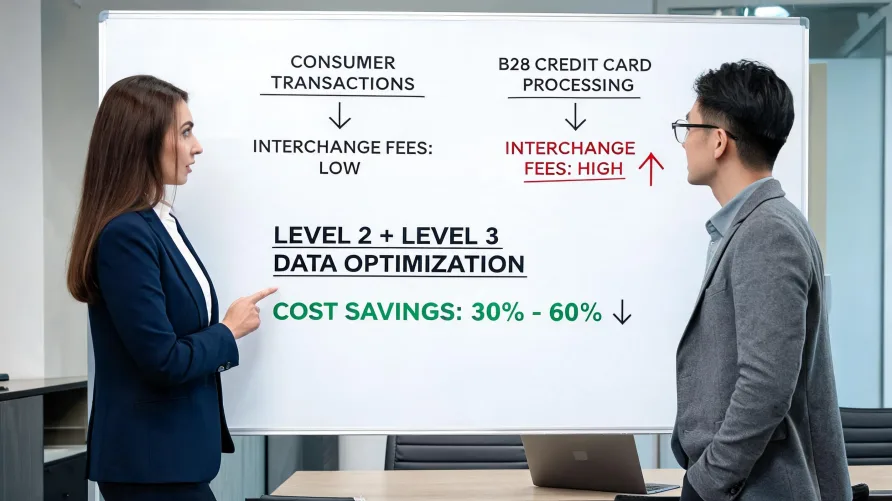
B2B credit card processing costs more than consumer transactions, but most of that extra expense is avoidable. Commercial cards issued to businesses carry higher interchange rates than personal cards, and the average B2B transaction runs five to ten times higher than a typical retail purchase. That combination means processing fees on a single invoice payment can reach hundreds of dollars. The difference between paying full commercial interchange and qualifying for Level 2 or Level 3 rates can cut those costs by 30% to 60%, depending on card type and transaction size. This isn't a niche concern. According to the Federal Reserve's most recent Payments Study, commercial card payment volume in the United States exceeded $4.6 trillion annually, and that figure continues to grow as more B2B buyers shift away from checks. If your business accepts card payments from other businesses, the data you pass with each transaction directly determines what you pay. Why B2B Credit Card Processing Rates Are Higher The short answer: risk and reward. Visa, Mastercard, and other card networks set interchange rates based on transaction characteristics. Consumer cards used at a physical terminal with a chip carry lower risk, so they get lower rates. Commercial cards, purchasing cards, and corporate cards carry higher interchange because the issuing bank extends larger credit lines to business accounts and assumes more exposure. A standard consumer credit card transaction might cost 1.5% to 2.0% in interchange alone. A commercial card transaction on the same network can run 2.5% to 3.0% or higher at the base level. On a $15,000 invoice, that spread represents $150 to $225 in additional fees before you add processor markup. Multiply that across dozens of monthly transactions and you're looking at thousands of dollars in annual cost that exists purely because of how the transaction was submitted. The card networks publish their interchange rate schedules, and both Visa and Mastercard maintain separate rate tiers for commercial transactions. Those tiers reward merchants who submit additional transaction data beyond what a typical retail sale requires. That reward structure is where Level 2 and Level 3 processing enters the picture. What Level 2 and Level 3 Data Actually Means Every card transaction includes basic data: card number, expiration, amount, and merchant information. That's Level 1. It's enough to authorize and settle the payment, but it qualifies for the highest interchange tier on commercial cards. Level 2 adds a handful of fields that give the card-issuing bank more visibility into the transaction. The required fields include a customer code or purchase order number, the transaction tax amount, and the merchant's tax identification number. Submitting this data correctly moves the transaction into a lower interchange bracket. For Visa commercial cards, the reduction typically ranges from 0.30% to 0.50% compared to the standard commercial rate. Level 3 goes further. It requires line-item detail for every product or service on the invoice: item descriptions, quantities, unit costs, commodity codes, and extended amounts. The data mirrors what you'd see on a detailed purchase order. This level of detail qualifies for the deepest interchange discounts the networks offer, often bringing commercial card rates close to or below standard consumer card interchange. The savings are real. On a $25,000 transaction, the difference between standard commercial interchange and a Level 3 qualified rate can exceed $300 on that single payment. For B2B companies processing $500,000 or more in annual card volume, Level 3 qualification routinely saves $10,000 to $30,000 per year. How to Qualify for Level 3 Rates Qualification isn't automatic. Your payment processing system needs to capture, format, and transmit the required data fields with each transaction. The process breaks down into three parts. First, your invoicing or ERP system needs to generate the line-item detail. If you already send itemized invoices to your customers, you likely have this data available. The challenge is getting it into the transaction record that your processor submits to the card network. Second, your processor or payment gateway must support Level 2 and Level 3 data transmission. Not all do. Many processors built for retail or e-commerce handle consumer transactions well but don't have the infrastructure to pass enhanced commercial data. This is a critical question to ask any processor before signing a contract. If the gateway can't transmit Level 3 fields, your transactions will never qualify regardless of what data you have available. Third, the data must be formatted correctly according to each card network's specifications. Visa and Mastercard have slightly different field requirements and validation rules. A transaction that qualifies for Level 3 on one network might only hit Level 2 on another if a required field is missing or formatted incorrectly. Your processor should handle this mapping, but errors in data formatting are one of the most common reasons transactions fail to downgrade to the lower rate tier. One practical note: Level 3 data is most relevant for card-not-present transactions, which is how most B2B payments are processed. If your customers are calling in orders, paying through an online portal, or submitting payment against emailed invoices, those transactions are card-not-present by definition and carry higher base interchange. Level 3 data offsets that premium. The Net-Terms vs. Card Payment Tradeoff Many B2B companies default to net-30 or net-60 terms because that's how the industry has always operated. But extending credit to customers carries real costs that rarely appear on an income statement. Outstanding receivables tie up working capital. According to Federal Reserve data, small businesses in the U.S. carry an average of 30 to 45 days in accounts receivable at any given time. For a company doing $2 million in annual revenue, that's roughly $165,000 to $250,000 in cash sitting in unpaid invoices. The cost of that tied-up capital, whether measured as lost investment return or the interest on a credit line used to cover the gap, often exceeds 2% annually. Then there's collection risk. Industry estimates put B2B bad debt write-offs between 1% and 3% of revenue for companies extending traditional credit terms. Add the staff time spent on collections calls, payment reminders, and dispute resolution, and net terms start looking more expensive than a 2.5% processing fee. Card payments clear in one to two business days. That cash flow acceleration alone can justify the processing cost for many B2B operations, especially when Level 2 and Level 3 qualification brings the effective rate down to 1.5% to 2.0% on commercial cards. The math shifts further when you factor in eliminated bad debt and reduced AR staff hours. This doesn't mean every B2B company should stop offering net terms. Large buyers with strong payment histories and high volume may expect them. The strategic move is offering card payment as the default, with net terms reserved for established accounts where the relationship justifies the credit exposure. AR Automation and Card-on-File for Repeat Customers For B2B companies with recurring customer relationships, card-on-file programs paired with automated billing can transform accounts receivable from a cost center into a predictable cash flow engine. The concept is simple. Store a customer's commercial card securely, per PCI DSS requirements, and charge it automatically on the invoice due date. The customer gets a receipt, your AR aging report stays clean, and the payment processes with Level 2 or Level 3 data attached so you qualify for the best available rate. PCI DSS compliance is non-negotiable here. Storing card data requires either PCI-validated tokenization through your processor or full PCI DSS certification for your own systems. Most B2B companies use tokenization, where the processor stores the actual card number and returns a token that your system references for future charges. This keeps sensitive data out of your environment entirely. The operational benefit compounds over time. A B2B distributor processing 200 repeat invoices per month can eliminate most manual payment collection, reduce DSO by 15 to 25 days, and cut AR labor by 60% or more. Those efficiency gains often dwarf the processing fees, particularly when Level 3 data keeps the per-transaction cost low. Virtual Card Acceptance and B2B Credit Card Processing Virtual cards are one of the fastest-growing payment methods in B2B transactions. These are single-use or limited-use card numbers generated by the buyer's bank or expense management platform for a specific purchase amount. They've become standard practice for corporate procurement departments and accounts payable automation systems. For sellers, virtual cards function like any other card-not-present transaction. The buyer provides a 16-digit card number, expiration, and CVV, and you process it through your existing gateway. The difference is that virtual cards almost always carry commercial interchange rates, and they frequently qualify for Level 2 and Level 3 savings when the right data is submitted. The catch is that virtual cards can carry higher interchange rates than physical commercial cards if not processed correctly. Because they're categorized as commercial card-not-present transactions, they default to the highest interchange tier without enhanced data. Processing them with Level 3 line-item detail is especially important. Virtual card volume is growing rapidly in procurement-heavy industries like manufacturing, healthcare, and government contracting. If your business receives payments from large organizations or government agencies, you're likely already seeing virtual cards in your receivables mix. Confirming that your processing setup handles them with Level 3 data attached is worth verifying. Industry-Specific Rate Optimization Not all B2B transactions are created equal, and the savings from Level 2 and Level 3 processing vary by industry. Government contractors see some of the largest benefits. GSA SmartPay cards and other government purchasing cards are designed for Level 3 processing, and federal procurement rules encourage their use. Contractors who submit proper Level 3 data on government card payments routinely qualify for interchange rates 40% to 60% below standard commercial rates. Wholesale distributors processing high-volume, high-ticket orders benefit significantly from Level 3 because their invoices naturally contain the line-item detail the networks require. The data is already in the ERP system. Connecting it to the payment flow is the primary technical challenge. Professional services firms face a different situation. Their invoices often contain fewer line items, sometimes just a single line for consulting hours or project fees. Level 2 data is typically achievable, but full Level 3 qualification may require restructuring how invoices are formatted to include the commodity codes and item-level detail the networks expect. Construction and trades businesses fall somewhere in between. Material purchases lend themselves to Level 3 detail, while labor charges may not. A blended approach, submitting Level 3 data where possible and Level 2 for service-only invoices, captures the maximum available savings across the full transaction mix. Making B2B Card Acceptance Work The decision to accept cards for B2B transactions isn't just about processing fees. It's about total cost of payment. When you account for the capital cost of outstanding receivables, bad debt losses, collection labor, and the operational overhead of managing net terms, card acceptance with Level 2 and Level 3 optimization often delivers a lower all-in cost than traditional invoicing. The starting point is understanding your current card mix. Pull a month of processing statements and identify what percentage of your volume comes from commercial, purchasing, and corporate cards. If that number exceeds 30% of total card volume, the savings from Level 2 and Level 3 optimization are likely material. From there, confirm your processor and gateway support enhanced data transmission. Ask specifically about Level 3 support and whether downgrade monitoring is included. Downgrade monitoring flags transactions that should have qualified for a lower rate but didn't, usually because of a missing data field. It's the fastest way to identify and fix lost savings. B2B credit card processing doesn't have to be the margin drain that many business owners assume. The tools and rate structures exist to bring commercial card costs in line with consumer rates. The gap between what most B2B companies pay and what they could pay comes down to data, and closing that gap starts with how your transactions are submitted. For reviews of processors that support Level 2 and Level 3 data in the credit card processing space, our coverage includes detailed scoring and analysis of providers serving B2B merchants.
B2B Credit Card Processing: Level 2 and 3 Savings in Practice