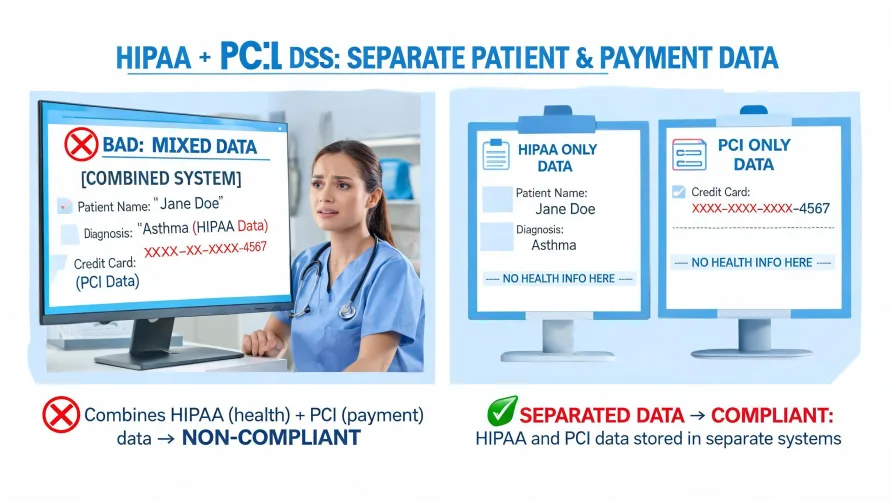
Healthcare practices that accept credit cards face two separate regulatory frameworks at the same time: HIPAA for patient health information and PCI DSS for payment card data. Healthcare credit card processing sits at the intersection of these two systems, and understanding where they overlap, where they don't, and what each actually requires is the difference between a compliant operation and an expensive mistake. Most practices get the PCI side right by default through their processor, but the HIPAA side of the payment equation catches many off guard. The confusion is understandable. Both frameworks deal with sensitive data. Both require safeguards. But they protect different things, they're enforced by different entities, and the compliance obligations they create for your practice are distinct. Getting this right doesn't require a legal team. It requires knowing which rules apply to which data and building your payment workflows accordingly. Where HIPAA and PCI DSS Actually Overlap The short answer to whether HIPAA applies to payment processing is: it depends on what data touches the transaction. HIPAA protects Protected Health Information, or PHI. PCI DSS protects cardholder data. In a typical retail credit card transaction, there's no PHI involved, so HIPAA doesn't apply. A medical practice charging a patient's card is different because the transaction can be linked to a healthcare service. Here's where the distinction matters. If your payment processor only receives the card number, expiration date, transaction amount, and a generic merchant name, that processor isn't handling PHI. The card network and issuing bank see even less. Nothing in that data stream identifies what medical service was provided or what condition was treated. PCI DSS applies to those parties. HIPAA does not. The overlap emerges when health information accompanies the payment data. If your billing system sends a diagnosis code, procedure description, patient medical record number, or treatment details alongside the payment request, the processor is now touching PHI. That changes the compliance picture entirely. According to guidance published by HHS, any entity that creates, receives, maintains, or transmits PHI on behalf of a covered entity is functioning as a business associate, regardless of whether handling health data is their primary business. Most modern payment workflows are designed to keep these data streams separated. The billing system tracks the clinical and insurance details. The payment terminal or gateway handles the card transaction. They don't need to exchange health information to complete the charge. But older systems, custom integrations, and certain practice management platforms can blur this boundary in ways that create HIPAA exposure for your processor without anyone realizing it. When You Need a Business Associate Agreement With Your Processor A Business Associate Agreement, or BAA, is the contract HIPAA requires between a covered entity and any business associate that handles PHI. So the question of whether you need a BAA with your payment processor comes down to one thing: does your processor access, store, or transmit PHI as part of the payment workflow? If your practice uses a standalone payment terminal that only captures card data, the answer is almost certainly no. The processor sees a dollar amount and a card number. No PHI involved, no BAA required. If your practice management software sends clinical information to the payment gateway as part of the billing transmission, the answer is likely yes. This is more common than practices realize, particularly with older all-in-one systems where the billing module and the payment module share data fields. A system that includes a procedure code or patient diagnosis in the payment authorization request has created a PHI transmission, and HHS considers that enough to trigger business associate status. Some processors that specialize in medical practice merchant services will sign a BAA proactively. They've built their systems to handle the possibility that PHI might flow through their environment, and the BAA is part of their standard onboarding. Other processors, particularly general-purpose ones, won't sign a BAA because their systems aren't built to meet HIPAA's security requirements for PHI. Neither approach is wrong on its own. What matters is that the BAA status matches the actual data flow. The practical step for any healthcare practice is to map the data that moves between your practice management system, your billing platform, and your payment processor. If health information stays entirely within your practice systems and only card data reaches the processor, you can operate without a BAA. If any PHI crosses that boundary, you need one, and the processor needs to be willing and able to accept that obligation. Patient Billing Integrations and Payment Workflows Healthcare payment workflows have become significantly more complex over the past decade. Patient responsibility has grown as deductibles and out-of-pocket maximums have increased, which means more practices are collecting larger portions of revenue directly from patients rather than from insurance reimbursement. According to data published by the Federal Reserve, healthcare-related debit and credit card transactions have grown steadily in both volume and average transaction size. This shift makes the integration between your billing system and your payment processing particularly important. A well-configured integration lets your front desk collect copays at check-in, post payments directly to the patient's account in the practice management system, and generate statements for remaining balances, all without manually re-entering transaction data. The compliance consideration here is making sure the integration passes the right data in the right direction. The billing system should send the payment amount to the processor. The processor should return a confirmation, authorization code, and receipt data. Clinical details shouldn't travel with the payment request. Most current integrations built by established practice management platforms handle this separation correctly, but it's worth confirming with your vendor, especially if you're running a system that was configured more than five or six years ago. Payment Plans and Recurring Charges for Patient Balances Payment plans are increasingly standard in healthcare, and healthcare credit card processing must support them without creating compliance problems on either the HIPAA or PCI side. Recurring charges introduce specific PCI DSS requirements because they involve storing card data or a token that represents it. Under PCI DSS, your practice should never store full card numbers in your own systems. If you're offering payment plans with automatic monthly charges, the card data needs to be tokenized, meaning your processor replaces the actual card number with a non-sensitive token that can only be used through their system. Your practice management software stores the token. The processor stores the card. That separation is a PCI requirement, not a suggestion. On the HIPAA side, the recurring payment record itself doesn't typically constitute PHI as long as it doesn't reference the clinical service. A record that says "Patient Smith owes $450 on a 6-month plan" linked to a diagnosis code is PHI. A record that says "Account 12345 has a recurring charge of $75/month" tied only to a billing account number isn't. How your system structures that data determines your exposure. Payment plan communications add another layer. Statements and payment reminders sent to patients that reference specific services or conditions must comply with HIPAA's minimum necessary standard. A payment reminder that says "balance for your cardiology visit on March 3" contains PHI. One that says "balance due on your account" doesn't. Most billing systems let you configure the level of detail included in patient-facing communications, and for payment-related messages, less detail is both compliant and sufficient. HSA and FSA Card Processing Health Savings Account and Flexible Spending Account cards have specific handling requirements that general credit card processing doesn't. These cards are tied to tax-advantaged accounts, and the IRS requires that transactions be verified as eligible medical expenses. That verification happens through a system called IIAS, the Inventory Information Approval System, or through manual substantiation after the transaction. For practices that see patients regularly, HSA and FSA acceptance is relatively simple because healthcare merchant category codes automatically qualify most transactions. Your processor assigns your practice an MCC, typically 8011 for doctors or 8021 for dentists, and that code tells the card issuer the transaction is a qualified medical expense. No additional substantiation is required at the point of sale for most provider-based transactions. The complexity comes with mixed-use practices or retail health settings where not every item sold qualifies as a medical expense. A dermatology practice selling skincare products alongside providing clinical services, for example, needs a system that can distinguish qualifying from non-qualifying items at the register. IIAS-certified systems handle this automatically, but not every processor supports IIAS certification. If your practice sells any non-medical products or services, confirm that your processing setup can handle the split. FSA cards carry an additional consideration: many FSA plans have a use-it-or-lose-it structure tied to the plan year, which means patients sometimes attempt larger purchases near year-end. Processing systems should be prepared for higher FSA transaction volumes in Q4, and staff should understand that FSA card declines are often a balance issue on the patient's end rather than a processing failure. Common Compliance Pitfalls at the Intersection The most frequent compliance failure isn't a dramatic data breach. It's a slow drift where health information gradually leaks into payment workflows through small configuration decisions that nobody flags. Storing payment records alongside clinical records in the same unsegmented database creates unnecessary exposure. If your practice management system keeps billing and clinical data in the same tables without access controls, a breach of the billing data could also expose PHI, triggering HIPAA's breach notification requirements on top of PCI's. Logical segmentation between clinical and financial data, even within the same system, reduces the scope of both PCI and HIPAA obligations. Another common pitfall is using paper-based payment authorization forms that collect both card information and clinical details on the same document. A form that asks for a credit card number and also references the procedure being performed has created a document that's simultaneously subject to PCI and HIPAA requirements, including storage, access control, and destruction rules from both frameworks. Keep payment authorization separate from clinical consent. Staff training gaps are equally problematic. Front desk employees who handle both patient check-in and payment collection need to understand that reading a card number aloud in a waiting room is a PCI concern, and that discussing a patient's balance for a specific procedure within earshot of other patients is a HIPAA concern. Neither requires complex technology to solve. Both require awareness. Finally, practices sometimes assume that HIPAA compliance covers their payment security, or that PCI compliance addresses their health information obligations. It doesn't work that way. PCI DSS is enforced by the card networks through your acquiring bank. HIPAA is enforced by the HHS Office for Civil Rights. A practice can be fully PCI compliant and still violate HIPAA, or fully HIPAA compliant and still fail a PCI assessment. They're parallel obligations, not substitutes for each other. Building a compliant healthcare payment operation isn't about choosing one framework over the other. It's about understanding where each applies, keeping the data streams appropriately separated, and making sure every vendor in your payment chain knows their role. For practices evaluating their processing setup, our credit card processing reviews cover providers that serve the healthcare market and can help you identify the right fit for your compliance requirements.
Healthcare Credit Card Processing: HIPAA and Payment Data Together