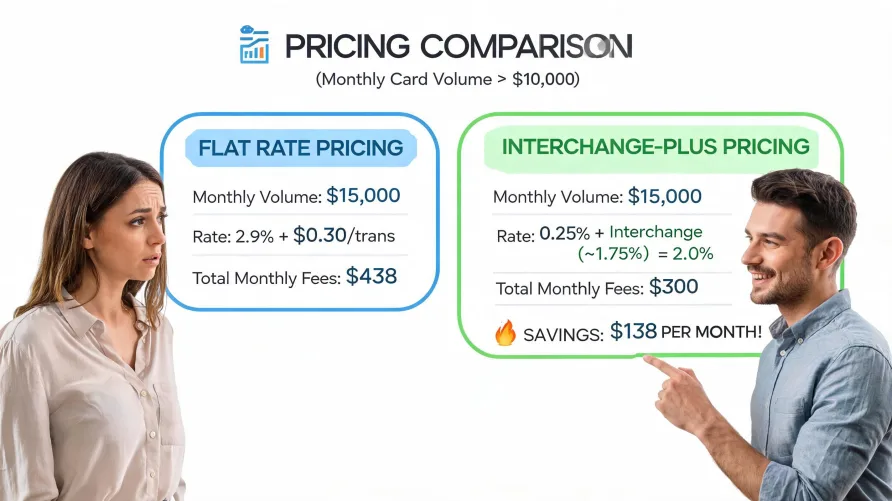
Choosing between interchange plus vs flat rate pricing comes down to monthly card volume and average transaction size. Flat-rate pricing is simpler and often cheaper below roughly $5,000 in monthly card sales. Interchange-plus pricing almost always costs less once you consistently process $10,000 or more per month, and the gap widens fast after that. The crossover point depends on your card mix, whether transactions happen in person or online, and how much time you're willing to spend reading your processing statements. Both models charge you for the same underlying cost: interchange fees set by Visa, Mastercard, and the other card networks. The difference is how your processor packages that cost and what markup sits on top. Getting this choice right can save a mid-volume business over $1,000 a year. Getting it wrong usually means overpaying without realizing it. What Interchange-Plus Pricing Actually Means Interchange-plus pricing separates your processing costs into two visible parts: the interchange fee set by the card networks and a fixed markup from your processor. The interchange fee varies by card type, transaction method, and merchant category code. A standard consumer Visa debit card swiped in person might carry an interchange rate around 0.05% plus $0.21, while a Visa rewards credit card processed online could run closer to 2.10% plus $0.10. Your processor adds its own margin on top of whatever interchange applies to each transaction, typically expressed as a percentage plus a per-transaction fee. A common markup looks like 0.20% to 0.30% plus $0.10 per transaction. Every line on your statement shows the interchange category for that batch of transactions, the network's cost, and the processor's markup separately. That transparency is the primary advantage of this model. The Federal Reserve tracks interchange fee data as part of its Regulation II oversight. Its most recent published figures show the average debit card interchange fee at approximately $0.24 per transaction. Credit card interchange runs higher and varies more widely across card types, but the principle holds: you see the network's actual cost on your statement, and your processor's markup sits right next to it. The downside is statement complexity. A single month's statement under interchange-plus pricing might show dozens of different interchange categories. If you don't know what you're looking at, the detail can feel overwhelming rather than useful. What Flat-Rate Pricing Actually Means Flat-rate pricing bundles everything into one percentage and sometimes a small per-transaction fee, regardless of card type. You might pay 2.6% plus $0.10 on every transaction whether the customer uses a basic debit card or a premium rewards credit card. Your statement is one line. Your costs are predictable. The trade-off is built-in overpayment on cheaper card types. Basic debit cards carry interchange rates well below 1% thanks to the Durbin Amendment's cap on debit interchange for large issuers, codified in the Dodd-Frank Act. When you pay a flat 2.6% on a transaction that costs the network less than 0.5%, the difference goes straight to your processor. For businesses where most customers pay with debit or standard credit cards, that hidden margin compounds every month. Interchange Plus vs Flat Rate: Running the Numbers Abstract comparisons don't help much. Here's what the difference looks like at three common volume levels, using realistic assumptions: a 60/40 credit-to-debit card split, average credit interchange of 1.80%, average debit interchange of 0.50% (reflecting the Durbin Amendment cap for regulated issuers), an interchange-plus markup of 0.25% plus $0.10, a flat rate of 2.6% plus $0.10, and a $50 average transaction size. At $3,000 per month, roughly 60 transactions, the flat-rate total comes to about $84. Under interchange-plus with a $10 monthly account fee, the total lands around $62. That's a $22 monthly difference, or about $264 per year. Real savings, but not transformative. At this volume, the simplicity of flat-rate pricing might be worth the premium for a business owner who doesn't want to think about processing costs at all. At $10,000 per month the picture changes. Flat-rate processing costs roughly $280. Interchange-plus runs about $188, including the monthly fee. That's $92 per month in savings, adding up to over $1,100 per year. For most small businesses, that's money that belongs somewhere else in the budget. At $25,000 per month, the gap becomes hard to ignore. Flat-rate costs hit around $700, while interchange-plus totals approximately $448. The annual difference exceeds $3,000. At this volume, staying on flat-rate pricing is an expensive convenience. These examples use moderate assumptions. Your actual numbers will shift based on your specific card mix, average ticket size, and the markup your processor quotes. But the pattern is consistent: interchange-plus gets cheaper relative to flat rate as volume grows. How Your Card Mix Changes the Equation Not all cards cost the same to process, and the spread between the cheapest and most expensive card types is where the pricing model choice really matters. A regulated debit card from a large bank might carry interchange under 0.30%. A corporate purchasing card or international rewards card can exceed 2.50%. That range is enormous, and it determines how much hidden margin you're paying under flat-rate pricing on any given transaction. If your customers mostly pay with debit cards or basic consumer credit cards, interchange-plus pricing saves you more because your actual interchange costs sit well below what a flat rate would charge. A sandwich shop where 70% of transactions are debit cards is leaving significant margin on the table at a flat rate. Conversely, if your customers frequently use rewards cards, corporate cards, or international cards, the savings from interchange-plus narrow because your average interchange is already closer to the flat rate anyway. A high-end consulting firm billing $5,000 invoices to corporate Amex cards won't see the same dramatic benefit from switching models. The card mix question isn't theoretical. Ask your current processor for an interchange qualification report. It shows exactly which card categories you're processing and what interchange you're actually paying on each type. That single document tells you more than any general pricing comparison ever could. Card-Present vs Card-Not-Present Transactions Where the card is when the transaction happens affects interchange rates directly. Card-present transactions, where the customer taps, dips, or swipes a physical card, qualify for lower interchange rates because fraud risk is lower. Card-not-present transactions, such as online purchases or phone orders, carry higher interchange because the card networks price in the increased fraud exposure. The difference between card-present and card-not-present interchange on the same card type can be 0.30% to 0.50% or more. This matters for the pricing model decision because it shifts the crossover point. A retail store processing most transactions in person sees lower average interchange, which means the gap between interchange-plus and flat rate is wider. The flat rate overcharges more dramatically on those cheap in-person debit transactions. An e-commerce business processing everything online sees higher average interchange, which narrows the gap and makes flat-rate pricing relatively more competitive at lower volumes. Businesses operating in both channels should look at their mix carefully. If 80% of your volume is card-present, interchange-plus likely wins at lower thresholds than the examples above suggest. The Tiered Pricing Model: Why You Should Skip It Some processors still offer tiered pricing, which groups transactions into categories like "qualified," "mid-qualified," and "non-qualified," each with a different rate. This sounds reasonable until you look at how the tiers actually work. The processor decides which tier each transaction falls into, and the criteria aren't standardized across the industry. What one processor calls "qualified" might be "mid-qualified" at another. There's no requirement to use the same definitions, and most don't publish their tier assignment logic in any detail. The result is a pricing model that's neither transparent like interchange-plus nor simple like flat rate. Tiered pricing tends to benefit the processor more than the merchant because the tier assignments create room for margin that's difficult to audit. A transaction on a basic debit card might land in the "mid-qualified" bucket and cost you more than it would under either of the other two models. If a processor quotes you tiered pricing, ask for the interchange-plus equivalent instead. Most will offer it. If they won't, that tells you something. Interchange Plus vs Flat Rate by Industry The right pricing model depends partly on what kind of business you run. Restaurants and quick-service businesses process high volumes of small transactions, mostly card-present. Average interchange tends to be low because of the debit-heavy card mix and in-person processing. Interchange-plus pricing usually wins here, even at moderate monthly volumes, because the gap between actual interchange and a flat rate is wide on every $12 lunch tab. Professional services firms, consultants, agencies, and similar businesses typically process fewer transactions at higher dollar amounts, often card-not-present. The card mix skews toward corporate and rewards cards with higher interchange. Flat-rate pricing can remain competitive here longer, and the simplicity may outweigh the modest savings from switching. E-commerce businesses face higher interchange rates across the board due to card-not-present processing. At low volumes, flat rate keeps things simple. Once monthly volume crosses $8,000 to $10,000, interchange-plus usually starts saving money even with the higher average interchange. Retail stores with consistent foot traffic and a healthy debit card mix are among the clearest cases for interchange-plus pricing. The math almost always favors it above $5,000 per month. When to Make the Switch There isn't a universal trigger point, but a few signals suggest it's time to move from flat rate to interchange-plus. If your monthly card volume has grown past $7,000 to $10,000, the savings are likely worth the added statement complexity. If more than 40% of your transactions are debit cards, you're overpaying on flat rate at almost any volume. And if your processor won't provide a detailed interchange breakdown when you ask for one, that's a reason to shop around regardless of which model you're on. The switch itself isn't complicated. Most processors can set up an interchange-plus account within a few business days. The harder part is comparing quotes accurately, since processors don't always present interchange-plus markup in the same format. Focus on the markup over interchange, not the "effective rate" they quote, because the effective rate blends interchange and markup together and makes apples-to-apples comparison difficult. Whatever model you're on now, run the math with your actual numbers before making a change. Your processing statement and an interchange qualification report give you everything you need to estimate costs under either model. The credit card processing providers covered on this site can help you compare options in this market and find the right pricing structure for your volume.
How to Choose Between Interchange-Plus and Flat-Rate Pricing