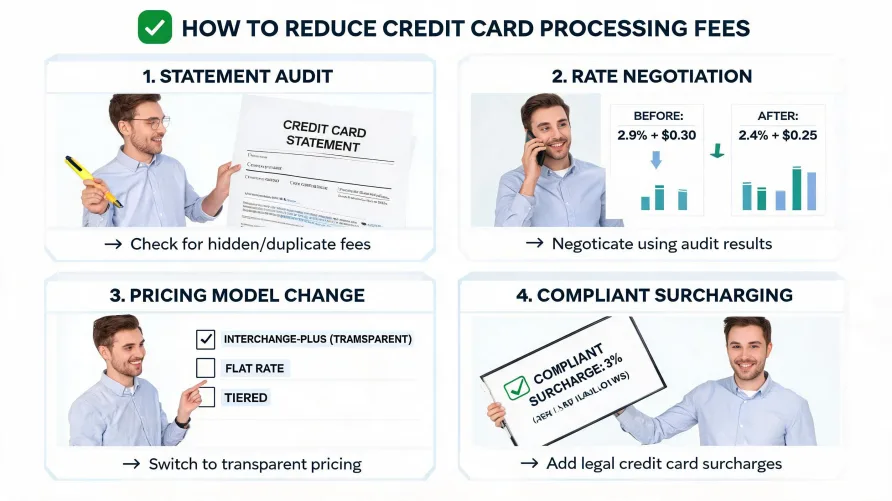
How to Reduce Credit Card Processing Fees Most businesses overpay for credit card processing because they've never questioned their rates. Learning how to reduce credit card processing fees starts with understanding what you're actually being charged, then working through a series of tactical changes that can cut costs by 20% to 40% without switching providers. Some of the biggest savings come from steps that take less than an hour: reading your statement properly, calling your processor, and adjusting how you accept payments. The eight strategies below move from lowest effort to highest, and most businesses find real savings before they ever reach the last step. Audit Your Processing Statement Before Anything Else You can't reduce what you can't measure. Every merchant processing statement breaks charges into three buckets: interchange fees set by the card networks, assessment fees collected by Visa and Mastercard, and your processor's markup on top of both. Interchange and assessments are non-negotiable, set by the card networks themselves with no room for merchant input. The markup is where your savings live, and it's the only component you can directly influence through negotiation, pricing model changes, or switching providers. Pull your last three monthly statements and calculate your effective rate by dividing total processing fees by total sales volume. If that number lands above 2.5% for card-present transactions or above 3.0% for card-not-present, you're almost certainly paying more markup than necessary. Federal Reserve data on merchant discount rates puts the average for card-present businesses in the 2.1% to 2.3% range, so anything significantly above that deserves closer examination. While you're reviewing those statements, look for line items you don't recognize: PCI non-compliance fees, monthly minimums, batch processing charges, and statement fees are all common processor add-ons that many merchants never question. Some of these charges are negotiable, and others disappear entirely once you meet your compliance requirements through the PCI Security Standards Council's self-assessment process. The statement audit isn't glamorous work, but it's the foundation every other tactic on this list builds on. How to Reduce Credit Card Processing Fees by Renegotiating Markup Calling your current processor is the fastest path to lower rates, and it costs you nothing but time. Most processors expect to lose a percentage of their merchant base each year, and retention teams have authority to reduce markups without manager approval. This doesn't require threats or bluffing. A direct request backed by your effective rate calculation and a competing quote gives you real position. Ask specifically about three things: reducing the basis-point markup on interchange-plus pricing, lowering or eliminating the monthly account fee, and waiving PCI non-compliance charges if you're already compliant. Processors typically have 10 to 30 basis points of margin they can remove without escalating beyond the retention team. For a business processing $30,000 per month, even a 20-basis-point reduction saves $720 per year, and most processors will offer something rather than risk losing the account entirely. If your processor won't move at all, that's still useful information because it tells you their pricing floor and gives you a clean benchmark for evaluating alternatives. Switch Pricing Models to Reduce Credit Card Processing Fees Three pricing models dominate the processing market: flat-rate, interchange-plus, and tiered. Each works best at a specific volume and transaction profile, and choosing the wrong one is one of the most common reasons businesses overpay. Flat-rate pricing charges a single percentage on every transaction regardless of card type, which makes it attractive for businesses processing under $5,000 per month but almost always too expensive above that volume because the rate doesn't adjust downward when customers use lower-cost card types like standard debit. Interchange-plus pricing separates the interchange fee from the processor's markup. You pay the actual interchange rate set by the card networks plus a fixed markup, typically 0.15% to 0.50% plus a per-transaction fee. This model gives you complete visibility into what goes to Visa or Mastercard and what goes to your processor. For businesses processing $10,000 or more per month, interchange-plus almost always costs less than flat-rate pricing. Tiered pricing groups transactions into qualified, mid-qualified, and non-qualified categories. The qualified rate looks low on paper, but processors have broad discretion over which transactions land in the more expensive tiers. This is the least transparent model and frequently the most expensive one in practice. Businesses that switch from tiered to interchange-plus commonly see their effective rate drop by 0.3% to 0.5%, which on $20,000 in monthly volume saves $720 to $1,200 per year. If you're currently on tiered pricing, this single change may be the highest-impact move available to you. Consolidate Volume for Better Rates Processing volume is your strongest negotiating asset. If your business runs multiple locations, franchise units, or separate online and in-store merchant accounts, consolidating that volume under a single processing relationship strengthens your position at the negotiating table considerably. A restaurant group operating four locations at $25,000 per month each has far more power as a single $100,000-per-month account than as four independent accounts. Most processors offer volume-based pricing tiers, and crossing into a higher bracket can reduce your per-transaction markup automatically. The same logic applies to businesses with separate accounts for retail and e-commerce sales, where combining channels under one processor often improves the rates on online transactions, which carry higher markups because of the greater fraud risk inherent in card-not-present environments. Submit Level 2 and Level 3 Data for B2B Transactions If your business sells to other businesses or government agencies, you may be missing one of the largest single savings opportunities available. Visa and Mastercard set lower interchange rates for transactions that include enhanced purchasing data, and the difference isn't trivial: Level 3 qualified rates can run 0.50% to 1.00% below standard commercial card interchange. For a B2B company processing $50,000 per month in commercial card transactions, that translates to $3,000 to $6,000 in annual savings, and companies with heavy government contract volume often see even larger reductions because government purchasing cards are specifically designed to reward enhanced data submission with the lowest available interchange. Level 2 data includes the sales tax amount and customer purchase order number. Level 3 adds line-item detail like item descriptions, quantities, unit costs, and commodity codes. Your payment terminal or gateway needs to support these fields, and not every processor enables them by default. Ask whether Level 2 and Level 3 data submission is active on your account. Enabling it is often a configuration change, not a hardware upgrade. Increase Your Card-Present Transaction Ratio Interchange rates are lower for card-present transactions than card-not-present transactions because fraud risk drops when the physical card is read at a terminal. Visa's published interchange schedules show differences of 0.30% to 0.80% between the two categories for the same card type, and that gap represents real money multiplied across every transaction your business processes in a given year. Service businesses that invoice clients and then key in card numbers by phone are paying some of the highest interchange rates available. Shifting that volume to a mobile card reader or a hosted payment link, which qualifies as an e-commerce transaction with better security data than a manual key entry, can reduce the per-transaction cost noticeably. Even within card-present transactions, the method matters: chip-read and contactless transactions qualify for lower rates than magnetic stripe swipes in most cases. Make sure your staff uses the chip reader rather than defaulting to a swipe, because that small operational change has a measurable impact over thousands of transactions per year. Pass Credit Card Processing Fees to Customers Surcharging and cash discounting are two legal approaches to shifting some or all of the processing cost to the customer paying with a card. They work differently, and the rules vary by state, so understanding the distinction matters before implementing either one. A surcharge adds a fee at the point of sale when a customer pays with a credit card. Both Visa and Mastercard allow surcharging under specific conditions: the merchant must register with the card networks, post clear signage, display the surcharge as a separate line item on the receipt, and cap it at 3% or the actual cost of acceptance, whichever is lower. Surcharging isn't permitted on debit card transactions regardless of how they're processed. As of this writing, several states either prohibit or restrict credit card surcharges, though the legal status has shifted following court challenges to state-level bans. Requirements vary, so check your state attorney general's office for current rules before implementing a surcharge program. A cash discount program takes the opposite approach, offering a lower posted price to customers who pay with cash rather than cards. The legal distinction matters: you're discounting for cash, not adding a fee for cards. This framing carries different implications under state consumer protection statutes, and cash discount programs have gained traction with small businesses in thin-margin industries like food service and convenience retail. Either approach can offset 1.5% to 3.0% of processing costs, but the tradeoff is customer experience. Some buyers won't notice or won't care, while others will take their business elsewhere. Test with a single location or limited period before committing across your entire operation. When Switching Processors Makes Sense Switching processors requires the most effort of any strategy on this list, but it sometimes delivers the largest savings. If you've audited your statement, negotiated with your current provider, and their best offer still leaves your effective rate well above market, it's time to look elsewhere. Before making the move, check your current contract for early termination fees. Some agreements include liquidated damages clauses that charge a fixed amount or a per-remaining-month penalty for early cancellation. These fees range from a few hundred dollars to several thousand depending on the contract terms and remaining duration, so factor the termination cost into your first-year savings calculation to confirm the switch actually pays off on a net basis. When evaluating a new processor, request the quote in interchange-plus format even if you're comparing against a flat-rate alternative. This makes the markup comparison direct and transparent. Ask about contract length, rate guarantee periods, and whether the quoted rate covers all fees or just the per-transaction charge, because monthly fees, PCI fees, and batch fees can erode what initially looks like a better rate. Equipment deserves attention too: if your current terminals are leased, you may owe a buyout to end the lease, and if they're owned, confirm the new processor supports your existing hardware before signing anything. Reprogramming a terminal is typically free or low-cost, but replacing one adds $200 to $600 per device. What's the Cheapest Way to Accept Credit Cards? No single answer fits every business. The lowest-cost approach depends on your monthly volume, average ticket size, transaction type, and customer payment mix. For businesses processing under $3,000 per month, a flat-rate mobile reader with no monthly fee keeps costs simple and predictable. The per-transaction rate runs higher than interchange-plus, but at low volume the monthly savings from interchange-plus won't offset the account fees most processors charge for that pricing model. For businesses processing $10,000 or more per month with mostly card-present transactions, interchange-plus pricing through a traditional processor is almost always the most cost-effective path. Add Level 2 and Level 3 data submission if you handle commercial cards, and you're close to the floor of what's achievable without surcharging. For high-volume businesses above $50,000 per month, direct processor relationships with custom interchange-plus rates and negotiated volume discounts provide the best economics. At this scale, single-digit basis-point reductions translate to thousands in annual savings. The thread connecting every business size is visibility. You can't optimize what you don't understand. Start with the statement audit, work through the negotiation and structural changes described above, and revisit your processing setup at least annually as your volume and transaction patterns shift. For a closer look at how fees are structured and how to evaluate providers in this category, the credit card processing section of this site covers each topic in detail.
How to Reduce Credit Card Processing Fees