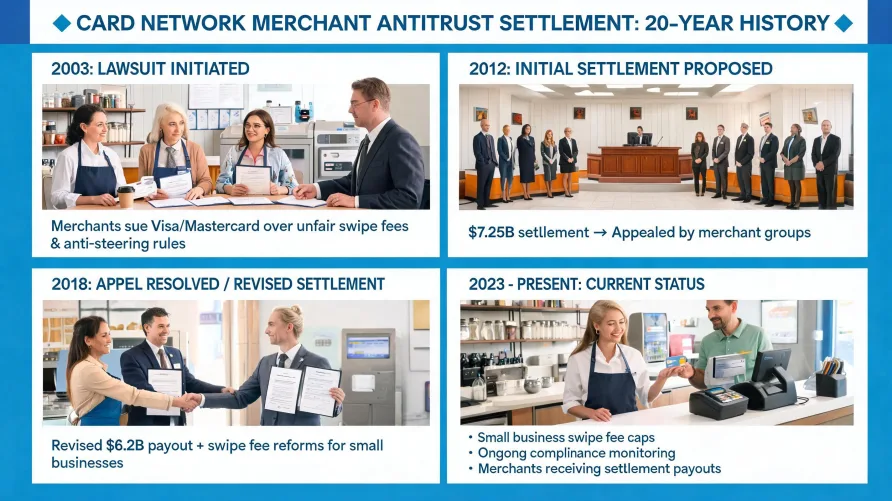
The interchange lawsuit settlement is shorthand for one of the longest-running antitrust cases in American history. Formally titled In re Payment Card Interchange Fee and Merchant Discount Antitrust Litigation, the case pits millions of U.S. merchants against the two largest card networks and their issuing banks over the fees charged every time a customer uses a credit card. Since 2005, the litigation has produced multiple proposed settlements, two appellate reversals, and billions of dollars in contested damages. For any business that accepts credit cards, this case has direct implications for what you pay every time a transaction clears. How the Interchange Lawsuit Settlement Began The case started with a wave of class action lawsuits filed in 2005 by merchants and trade associations in federal courts across the country. The central allegation was that the two dominant card networks conspired with their member banks to fix interchange fees at artificially high levels. Merchants also challenged the networks' rules that prevented steering customers toward lower-cost payment methods, including honor-all-cards policies that forced any merchant accepting one card from a network to accept every card that network issued, regardless of the interchange rate attached to it. The Judicial Panel on Multidistrict Litigation consolidated the cases in the Eastern District of New York as MDL No. 1720. The case has remained in that court ever since, generating thousands of docket entries over two decades. The plaintiff class was estimated at more than 12 million merchants. The antitrust theory rested on Section 1 of the Sherman Act. Merchants argued that default interchange rates weren't set through competition but through coordinated price-fixing among banks that would otherwise compete on processing costs. The anti-steering rules compounded the alleged harm by blocking merchants from encouraging customers to choose cheaper payment options at the register. The $7.25 Billion Interchange Lawsuit Settlement In 2012, the parties announced what was then the largest antitrust class action settlement in U.S. history. The proposed deal totaled approximately $7.25 billion in cash payments to merchants, paired with a temporary reduction in interchange rates. Injunctive relief provisions would have modified certain network rules, including limited permission for merchants to add surcharges on credit card transactions. Judge John Gleeson of the Eastern District of New York granted preliminary approval, then final approval in 2013. Opposition was immediate and intense. Thousands of merchants opted out of the class, including some of the largest retailers in the country, and major trade associations publicly rejected the deal as inadequate. Objectors focused on three issues: the release of claims was too broad, effectively barring merchants from bringing future antitrust challenges related to interchange. The monetary relief was too small relative to the estimated overcharges that had accumulated over more than a decade. And the injunctive relief, which included limited permission for merchants to surcharge credit card transactions, was largely cosmetic. That surcharging permission was already restricted by state laws in roughly ten states at the time, which made the concession worth less than it appeared. The temporary interchange reduction would expire after only eight months, a short window for a case alleging decades of anticompetitive conduct. Many merchants felt they were signing away future legal rights in exchange for token relief that wouldn't meaningfully change their cost structure. Why the Second Circuit Overturned Everything The most consequential development came in 2016, when the U.S. Court of Appeals for the Second Circuit vacated the entire settlement. The appellate panel found that the same class representatives had negotiated both the monetary damages and the injunctive relief, creating an inherent conflict of interest. Merchants who wanted maximum cash payouts had fundamentally different priorities than merchants who wanted lasting structural rule changes. Combining both goals into a single negotiation meant neither group was properly represented. The opinion, In re Payment Card Interchange Fee & Merchant Discount Antitrust Litigation, 827 F.3d 223 (2d Cir. 2016), reset the case completely. The court didn't rule on the merits of the antitrust claims themselves. It held that the settlement process was structurally flawed. That distinction matters because it forced the entire case to be reorganized rather than simply revised. This cost years. It also sent a clear signal that federal courts would scrutinize interchange settlements with real rigor rather than deferring to large dollar figures. How the Litigation Split Into Two Tracks Following the Second Circuit's decision, the district court divided the case into a damages class under Federal Rule of Civil Procedure 23(b)(3) and an injunctive relief class under Rule 23(b)(2). The damages class pursued monetary compensation for past interchange overcharges. The injunctive relief class pursued forward-looking changes to network rules and fee-setting practices. The separation directly addressed the conflict the Second Circuit identified. Each class could negotiate its own objectives without sacrificing one goal for the other. The damages class moved toward a revised monetary settlement, while the injunctive relief class continued litigating for structural reforms. The split also created different strategic dynamics. Merchants in the damages class could opt out and pursue individual lawsuits if they believed they could recover more on their own. Several large retailers chose that path, filing separate cases that have since settled or gone to trial independently. The opt-out window for the damages class has long since closed, so this route isn't available to merchants who remained in the class. The Damages Class Settlement The damages class reached a revised settlement that the district court approved in December 2019. The initial fund was approximately $5.54 billion, later supplemented to roughly $6.24 billion. The settlement covered interchange fees paid by class members from January 2004 through January 2019. Claims distribution began in 2024 after the filing period closed. Eligible merchants who didn't opt out received payments based on their estimated interchange volume during the class period. The amounts varied enormously. High-volume merchants received substantial payments, while smaller businesses received checks that, in many cases, represented a fraction of what they actually paid in interchange over those fifteen years. This settlement is final. It can't be reopened or expanded. For business owners asking whether they're owed money from this case, the answer depends on whether you accepted card payments during the class period, whether you filed a claim, and whether you or a prior owner of your business opted out. The 2024 Proposed Interchange Lawsuit Settlement and Its Rejection The injunctive relief class, seeking rule changes rather than cash, continued on its own track. In March 2024, the parties announced a proposed settlement for this class. The terms would have required the card networks to reduce interchange rates by at least four basis points for three years and cap rates at current levels for five years. Merchants would have gained expanded rights to surcharge credit card transactions and steer customers toward lower-cost payment methods. Merchant advocacy groups responded with sharp criticism. The four-basis-point reduction, applied to a transaction averaging around $50, amounts to roughly two cents per swipe. For a small business processing $500,000 annually in card transactions, the three-year savings would total approximately $600. Trade organizations including the National Retail Federation called the proposed terms inadequate relative to the scope of the alleged harm and argued that temporary rate reductions with built-in expiration dates wouldn't change the structural dynamics of interchange pricing. Judge Margo Brodie of the Eastern District of New York rejected the proposed settlement. Her ruling found that the relief didn't justify the broad release of claims merchants would have been required to sign. The rejection was significant not just for this case but as a signal to both sides that the court expected materially better terms before approving any deal for the injunctive class. It returned the class to active litigation, with no replacement settlement framework announced as of early 2025. Can Merchants Still Sue Over Interchange Fees Whether a merchant can bring new claims depends on where they stand in the existing litigation. Merchants who remained in the damages class are bound by that final settlement. They can't pursue separate damages claims for the period it covers. That chapter is closed. The injunctive relief class is a different story. Because the 2024 proposed settlement was rejected, forward-looking claims about network rules and fee structures remain unresolved. Merchants in that class still have active claims in the ongoing litigation. Merchants who opted out of the damages class, typically large retailers with resources to litigate individually, pursued separate cases. Some have already resolved through individual settlements or trials. The opt-out window closed years ago, so this path isn't available retroactively. New lawsuits based on current interchange practices aren't automatically barred by the existing case, though any new action would face steep procedural hurdles. Courts would closely evaluate whether new claims overlap with the ongoing MDL, and the existing case has consumed enormous judicial resources over two decades. Federal Enforcement and Congressional Action The private class action wasn't the only legal front. The U.S. Department of Justice filed its own antitrust lawsuit in 2010 against the two major card networks and American Express, alleging that rules prohibiting merchant steering violated federal antitrust law. The two largest networks settled with the DOJ in 2011, agreeing to allow merchants to offer discounts for specific payment methods, inform customers about processing costs, and promote lower-cost alternatives at the point of sale. Those consent decrees remain in effect and have given merchants more freedom to steer customers than they had before the lawsuit, though relatively few small businesses have taken advantage of these rights in practice. American Express refused to settle and fought the case to the Supreme Court. In Ohio v. American Express Co., 585 U.S. 529 (2018), the Court ruled 5-4 that the credit card market functions as a two-sided platform and that anti-steering rules didn't violate antitrust law when both the merchant side and the cardholder side were considered together. That decision narrowed the legal theories available to plaintiffs challenging interchange practices and has shaped how courts analyze platform-based markets more broadly. Congress has taken its own approach. The Durbin Amendment to the 2010 Dodd-Frank Act capped debit card interchange fees for banks with more than $10 billion in assets, and the Federal Reserve implemented regulations enforcing those caps in 2011. On the credit card side, the Credit Card Competition Act has been introduced in multiple sessions of Congress. It would require at least two unaffiliated network routing options on every credit card, aiming to introduce network-level competition that could pressure interchange rates downward. As of this writing, that legislation hasn't passed. Where the Interchange Lawsuit Settlement Stands Today The damages class settlement is final and largely distributed. That track of the litigation is over for merchants who remained in the class. The injunctive relief class is back in active litigation following Judge Brodie's rejection of the 2024 proposed settlement. No new settlement terms have been publicly announced. The case could move toward trial or produce a revised settlement proposal, but either path will take time. This litigation has been working through the courts for more than twenty years, and there's no sign that the remaining issues will resolve quickly. For business owners, the practical reality is that interchange fee structures haven't been permanently altered by any settlement to date. Surcharging and discounting rules have loosened somewhat over two decades of litigation and DOJ intervention, but the core interchange rate-setting mechanism remains intact. If you accept credit cards, you're still paying interchange rates set by the networks, not rates set by competitive bidding among banks. Businesses that want to reduce their effective processing costs now don't need to wait for the courts. Understanding interchange-plus pricing, reviewing your current processing agreement, and checking whether your state permits surcharging are all steps available today. Our credit card processing reviews cover the providers serving this market and what they charge in practice.
The Interchange Antitrust History and Where It Stands