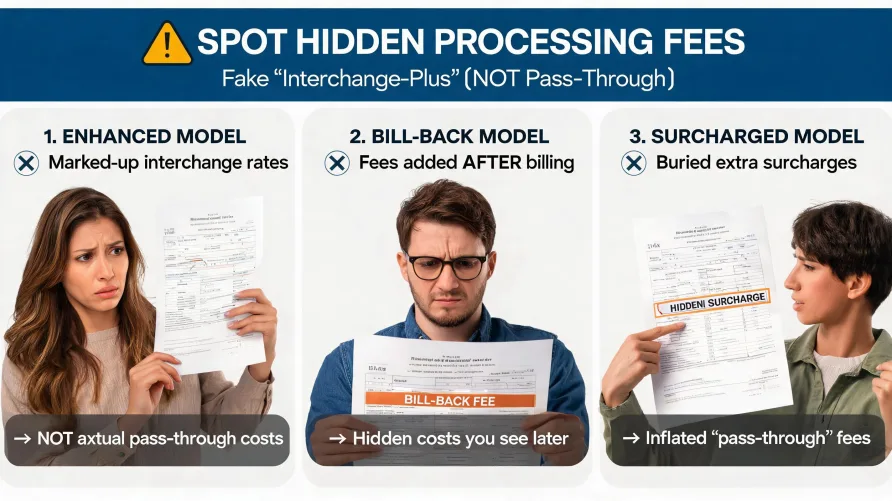
Some processors advertise interchange-plus pricing but don't actually pass through true interchange rates. This practice, sometimes called fake interchange plus pricing, layers hidden markups on top of interchange categories, bills costs retroactively, or bundles surcharges in ways that make your effective rate far higher than the quoted markup suggests. The result looks transparent on the surface but functions more like tiered pricing once your statement arrives. Understanding how these disguised models work, and what to look for on your monthly statement, is the difference between paying a fair processing rate and overpaying by thousands of dollars a year. What Real Interchange-Plus Pricing Looks Like Before you can spot a fake, you need to understand the real thing. True interchange-plus pricing passes through the exact interchange rate set by the card networks and adds a fixed markup on top. That markup is the processor's profit, and it doesn't change based on card type, transaction method, or time of month. On a genuine interchange-plus statement, every transaction line shows the specific interchange category it qualified for, the exact rate charged by the network, and the processor's markup applied on top. The math is auditable. You can cross-reference any line against the published interchange tables from Visa or Mastercard and confirm the pass-through is accurate. That auditability is the entire point of the model, and it's what separates true interchange-plus from every pricing structure that borrows the name without delivering the transparency. Enhanced Interchange-Plus: Fake Interchange Plus Pricing in Disguise The most common variant of fake interchange plus pricing goes by "enhanced" interchange-plus. A processor using this model still shows interchange categories on your statement, but the rates listed aren't the actual interchange rates published by the card networks. Instead, the processor adds basis points to each interchange category before applying the quoted markup. If a Visa Rewards 1 transaction carries a true interchange rate of 1.65% + $0.10, an enhanced model might list that same category at 1.80% + $0.10 on your statement. Your quoted markup of 0.20% then goes on top of the inflated figure, not the real one. On a single transaction, 15 basis points of padding might cost you an extra $0.15 per $100 in sales. But across a business processing $30,000 a month, that hidden padding adds roughly $540 a year in charges that don't appear anywhere as a separate line item. The cost compounds quietly. The padding is almost invisible unless you know where to look. Your statement still appears organized by interchange category, still shows a separate markup line, and the format looks identical to a genuine pass-through model. But the effective cost per transaction is meaningfully higher because the base rate itself has been quietly inflated before your markup is applied. Some processors pad uniformly across all categories. Others apply larger padding to card types that already carry higher interchange rates, since a few extra basis points on a 2.40% category draws less scrutiny than the same padding on a 1.51% category. Either approach produces economics closer to tiered pricing than to real interchange-plus, and without careful verification you won't know the difference from the statement format alone. What Is Bill-Back Pricing in Credit Card Processing Bill-back pricing is a less common but equally misleading structure. In this model, the processor charges a flat or qualified rate at the time of each transaction, then "bills back" the difference between that initial charge and the actual interchange cost on a separate line or in a later section of your monthly statement. The initial transaction charges look clean and low. A merchant scanning daily batch totals might see a consistent per-transaction rate and assume everything is normal. The additional charges show up later, sometimes grouped at the bottom of the statement under vague labels like "interchange adjustments," "rate corrections," or "processing differentials." That isn't transparency. It's the opposite. Bill-back pricing makes it nearly impossible to reconcile individual transactions against their true cost. The initial charge and the adjustment are separated by time and location on the statement, which discourages the kind of line-by-line verification that real interchange-plus invites. According to guidance from the Federal Trade Commission on transparent pricing practices, businesses should be able to verify all charges against published rate schedules. Bill-back structures make that verification unreasonably difficult by design, not by accident. Surcharged Interchange-Plus and Bundled Fees A third variant adds surcharges or assessment fees on top of an otherwise legitimate interchange-plus structure but buries them in ways that inflate your effective rate without appearing in the quoted markup. Network assessment fees are a real cost. Visa, Mastercard, and other networks charge assessments on top of interchange, and those fees do need to appear on your statement. The question is whether those assessments are passed through at their actual published rates or whether additional margin has been layered into the assessment line items. Visa's assessment fee schedule, for example, is publicly available and lists specific per-transaction and volume-based charges. If the assessment charges on your statement exceed those published rates, the difference is margin disguised as a network cost. Some processors also add per-transaction fees, batch fees, or monthly technology charges that aren't included in the quoted interchange-plus rate. The markup you agreed to might be 0.15% + $0.08, but your effective cost per transaction is substantially higher once these additional line items are factored in. That's not a violation of interchange-plus in the strictest definition, but it turns a seemingly competitive quote into an expensive processing arrangement once the full cost picture emerges. How to Spot Fake Interchange Plus Pricing on Your Statement The verification process requires your most recent processing statement and a current copy of the interchange rate tables published by Visa and Mastercard. Both networks publish their full interchange schedules online, typically updated in April and October each year. Start by selecting five to ten transactions from your statement that represent different card types and entry methods. For each one, identify the interchange category listed on your statement, the rate charged for that category, and the markup applied on top. Then compare each rate against the published network tables for that same interchange category. If your statement shows 1.80% for a category that the published table lists at 1.65%, the difference is padding, and your pricing isn't true interchange-plus. Check the assessment line as well, since network assessments are published and verifiable just like interchange rates. If your statement's assessment charges exceed the published schedule, additional margin has been added there too. This verification takes about 30 minutes the first time. It's the single most effective way to confirm whether your processor is delivering the pricing model they sold you. Warning Signs That Your Pricing Is Disguised Several red flags suggest your interchange-plus pricing may not be what it appears. The most obvious is a statement that doesn't show individual interchange categories at all. Real interchange-plus pricing itemizes by category. If your statement groups transactions into buckets like "qualified," "mid-qualified," and "non-qualified," you're looking at tiered pricing regardless of what your contract calls it. Another warning sign is an effective rate that doesn't match the math. Add your quoted markup to the average interchange rate for your transaction mix, typically between 1.7% and 2.1% for most retail businesses. If your actual effective rate is significantly higher, something is inflated underneath. Vague adjustment lines are a third red flag. Terms like "interchange differential," "rate adjustment," or "bill-back" on your statement suggest a model that separates initial charges from true costs. Those adjustments deserve scrutiny. Finally, watch for resistance from your processor when you ask for transaction-level interchange data. A processor delivering genuine pass-through has nothing to hide when you request line-item verification. Resistance is a signal. How to Demand Genuine Transparency From Your Processor If your verification reveals padding, bill-back structures, or unexplained surcharges, you have options. Request a side-by-side comparison of your statement's interchange rates against the published network tables. Ask the processor to explain any discrepancies in writing. A processor offering true interchange-plus should be able to demonstrate pass-through accuracy for any transaction on your statement without hesitation. Review your contract language carefully. Look for terms like "enhanced," "modified," "adjusted interchange," or "bill-back." These phrases often appear in contracts that permit something other than true pass-through pricing, even when the sales pitch described it differently. According to the Electronic Code of Federal Regulations, payment processing agreements must clearly disclose all applicable fees, but the disclosure language can be buried in lengthy terms of service that most business owners don't read in full. If the contract language permits padding or retroactive billing, you're dealing with a bait and switch interchange plus arrangement whether or not anyone uses that term. At that point, the choice is whether to renegotiate for genuine pass-through terms or find a processor that offers them from the start. For a broader look at how interchange-plus compares to other processing models, our credit card processing coverage breaks down the pricing structures, fee types, and provider options in this market.
Tiered Pricing Disguised as Interchange-Plus