
What You’re Actually Paying With Helcim
Most small businesses overpay for credit card processing without realizing it. Flat-rate processors charge the same percentage on every transaction regardless of the card type, which means your margin on a basic debit card swipe subsidizes someone else’s premium rewards card. Helcim takes the opposite approach, and it’s the reason we score the service 8.2 out of 10 for the credit card processing category. Founded in Calgary, Alberta in 2006 by Nicolas Beique, Helcim has spent nearly two decades building a payment platform around a simple idea: show merchants exactly what every transaction costs, charge a small transparent margin on top, and don’t nickel-and-dime them with monthly fees. The company raised $32.7 million across two venture rounds, was ranked #44 on the Globe and Mail’s Top Growing Companies list in 2025, and now serves thousands of merchants across the United States and Canada with a team of roughly 150 employees.
Helcim uses interchange-plus pricing, which passes the actual interchange rate set by Visa, Mastercard, and other card networks directly to you. On top of that base cost, Helcim adds its own margin: 0.40% + 8¢ per in-person transaction, or 0.50% + 25¢ per online or keyed transaction. That’s the whole fee structure. There are no monthly fees, no setup fees, no PCI compliance fees, and no cancellation penalties.
The practical difference matters. According to Helcim’s own data, merchants save an average of 25% compared to flat-rate processors. That gap widens for businesses with high transaction volumes or a customer base that skews toward lower-interchange card types like standard debit.
Helcim’s Pricing in Annual Dollar Terms
For a business processing $10,000 per month in card transactions, split roughly between in-person and online sales, the Helcim margin alone (excluding interchange, which every processor pays) works out to about $40 to $50 in in-person margin fees plus $50 to $75 in online margin fees per month. That’s roughly $1,080 to $1,500 per year in Helcim’s markup specifically. A flat-rate processor charging 2.9% + 30¢ on those same transactions would collect approximately $3,480 in total fees annually, of which a meaningful portion is excess margin above the interchange floor. You can’t make an exact apples-to-apples comparison because interchange fluctuates per transaction, but the directional savings are real and compounding over time.
The automatic volume discount system is where Helcim pulls further ahead. Five tiers kick in based on your three-month rolling average of card processing volume. At the entry level (under $50,000/month), you’re at the standard rates. Cross $50,000 and your in-person margin drops to 0.35% + 7¢. At $100,000 it falls to 0.25% + 7¢. The top tier, over $1 million monthly, reduces it to just 0.15% + 6¢. No phone call required. No renegotiation. The system recalculates monthly and adjusts your rate automatically.
For a business processing $75,000 per month in-person, the jump from Tier 1 to Tier 2 saves approximately $37.50 in margin fees per month, or $450 per year. That’s money back in your pocket without lifting a finger.
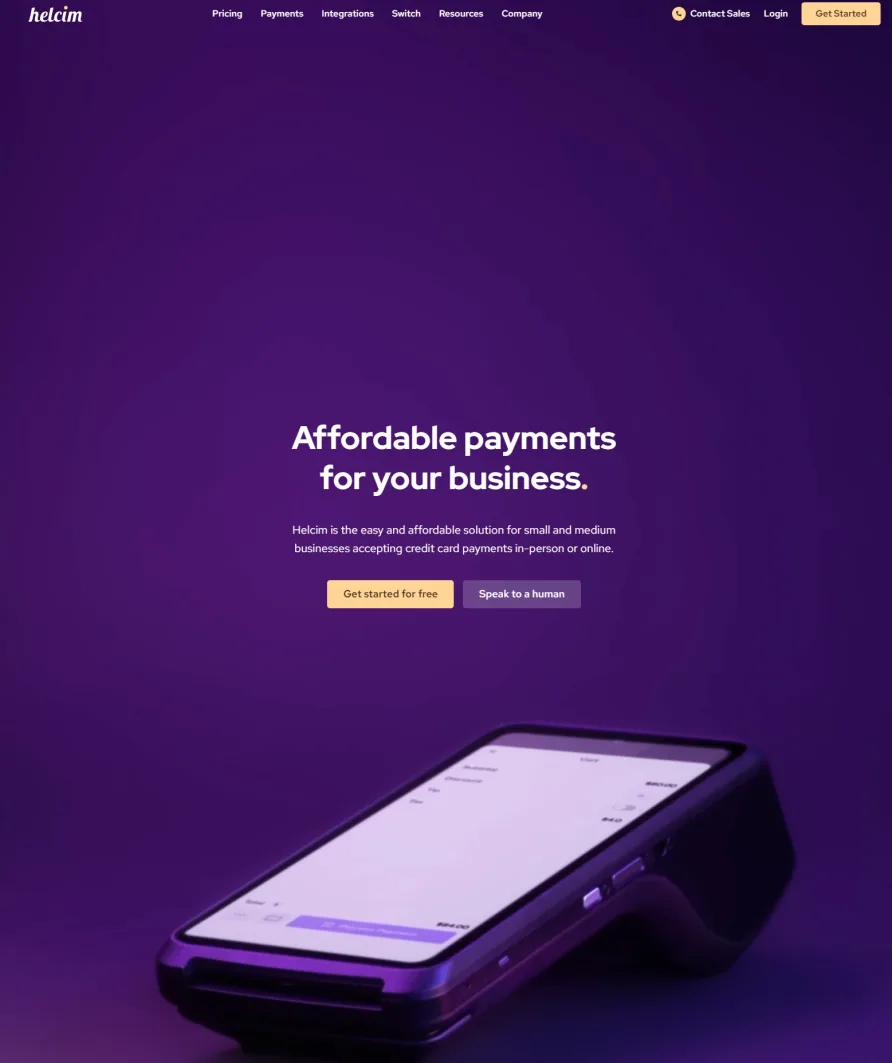
Hardware costs are straightforward but limited. The Helcim Card Reader runs $99 and connects wirelessly to any device running the Helcim POS app. The Smart Terminal, a standalone countertop device with a touchscreen, costs $349 and can also be split into monthly payments. There are no leases and no rental fees, you own the hardware outright. Tap to Pay on iPhone adds 10¢ per transaction if you prefer to skip dedicated hardware entirely. ACH transfers cost 0.5% + 25¢ for volumes under $25,000, dropping to a flat 0.5% above that threshold.
Everything Included at No Extra Cost
Where most processors charge separately for add-on tools or push you toward premium tiers, Helcim bundles its full software suite into every free account. The POS system works on any internet-connected device, tablet, phone, or desktop, and handles inventory tracking, customer profiles, order history, and employee management. The virtual terminal lets you key in credit card numbers for phone orders or manual payments from any browser. Invoicing supports one-time and recurring billing with automated payment reminders. The online store builder provides a hosted checkout page where you can list products, accept payments, and manage orders without a separate e-commerce subscription.
The CRM stores customer contact information, purchase history, and saved payment methods through Helcim’s secure card vault. This matters for businesses running subscription models or repeat-customer operations where tokenized card storage reduces checkout friction. Helcim Fraud Defender scores every transaction for risk and automatically declines those below your configured threshold. Level 2 and Level 3 interchange optimization automatically submits additional transaction data for B2B and government card purchases, which can reduce interchange fees by 0.5% to 1.5% on qualifying transactions, a feature that typically requires expensive gateway add-ons from other providers.
One tool worth special mention is Fee Saver, Helcim’s built-in surcharging feature. It lets you pass credit card processing fees to your customers when they choose to pay by card over cheaper options like debit, ACH, or cash. The system handles the compliance rules by region and card brand automatically. It’s a one-click activation. Fee Saver isn’t available in all states, Connecticut, Colorado, Maine, Massachusetts, and Oklahoma restrict surcharging, but for eligible merchants, it can effectively reduce your processing cost to zero on credit card transactions.
Who Should Process With Helcim
Consider a dental practice collecting an average of $250 per patient visit, processing 200 card payments per month across a front-desk terminal and online invoice payments. At roughly $50,000 monthly, that practice sits right at the edge of Tier 2 volume discounts. The interchange-plus model means the practice pays less when patients use standard debit cards versus premium rewards cards, and the free invoicing tool eliminates the need for a separate billing platform. The CRM tracks patient payment history, and the card vault stores payment methods for recurring treatment plans. That’s a complete payment operation with zero monthly software cost.
Helcim is built for that kind of business: professional services firms, specialty retailers, B2B wholesalers, and service-based operations processing $5,000 or more per month that want pricing transparency without sacrificing functionality. The platform serves over 800 industries according to the company, with particular strength in healthcare, legal, automotive, and professional services verticals where average order values tend to be higher and interchange-plus savings are most pronounced.
Businesses processing under $5,000 monthly may find the savings less dramatic. At very low volumes, the per-transaction fees represent a larger share of each sale, and the lack of a free hardware option means the upfront $99 to $349 investment takes longer to recoup. The interchange-plus model also introduces variability, your monthly processing cost won’t be the same predictable number each month because interchange rates fluctuate by card type and transaction method. If budgeting predictability matters more than absolute savings, that tradeoff is worth considering.
Where Helcim’s Coverage Ends
Helcim serves merchants in the United States and Canada only. If your business operates outside North America or needs to open merchant accounts in other countries, you’ll need a different provider. International card transactions from foreign cardholders are accepted but incur cross-border fees set by the card networks, not Helcim.
The hardware selection is limited to two devices. Some businesses, particularly restaurants, retail chains, or operations with complex POS requirements like kitchen display systems, tableside ordering, or integrated barcode scanning, may find the Helcim terminal ecosystem too constrained. Users who’ve reviewed the hardware note that the card reader can feel clunky for customers unfamiliar with the tap/chip/pin sequence, and the button layout has drawn complaints about accidental wrong presses. Helcim’s October 2025 POS software update and the July 2025 Smart Terminal hardware refresh addressed some of these concerns with a redesigned interface and faster processing speeds, but the form factor options remain narrow.
High-risk industries are excluded. Helcim publishes a restricted industry list, and businesses in categories like firearms, adult entertainment, CBD, gambling, and cryptocurrency won’t be approved. That’s standard across most mainstream processors, but it’s a firm boundary here.
Customer support is available by phone and email through an in-house team of non-commissioned specialists. There’s no live chat. Support hours aren’t 24/7, and some users report that ticket responses during busy periods can default to generic knowledge-base links rather than specific troubleshooting. A recurring theme in onboarding feedback is that merchants who need hands-on setup help sometimes feel undertrained going in. Once past the initial learning curve, however, ongoing support interactions tend to rate well.
Recent Platform Development
Helcim’s most significant recent launch is the Payment Extension, released in January 2026. It’s a browser add-on that lets merchants integrate Helcim’s payment processing into whatever web-based business software they already use, scheduling platforms, practice management systems, or industry-specific tools. Transaction data flows between the existing software and Helcim automatically, so invoices get marked as paid and accounting records stay synced without manual entry. At launch, the extension supports over 20 platforms, with plans to exceed 100 integrations by the end of 2026. For merchants who felt locked into a software vendor’s bundled payment processing, this creates a way out.
The company also launched a redesigned Smart Terminal in July 2025 with a larger touchscreen, faster processing, and optional mobile data connectivity for businesses operating away from Wi-Fi. An October 2025 POS update added product favorites, quick-add temporary items, line-item discounts, and improved customer profile linking.
Final Take
If your business processes enough card volume for the interchange-plus model to generate real savings over flat-rate pricing, and $5,000 per month is roughly where that inflection starts, Helcim delivers on its core promise. You get full pricing transparency, a growing platform of included tools, and automatic rate reductions as your volume increases. The rate-lock guarantee adds a layer of cost predictability that’s rare in payment processing. For professional services firms, growing retailers, and B2B operations that want to see exactly where every cent of their processing fees goes, Helcim is a strong fit. The businesses that should look elsewhere are high-risk merchants, very low-volume operations where flat-rate simplicity has more appeal, and companies needing extensive POS hardware ecosystems or international merchant accounts. That’s a clearly defined boundary, and Helcim doesn’t pretend otherwise.