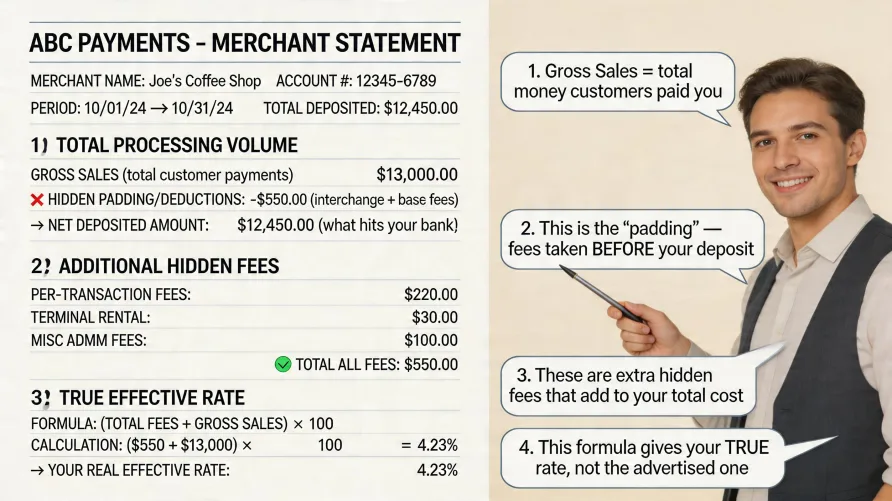
Reading a merchant statement isn't supposed to be hard, but most processors design them so you can't tell the difference between a legitimate cost and a markup. After looking at hundreds of statements over the years, I can tell you that the majority of business owners I talk with have never been walked through theirs line by line. They hand it to their bookkeeper, see the net deposit hit the bank, and move on. That's how processors get away with quiet pricing changes, padded fees, and "regulatory recovery" charges that have nothing to do with any actual regulator. This walkthrough uses a composite example built around a typical interchange-plus statement for a small services business doing about $85,000 a month in card volume. Numbers and structure are realistic. The point is to show you what each section means, what should be there, what's frequently padded, and which lines warrant a phone call to your processor. How to read the summary totals at the top Every statement opens with a top-level summary box. Gross volume, transaction count, average ticket, total fees, net funded amount. That's where I start, but I don't trust the totals on their face. The first thing I do is pull out a calculator and verify two numbers: total volume divided into total fees, and net deposit reconciled against my own batch records. Take this composite. Gross sales of $87,420.18 across 1,247 transactions, with $1,840.50 in refunds. Net sales come in at $85,579.68. The summary lists total fees at $2,178.43 and a net deposit of $83,401.25 over the month. Effective rate works out to 2.55% on net sales. That's the headline number. Whether it's reasonable depends entirely on the card mix, ticket size, and pricing model, which I'll cover further down. What should be there: gross volume, refunds, net volume, transaction count, total fees, and net funded amount. What's frequently padded: a single "service fees" or "miscellaneous fees" lump sum that hides three or four separate charges. If your statement summary shows a single fee total without a corresponding fee breakdown later in the document, that's a problem. You can't audit what you can't see. The deposit summary tells you what actually hit your bank The deposit summary lists each batch you closed, the date it was funded, and the amount that arrived in your account. For our composite, this section shows 22 daily batches across the month, with funding lagging the batch date by one business day. Most batches landed clean. Two didn't. A $4,290 batch on the 14th was funded $4,158.20 because of a same-day refund the system applied against the deposit instead of pulling it from a separate fee line. A different batch on the 22nd showed a $50 "withheld" notation tied to a chargeback investigation. Neither of these would have been visible if I'd only checked the monthly summary. Reserves, holdbacks, and adjustments also live in this section. If you're on a rolling reserve or your processor holds money against future chargebacks, those movements show up in the deposit summary, not the fee detail. Go through batch by batch the first time you read a statement carefully, then spot-check the larger ones each month after that. The deposit dates also matter. Cutoff times for batch closure determine whether a Wednesday sale funds Thursday or Friday, and a processor that consistently funds two business days late instead of one can cost a small business real working capital across a year. Funding lag isn't a fee, but it has the same effect on cash flow, and changes to funding speed often appear in the deposit summary section before they appear anywhere else on the statement. How to read interchange detail without getting fooled This is the section processors least want you to read carefully, because it's where the markup hides. Interchange is the fee paid to the card-issuing bank, set by the card networks, and published. It's a real cost. Your processor doesn't keep it. What your processor keeps is the markup added on top, and on an interchange-plus statement, that markup should be itemized separately. On a tiered or "qualified/non-qualified/mid-qualified" statement, it's blended into the rates and almost impossible to verify. In our composite, the interchange-plus pricing is 0.30% plus $0.10 per transaction over interchange. Interchange and assessments come in at $1,580.94 across the volume. The processor markup line shows $381.34: $256.74 in basis points (0.30% of net volume) plus $124.70 in per-transaction fees (1,247 transactions at $0.10 each). The math checks. If yours doesn't, that's the first call. The detail section breaks transactions down by interchange category. Visa CPS Retail. Mastercard Merit III. Discover PSL. Each category has its own rate and per-transaction fee published by the networks. A few minutes on the Visa or Mastercard interchange disclosure pages, both of which are public, will tell you what your true cost is per category. If your statement shows transactions in a higher-cost category than they should be (a card-present retail transaction billed at a card-not-present rate, for example), that's a downgrade. Downgrades are sometimes legitimate but often the result of misconfigured terminals or expired data fields. One distinction matters here: interchange and assessments aren't the same thing. Interchange is paid to the card-issuing bank. Assessments are paid to the card networks themselves, typically around 0.14% for Visa and 0.13% for Mastercard, plus a handful of small fixed fees per transaction. Most statements lump them together under "interchange and assessments," which is fine as long as the combined number is itemized separately from your processor's markup. Some processors quietly fold assessments into their markup line and present a low advertised rate. Read the totals carefully and reconcile against the published network rates. Debit cards have their own cost structure under Federal Reserve Regulation II, which caps interchange for cards issued by banks with $10 billion or more in assets. Small-bank debit isn't subject to the cap, and prepaid debit has its own rules. If your customer mix includes a high share of regulated debit transactions, the regulatory cap holds your true cost down, but those savings only flow through if your processor passes interchange through transparently. On a tiered statement, debit savings tend to disappear into the processor's qualified bucket and never reach the merchant. This is one of the strongest arguments for moving off tiered pricing if you have the option. American Express transactions often appear in their own section, separate from Visa, Mastercard, and Discover. If you signed up for OptBlue, your processor handles Amex through the same settlement, and it shows on the statement alongside the others. If you have a direct Amex merchant account, Amex bills you separately and your processor statement won't include it. Either way, when you calculate effective rate, make sure you know which volume the statement totals include and which it doesn't. Fee summary, where the padding lives Below interchange and markup sits the recurring fee section. This is where most owners stop reading and where the padding lives. A typical month for our composite shows the following: Monthly statement fee: $9.95 PCI compliance fee: $14.99 Regulatory recovery fee: $9.95 Network access fee: $5.95 Monthly minimum fee: $0.00 (volume cleared the threshold) Batch fee: $0.25 per batch, 22 batches, $5.50 total IRS 1099-K reporting fee: $2.50 Gateway fee: $25.00 (card-not-present transactions) Annual PCI fee, amortized: $7.92 That's $81.76 in recurring fees on top of the interchange-plus margin. None of it is illegal. Most of it is partially or wholly padding. "Regulatory recovery fee" doesn't recover any specific regulatory cost. "Network access fee" isn't paid to a network. "PCI compliance fee" is sometimes a real cost, but if you're paying a separate annual PCI fee and a monthly PCI fee, you're being double-billed for the same thing. Read every line in this section, every month. New line items show up here without notice, and the contract you signed almost certainly allows it under a "third-party fee pass-through" or "amendment by notice" clause. I've seen statements where a "technology enhancement fee" of $7.99 appeared in month four of a contract, with no email, no notification, and no entry in the original pricing schedule. The owner had no idea it was there until I asked. I've also seen monthly statement fees double quietly between June and July, then again between November and December, on long-term accounts where the owner had stopped reading the statement years ago. The compounding adds up. A $5 increase per month is $60 a year, and processors hold these accounts for five, eight, ten years. That's hundreds to thousands of dollars in quiet creep, and none of it is illegal. Chargeback adjustments and retrieval entries Chargebacks live in their own section, with reversal entries that pull money back out of prior batches. Our composite shows one chargeback for $145.00 plus a $25.00 chargeback fee, and one retrieval request that resolved without a chargeback but still carried a $15.00 retrieval fee. Total chargeback-related cost: $185.00. A retrieval is a card issuer asking for documentation, often before deciding whether to formalize the dispute. If you respond fast and clearly, retrievals frequently end without a chargeback. If you ignore them, they almost always become chargebacks. Some processors charge for retrievals separately from chargebacks, some bundle them, and some charge for both. Read your contract. The pull-back entries deserve specific attention. When a chargeback hits, the original sale gets reversed against a future batch, often weeks later. If the customer paid in March and disputed in April, the April deposit summary will show the reversal, not the March one. Reconciling chargebacks against original sales is a quarterly job, not a monthly one, and I'd flag any chargeback pull-back that doesn't match an identifiable original transaction. How to calculate your effective rate from your statement Effective rate is a single number that tells you what you're actually paying as a percentage of card volume. The formula is simple: Total fees ÷ Total card volume = Effective rate For our composite: $2,178.43 ÷ $85,579.68 = 2.55% That number includes interchange, assessments, processor markup, and every recurring fee on the statement. It's the only rate that matters. Quoted rates of "1.5% and ten cents" are meaningless without the rest of the math. What's a reasonable effective rate? It depends on three things: card-present versus card-not-present mix, average ticket size, and card type distribution. A retail business with mostly debit and basic credit cards on card-present transactions can run an effective rate of 1.8% to 2.2%. A card-not-present business taking primarily rewards and corporate cards can easily land at 2.8% to 3.4% before any markup question even comes up. A B2B business invoicing corporate cards on Level II or Level III data with proper enhanced data submission should be lower than either. The composite at 2.55% sits in a normal range for a mixed card-present and card-not-present services business. If yours is materially higher and your card mix is similar, the markup is likely the answer. The lines that should trigger a phone call A few patterns in a statement consistently warrant a direct conversation with your processor or your account manager: A new line item appears that wasn't in the original pricing schedule. The total of recurring fees increased without notice, and your contract terms, end date, or rate plan changed without your written agreement. Effective rate creeps up over consecutive months while volume and card mix stay flat. Quiet rate increases of 5 to 25 basis points show up regularly on long-term accounts. Interchange categories shift toward higher-cost categories, which suggests downgrades from terminal misconfiguration or expired chip data, both of which are fixable. Chargeback or retrieval fees appear without a corresponding sale you can identify in your records. A "regulatory" or "compliance" fee shows up with vague language and no third-party pass-through documentation. Ask for the source. A legitimate pass-through has an invoice or a network bulletin behind it. A padded fee doesn't. Keep three months of statements side by side once a quarter. The patterns show up in comparison, not in isolation. What to do with what you find Once you've read your statement carefully, the next step is a real conversation with your processor, not an angry one. I've found that account managers will often correct padded fees if you ask specifically and reference the line item by name. "I'd like the regulatory recovery fee removed" is a different conversation from "your fees are too high." Specificity moves the needle. If the answer is no and you've been on the same processor for more than two years, the math probably favors a competitive bid. The U.S. small business card processing market is competitive, and processors hold customers because the pain of switching feels higher than the pain of staying. Read the statement, do the math, and then decide. For an overview of providers in this market, our credit card processing rankings cover the larger options operating in the U.S. small business segment.
Reading a Merchant Statement: A Line-by-Line Walkthrough