
How SMB Global Serves the High-Risk Market
For businesses that have been turned away by every mainstream payment processor, the search for a reliable merchant account can feel like hitting a wall. SMB Global is a high-risk credit card processing provider built specifically for that situation, offering offshore merchant accounts and domestic high-risk processing through a network of 20+ banking relationships. We score SMB Global 6.5 out of 10 for the credit card processing category, recognizing its deep specialization in an underserved market while acknowledging the trade-offs that come with opaque pricing and a very lean operation.
Founded in 2016 and headquartered in South Jordan, Utah, SMB Global Payments LLC is a privately held company with a small team. The company isn't a direct processor. Instead, it acts as an intermediary that matches high-risk merchants with acquiring banks from its portfolio of domestic and international banking partners. That positioning gives SMB Global flexibility that most processors don't have: if one bank declines your application, the company can reroute it to another partner with different risk tolerances. SMB Global lists TSYS, Nuvei, and Nexio among its processing partners and holds PCI DSS certification, which provides a baseline of security credibility for the transactions flowing through its platform.
The company serves a wide range of high-risk verticals, including travel agencies, e-cigarette and tobacco sellers, nutraceuticals and supplement companies, CBD merchants, debt consolidation firms, auto transport businesses, and furniture retailers. If your business falls into a category that traditional processors routinely reject, SMB Global positions itself as a provider that will at least hear you out and work to find a banking relationship that fits.
Offshore Credit Card Processing and International Accounts
The offshore merchant account offering is where SMB Global stands apart most clearly. For businesses selling products that are legal but unregulated or semi-regulated in the United States, an offshore account through a bank in a jurisdiction with different underwriting standards can be the difference between processing payments and shutting down. SMB Global's offshore accounts support multi-currency processing with dynamic currency conversion, allowing your customers to pay in their local currency while you receive funds in yours. This matters for international eCommerce operations where cart abandonment spikes when customers see prices in an unfamiliar currency.
There's a meaningful barrier to entry, though. SMB Global requires a minimum of $50,000 per month in credit card processing volume, or a strong financial history, to qualify for an offshore account. That threshold prices out many early-stage businesses and solopreneurs who might otherwise benefit from offshore processing. If you're a startup with limited processing history, you'll likely need to build volume through a domestic high-risk account first before qualifying for the offshore option.
Offshore accounts through SMB Global also come with relaxed processing volume caps compared to domestic accounts, which is a practical advantage for businesses experiencing rapid growth. A nutraceuticals company scaling its direct-to-consumer channel, for example, won't hit the same volume ceilings that often trigger holds and freezes with domestic processors. SMB Global promotes this flexibility prominently on its site, and published merchant testimonials describe unlimited processing as a factor that removed growth constraints. That said, terms vary by bank partner, so you should confirm any volume caps, rolling reserve mechanics, and hold triggers in writing before migrating your processing.
Chargeback Prevention and Fraud Tools
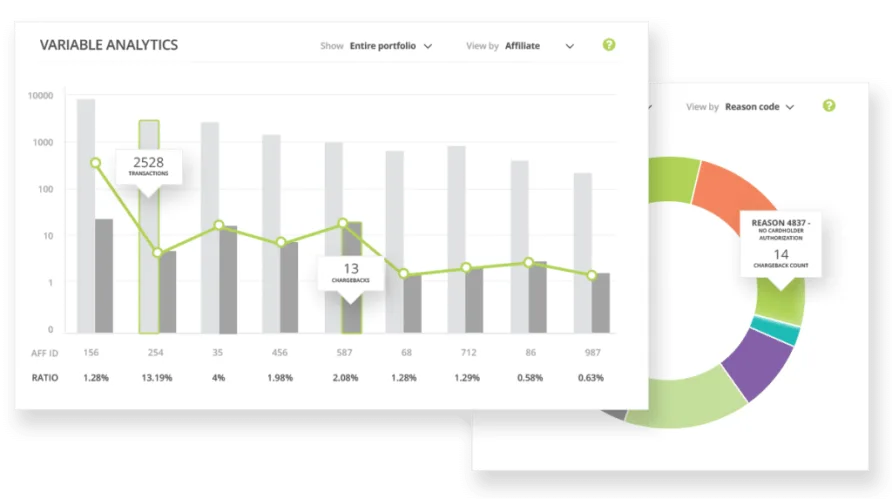
Chargebacks are the existential threat for high-risk merchants. Excessive chargebacks don't just cost money per dispute; they can get your merchant account terminated entirely. SMB Global includes a chargeback prevention suite that monitors your account in real time, using predictive algorithms to forecast month-end chargeback ratios before they become a problem.
The suite includes several components that work together. Real-time analytics display your chargeback counts and ratios as they happen, not days after the fact. An automated representment system handles the paperwork of disputing chargebacks, matching chargeback notifications with their original orders through a CRM-processor integration. You can drill down into chargeback data by reason code, subscription cycle, price point, product SKU, and geographic region. For a business running recurring billing across multiple product lines, that granularity helps pinpoint exactly which offers or billing cycles are generating the most disputes.
The fraud monitoring tools layer on top of the chargeback system, flagging potentially fraudulent transactions before they complete. SMB Global describes a negative database for identifying friendly fraud, which is the increasingly common scenario where a legitimate customer disputes a charge they actually authorized. This is a real concern for high-risk merchants. Friendly fraud accounts for a significant share of chargebacks in industries like nutraceuticals and subscription services.
Gateway Options and Shopping Cart Integrations
SMB Global offers three gateway options: NMI (Network Merchants Inc.), Authorize.net, and USA ePay. Each serves a different need. NMI's load-balancing feature lets you manage multiple merchant accounts through a single gateway, automatically routing transactions to specific accounts based on rules you set. That's useful if you're running multiple brands or need to distribute volume across accounts to stay within individual bank limits. Authorize.net is the more broadly compatible option with the largest library of pre-built integrations. USA ePay rounds out the selection as a widely adopted alternative that works with most major processors.
Across all three gateways, SMB Global advertises 175+ shopping cart integrations for eCommerce merchants. The company also provides developer-friendly APIs for businesses that need custom payment flows. For retail operations, SMB Global offers free EMV-compliant countertop terminals and mobile readers to qualifying merchants, though details on what qualifies aren't published.
One area where the gateway experience could improve is documentation. The integration portal links directly to NMI's own developer resources rather than providing SMB Global-branded guides or setup walkthroughs tailored to high-risk use cases. If you're a merchant with limited technical resources, you may find yourself navigating generic gateway documentation without much guidance on the high-risk-specific configurations that matter for your account setup.
What SMB Global Costs (and What It Won't Tell You)
Pricing is SMB Global's biggest blind spot for prospective merchants. The company publishes no rates, no fee schedules, no tier structures, and no example pricing on its website. Everything is quote-based after you submit a 15-minute application. This isn't unusual for high-risk providers, where rates genuinely vary based on industry, processing history, chargeback ratios, credit scores, and volume. But the total absence of even ballpark ranges makes it impossible to benchmark SMB Global against alternatives before you've already invested time in the application process.
High-risk merchant accounts typically carry per-transaction fees above what low-risk merchants pay through mainstream processors. Monthly account fees, PCI compliance fees, statement fees, an annual fee, and potentially a one-time setup fee are all common in this segment. ECommerce merchants will also pay a monthly gateway fee for NMI or Authorize.net access. The most significant cost factor unique to high-risk accounts is the rolling reserve, where the processor holds a percentage of your monthly processing volume as a hedge against future chargebacks. Rolling reserves aren't technically a fee, but they directly impact your cash flow.
Because SMB Global doesn't publish a rate card, any annual-cost estimate is illustrative. If a high-risk merchant's effective rate landed in the low-to-mid single digits, a $50,000-per-month card volume could translate to roughly $18,000 to $30,000 per year in processing costs before gateway fees, monthly charges, and reserve impact. A business processing $150,000 per month could see total annual costs well above $70,000 under similar assumptions. These figures aren't SMB Global-specific; they're grounded in what high-risk accounts typically involve. Your signed fee schedule is the only source of truth, so request a full breakdown of every line item before committing.
Who Should Consider SMB Global
SMB Global makes the most sense in a specific scenario: you run an eCommerce business in a high-risk or regulated industry, you've been declined by one or more domestic processors, and you need either an offshore merchant account or a domestic high-risk account from a provider that specializes in hard-to-place merchants. Think of a CBD company that has built steady monthly revenue selling compliant products online but keeps getting rejected by payment processors that won't touch the category. SMB Global's network of banking relationships gives that business multiple shots at approval rather than the single take-it-or-leave-it outcome you get from most providers.
The offshore account is the other key use case. A supplement company selling internationally from a U.S. base, facing cross-border fees on every transaction and tight domestic volume limits, could benefit from an offshore account that eliminates those fees through multi-currency processing and offers higher volume ceilings. The $50,000 monthly minimum means this option is realistic only for businesses already generating consistent revenue.
SMB Global isn't a fit for low-risk businesses, and the company acknowledges this directly by referring low-risk merchants to its partner Payline Data. It's also not ideal for businesses that need full pricing transparency before committing, or for merchants who require 24/7 phone support. If you're processing under $50,000 per month and don't need offshore capabilities, the domestic high-risk account may still be an option, but you'll want to press hard on contract terms and fee structures during the application process.
Where SMB Global Falls Short
The lack of pricing transparency is the most obvious gap. Every provider in this space uses custom pricing to some degree, but many at least publish starting rates or typical fee ranges. SMB Global gives you nothing to work with before you apply. That puts prospective merchants at a disadvantage during negotiations because you have no anchor point for what's reasonable.
The company's size is a practical consideration. SMB Global is a privately held operation with a small team, no external funding, and limited operational history compared to providers that have been placing high-risk merchants for decades. Because the company publishes limited operational data, merchants should validate reliability during onboarding: confirm funding timelines, reserve terms, early termination conditions, and escalation paths in writing before signing. Published merchant testimonials praise the company's responsiveness and approval speed, but the overall volume of verifiable merchant experiences remains thin.
Support coverage is another limitation. Phone and email are the only listed contact channels, and SMB Global doesn't advertise 24/7 availability. For merchants processing internationally across time zones, that could mean delays in resolving urgent issues outside of U.S. business hours. There's no live chat option on the website, either.
SMB Global has expanded its blog content in recent months with posts covering topics like automated underwriting and chargeback prevention strategies, signaling continued investment in its online presence. The company still lacks the product development transparency that larger providers offer through public changelogs or feature announcements, so there's limited visibility into what's actively being built or improved behind the scenes.
Our Verdict on SMB Global
SMB Global occupies a very specific niche in the credit card processing market, and it fills that niche competently. If you're a high-risk merchant who needs offshore processing capabilities or has been rejected elsewhere, the company's network of banking relationships and willingness to work with hard-to-place businesses has real value. The chargeback prevention tools add a layer of account protection that's especially important for merchants in dispute-heavy industries. For the right business at the right stage, SMB Global solves a problem that few other providers are willing to touch.
The caveats are real, though. You're working with a small, privately funded company that won't tell you what anything costs until after you've applied. The volume of publicly available merchant feedback is limited, which means your own due diligence during the application and contract review process carries more weight than usual. And you won't have 24/7 support if something goes wrong at 2 a.m. on a Saturday. If those trade-offs are acceptable given your alternatives, SMB Global deserves a conversation. If they aren't, you'll need to look at larger high-risk specialists that offer more upfront transparency, even if they're harder to get approved through.