
Cross-Border Payments Built for Global Commerce
If your business earns revenue from international clients, overseas marketplaces, or freelance platforms, you already know that moving money across borders isn't simple. Payoneer has spent nearly two decades building a financial platform designed specifically for this problem, and it does that core job well. We score Payoneer 6.9 out of 10 in the credit card processing category, though it's important to understand upfront that this isn't a traditional payment processor. You won't find point-of-sale hardware or domestic checkout tools here. What you will find is one of the most established cross-border payment networks available to small and mid-size businesses operating internationally.
Payoneer was founded in 2005 and is headquartered in New York City. The company trades publicly on NASDAQ under the ticker PAYO and crossed $1 billion in annual revenue in 2025. It serves nearly 2 million active customers across more than 190 countries and processes over $80 billion in annual transaction volume. In January 2026, Payoneer acquired Boundless, an Ireland-based Employer of Record platform, deepening its workforce management capabilities alongside its 2024 acquisition of Skuad.
How Payoneer Handles International Credit Card Processing
Payoneer's approach to credit card processing works differently than what most U.S. business owners expect. There's no merchant account, no terminal, and no gateway integration for your website in the traditional sense. Instead, the platform uses a payment request model. You send your client an invoice or payment request through Payoneer, and they can pay via credit card, ACH bank debit, or local bank transfer. The funds land in your Payoneer account, and you withdraw them to your local bank when you're ready.
Credit card payments carry a fee of up to 3.99% of the transaction amount, with an additional fixed fee of $0.49 in certain countries. That rate isn't competitive by traditional processing standards, where rates typically fall between 2.5% and 3.0% for card-not-present transactions. But Payoneer isn't trying to compete on domestic card processing. The value proposition is that your client in Germany, Japan, or Brazil can pay you by credit card without either party dealing with international wire fees or multi-day SWIFT transfers.
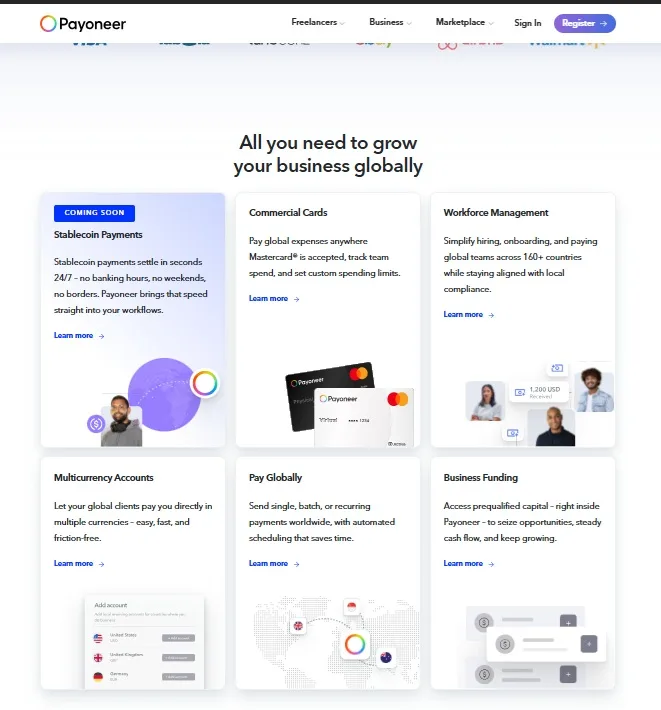
The real engine behind the platform is multi-currency receiving accounts. Payoneer gives you local bank details in USD, EUR, GBP, AUD, CAD, JPY, and other currencies, so your international clients or marketplace platforms can pay you as if you were a local vendor. This eliminates the friction and cost of international wire transfers entirely for marketplace payouts. Users who primarily receive payouts from platforms like Amazon, Upwork, Fiverr, or Airbnb typically pay no receiving fee at all.
What Payoneer Costs in Practice
Payoneer doesn't charge a monthly subscription, which immediately distinguishes it from most traditional credit card processors. There's no setup fee, no gateway fee, and no minimum transaction requirement. The cost structure is entirely transaction-based, but it has more layers than a simple per-swipe rate.
Credit card payment requests cost up to 3.99%. ACH and eCheck payments cost about 1%. Bank withdrawals in the same currency as your Payoneer balance carry a flat $1.50 fee, but once your cumulative monthly withdrawals and payments exceed $50,000, the rate shifts to 0.5% per transaction for the remainder of that calendar month. Withdrawals that require currency conversion include a markup of 0.5% to 2% above the mid-market exchange rate, depending on the currency pair and your transaction volume. Payoneer-to-Payoneer transfers to recipients in the same country cost a flat fee of up to $4.00 in USD, EUR, or GBP, while cross-border transfers between Payoneer accounts cost up to 1% of the amount with a minimum of $4.00. There's also a $29.95 annual account fee, though it's waived if you receive at least $2,000 (some accounts set the threshold at $6,000) in payments over any 12-month period. The annual account fee is easy to overlook because it's threshold-based. If your income fluctuates seasonally or you go through a slow period, you could dip below the receipt threshold without realizing it and trigger the $29.95 charge. Confirm your account's specific threshold and track your receipts against it.
To put that in annual terms: a freelance designer receiving $5,000 per month from two international clients via credit card would pay roughly $2,394 per year in processing fees at the 3.99% rate. That same designer receiving payments via ACH or local bank transfer would pay closer to $600 per year. The fee gap is substantial, so Payoneer works best when you can steer clients toward bank-based payment methods rather than cards.
For a team of five freelancers each receiving $3,000 monthly from overseas marketplace payouts, the cost picture changes considerably. Marketplace payouts are generally free to receive, and bank withdrawals in the same currency cost just $1.50 each. That team's annual Payoneer cost would be roughly $90 in withdrawal fees alone, assuming no currency conversion. Add currency conversion at 0.5% on $180,000 in annual volume, and total costs rise to approximately $990. That's a fraction of what traditional international wire transfers would cost.
The Currency Conversion Layer
Currency conversion deserves separate attention because it's where costs can quietly accumulate. Payoneer builds its conversion fee into the exchange rate rather than displaying it as a separate line item. The standard markup sits around 0.5% for common pairs like USD-EUR, but it can climb to 2% or higher for less common currencies. You won't see a "fee" label on the conversion; you'll simply notice that the rate offered is slightly less favorable than what you'd find on a currency exchange site. For businesses moving $10,000 or more per month across currencies, negotiating directly with Payoneer's account management team can reduce this markup.
Where Payoneer Fits Your Business
Consider an e-commerce seller based in the U.S. who sells on Amazon's European marketplaces. Each month, Amazon pays out in EUR and GBP. Without Payoneer, those funds would either sit in Amazon's system or route through expensive international wires to a U.S. bank. With Payoneer's local receiving accounts, the seller collects EUR and GBP as if they had European bank accounts, then converts and withdraws to their U.S. bank at a 0.5% markup. That's a meaningful saving over the 3-4% that traditional banks charge on international incoming wires.
Now consider a marketing agency in the U.S. that invoices clients in the UK and Australia. Those clients pay Payoneer via local bank transfer or ACH, paying 1% or less. The agency receives funds in GBP and AUD, holds the balances until exchange rates are favorable, then withdraws. Compare that to asking international clients to pay U.S. invoices via wire transfer, where fees on the sender's side alone can run $25-$50 per transaction.
Payoneer doesn't fit every scenario. A restaurant, retail store, or any business that needs to accept cards at a physical location won't find what they need here. There's no POS integration, no card reader, and no in-person payment capability. Businesses that primarily serve domestic U.S. customers and rarely deal in international transactions will find the platform unnecessary.
Payoneer Checkout and the Stripe Partnership
In August 2025, Payoneer announced a strategic partnership with Stripe to expand its Checkout offering for cross-border merchants selling direct-to-consumer through their own online stores. The upgraded Payoneer Checkout, powered by Stripe's technology, adds support for Buy Now Pay Later options like Affirm and Klarna, plus digital wallets including Apple Pay and Google Pay. The initial rollout targets the Asia-Pacific region, with China and Hong Kong as launch markets.
Since launching Payoneer Checkout in 2022, the company scaled the product from zero to nearly $1 billion in annual run-rate volume, generating $30 million in revenue in the twelve months ending June 2025. That's over 100% year-over-year revenue growth for the Checkout product specifically. The Stripe partnership signals that Payoneer is serious about expanding beyond its traditional marketplace payout and B2B payment roots into direct-to-consumer payment acceptance, though U.S. availability of the enhanced Checkout hasn't been confirmed yet.
The Dashboard and Mobile Experience
Payoneer's web dashboard organizes your balances by currency, showing each receiving account alongside its transaction history and available balance. The layout is clean enough, though first-time users may find the distinction between "receiving accounts" and "balances" confusing. Your receiving accounts are the local bank details you share with clients and platforms; your balances are the actual funds available to withdraw or spend. The terminology overlaps in places, and the dashboard doesn't always make it obvious which screen you need for a given task.
The mobile app, available on iOS and Android, covers the core workflows well: checking balances, viewing transaction history, initiating withdrawals, and making payments. Push notifications for incoming payments and completed withdrawals are particularly useful if you're managing cross-border finances across multiple time zones. The app doesn't replicate every desktop function, though. Administrative tasks like document uploads for verification still push you back to the web interface, and some account settings aren't accessible on mobile at all.
Security and Compliance Infrastructure
Payoneer holds licenses and regulatory authorizations in multiple jurisdictions, including the U.S. (registered Money Services Business with FinCEN), the EU, UK, Australia, Japan, Hong Kong, and as of early 2025, China. PCI DSS compliance covers card data handling. Two-factor authentication is standard on all accounts. The platform also maintains AML (Anti-Money Laundering) and CTF (Counter-Terrorism Financing) compliance programs, which is part of why account verification can feel intensive.
In December 2025, Payoneer partnered with Oscilar to integrate AI-powered fraud detection and risk intelligence into its core payment systems. The integration targets real-time fraud pattern detection and adaptive risk controls. For businesses, this means fewer fraudulent transactions getting through, but it can also mean occasional legitimate transactions getting flagged for manual review.
Customer Support: The Persistent Weak Spot
Support is Payoneer's weakest operational layer. The platform offers email, live chat, and phone support, with live chat and phone available only after signing in. Coverage spans over 20 languages, which is impressive for a global platform. The knowledge base and FAQ section are thorough and handle routine questions well.
The real concern isn't day-to-day questions. It's the edge cases: account reviews, verification holds, and payout delays. Payoneer's compliance obligations under international financial regulations require periodic account reviews, and the platform doesn't communicate timelines or status clearly during those reviews. Funds can sit inaccessible for weeks while the review process plays out, and reaching an agent with the authority to resolve the issue can require multiple contacts across different channels. We found that the verification workflow itself sometimes produces contradictory document requests depending on which agent handles the case, which resets the process unnecessarily. If your business depends on predictable cash flow, you should confirm escalation paths for compliance-related holds before relying on Payoneer as your sole payout channel, and maintain a backup payment method for time-sensitive periods.
The Gaps to Be Aware Of
Payoneer doesn't provide traditional credit card processing for domestic transactions. You can't accept card payments at a physical location, and you can't embed a checkout widget on your U.S.-facing website the way you would with a conventional payment gateway. The payment request model works for B2B invoicing and freelance payments but doesn't support real-time e-commerce checkout for domestic customers.
Reporting capabilities cover basic transaction history and monthly statements, but they lack the granular analytics that dedicated payment processors offer. There's no built-in revenue forecasting, no chargeback management dashboard, and no detailed interchange reporting. If you need to reconcile hundreds of daily transactions across multiple channels, you'll likely need to export data and work in a spreadsheet or accounting tool.
The payment request workflow itself has a limitation that trips up new users: Payoneer doesn't let you directly bill customers. You send a request, and the customer decides when and how to pay. There's no recurring billing, no automatic card-on-file charging, and no subscription management. Every payment requires the payer to take action.
Our Verdict on Payoneer
Payoneer occupies a specific niche extremely well. If your business collects payments from international clients, receives marketplace payouts from global platforms, or pays contractors and suppliers across borders, the platform offers genuine value that traditional credit card processors simply don't provide. The multi-currency receiving accounts, marketplace integrations with over 2,000 platforms, and competitive currency conversion rates make cross-border payments significantly less expensive and less complicated than routing everything through traditional banking channels.
The tradeoffs center on what Payoneer isn't. It isn't a replacement for a domestic credit card processor. Credit card acceptance at 3.99% is expensive by industry standards, and the payment request model doesn't support real-time checkout or in-person transactions. Customer support remains a genuine concern, particularly around account reviews and fund accessibility. For businesses that need reliable, global payment rails and can live without domestic card processing features, Payoneer delivers. For businesses looking for an all-in-one payment solution that covers both domestic and international transactions, this isn't it.