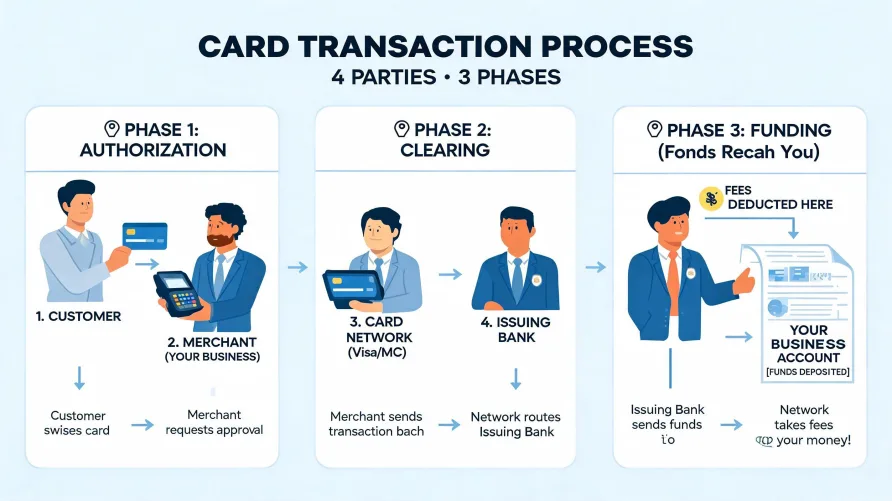
Credit card processing works through a coordinated exchange between four parties and two networks that authorize, clear, and settle every transaction in seconds. When a customer taps, dips, or swipes a card at your business, the payment doesn't move directly from their bank account to yours. It passes through a series of intermediaries, each performing a specific function and each taking a small cut of the sale. Understanding how credit card processing works gives you the foundation to evaluate costs, compare providers, and spot unnecessary fees hiding on your monthly statements. The system handles over 211 billion card transactions annually in the United States alone, according to the Federal Reserve's most recent Payments Study, and virtually every one follows the same sequence described below. The Four Parties Behind Every Transaction Every credit card transaction involves four distinct participants, regardless of the processor you use or the card brand your customer carries. The cardholder is the customer making the purchase. They've been issued a credit card by a financial institution and agreed to that institution's terms for repayment. From the cardholder's perspective, the transaction feels instant. Behind it, four organizations are coordinating in real time. The merchant is your business. You've signed an agreement with a payment processor or acquiring bank that allows you to accept card payments. That agreement spells out your processing rates, fee structures, and the terms under which funds get deposited into your account. Your obligations under that agreement include maintaining PCI DSS compliance, honoring valid cardholder disputes, and following the card networks' rules for accepting transactions. The issuing bank (sometimes called the issuer) is the financial institution that issued the customer's credit card. When a customer pays with a card from their bank, that bank is the issuer. The issuing bank carries the lending risk because it's extending credit to the cardholder and guaranteeing payment to the merchant's side of the chain. If the cardholder never pays their bill, the issuing bank absorbs the loss, not you. The acquiring bank (also called the acquirer) is the financial institution that maintains your merchant account. It receives the transaction data from your payment terminal or gateway, routes it through the card network, and ultimately deposits funds into your business bank account after settlement. Many businesses don't interact with the acquiring bank directly. Instead, they work with a payment processor that acts as an intermediary to the acquirer, handling everything from terminal setup to statement generation. Where Card Networks Fit In Card networks are often misunderstood. They don't issue cards, they don't lend money, and they don't hold consumer accounts. They operate the infrastructure that connects issuing banks to acquiring banks across thousands of financial institutions worldwide. Think of card networks as the highway system. The banks are the vehicles moving money, and the networks are the roads and traffic signals that make the movement possible. Every transaction that runs on a network rail follows that network's rules for data formatting, security standards, dispute resolution, and interchange pricing. The network sets the rules. The banks follow them. This distinction matters because the fees charged by card networks (called assessment fees) are separate from the fees charged by the issuing bank (interchange) and the fees charged by your processor (markup). All three show up on your statement, but they come from different sources and are controlled by different organizations. Confusing them is one of the most common mistakes business owners make when trying to reduce processing costs, because you can negotiate processor markup but you can't negotiate interchange or assessments. How Credit Card Processing Works in Three Phases A single card transaction moves through three distinct phases: authorization, clearing, and settlement. The first happens in seconds. The last can take days. Authorization Authorization is the real-time phase. When your customer presents their card, the payment terminal or online gateway collects the card data and sends an authorization request through the acquiring bank to the card network, which routes it to the issuing bank. The issuing bank checks several things in milliseconds: Does the account exist? Is the card active? Is there enough available credit? Does the transaction trigger any fraud rules? If everything passes, the issuer sends an approval code back through the same chain to your terminal. If anything fails, the issuer sends a decline code. The entire round trip typically takes under two seconds for in-person transactions, though online transactions may take slightly longer because of additional fraud screening steps. No money has actually moved yet. The issuing bank has simply placed a hold on the cardholder's available credit for the transaction amount. That hold reduces the cardholder's spending power but doesn't transfer funds. Clearing Clearing is the reconciliation phase. At the end of each business day, or at a time you configure with your processor, your payment system sends a batch of all authorized transactions to the acquiring bank. The acquirer forwards these to the card network, which sorts each transaction and routes it to the correct issuing bank. During clearing, the exact transaction amounts are confirmed and adjustments happen. If a restaurant customer added a tip after authorization, the cleared amount will differ from the authorized amount. The issuing bank validates each transaction against its authorization records and prepares to transfer funds. Transactions that don't match their original authorization may be flagged, which is why some businesses see occasional discrepancies between their batch totals and their deposit amounts. Most merchants don't see the clearing phase directly. It happens automatically between your batch submission and the arrival of funds in your account. Settlement Settlement is when money actually changes hands. The issuing bank transfers the transaction amount, minus interchange fees, to the card network. The network passes it to the acquiring bank, which deposits it into your merchant account after deducting its own processing fees. According to Federal Reserve research on U.S. payment systems, most card settlements complete within one to two business days after batching, though some processors offer next-day or same-day funding for an additional fee. The settlement timeline depends on your processor's schedule, your bank's processing windows, and whether the transaction was batched on a business day. Weekends and federal holidays can push settlement by an extra day or two, which is why businesses with tight cash flow should pay attention to their batching schedule. This is the point where your revenue becomes accessible cash. Everything before settlement is a promise. Settlement is the delivery. How Each Party Gets Paid Three separate fee layers are embedded in every credit card transaction, and understanding them is the key to reading your processing statement accurately. Interchange fees flow from the acquiring bank to the issuing bank through the card network. These are the largest component of processing cost, typically ranging from 1.5% to 3.5% of the transaction depending on card type, merchant category, and how the card was presented. A rewards credit card carries higher interchange than a basic debit card because the issuer needs to fund those reward programs. Corporate and premium cards carry higher rates still. The rates also vary by how the transaction is captured: a card physically tapped at a terminal qualifies for lower interchange than the same card number typed into an online checkout form, because in-person transactions carry lower fraud risk. Interchange rates are published by the card networks in schedules that run hundreds of pages long, and they aren't negotiable with your processor. They change on a set schedule, typically in April and October, and your processor is required to pass them through at cost if you're on an interchange-plus pricing model. Assessment fees go to the card network itself. These are smaller, usually a fraction of a percent, and cover the cost of operating the network infrastructure. Like interchange, assessment fees are fixed. Your processor passes them through. Processor markup is the only negotiable component. This is what your payment processor charges on top of interchange and assessments for handling your transactions, providing your terminal or gateway, managing your merchant account, and delivering your deposits. Markup structures vary widely. Some processors charge a flat percentage on every transaction. Others charge a per-transaction fee, and many use a combination. The pricing model your processor uses, whether interchange-plus, flat-rate, or tiered, determines how transparently you can see each of these three layers on your statement. For a typical $100 credit card sale, the total processing cost might break down roughly as $2.10 in interchange to the issuing bank, $0.14 in assessments to the card network, and $0.30 to $0.75 in processor markup. The exact split varies by card type and industry, but the proportions are consistent: the issuing bank takes the largest share because it carries the lending and fraud risk. Why the System Works This Way The credit card processing system wasn't designed by a single architect. It evolved over decades as a solution to a fundamental commercial problem: how does a merchant trust a stranger's promise to pay? Before card networks, extending credit to customers required a direct relationship. A local hardware store could run a tab for a known neighbor, but a hotel in another state had no way to verify a traveler's creditworthiness. The earliest charge card systems in the mid-twentieth century tried to solve this with proprietary merchant lists and paper-based verification, but the approach didn't scale. Card networks solved the problem by creating a standardized trust layer that works between strangers at any distance. The issuing bank vouches for the cardholder. The acquiring bank vouches for the merchant. The network enforces the rules that make the guarantee work even when the parties have never met. What started as a convenience for travelers and department store shoppers became the backbone of modern commerce, processing trillions of dollars in annual volume across millions of merchants. That architecture persists because it distributes risk effectively. The issuing bank manages consumer credit risk. The acquiring bank manages merchant risk, including chargebacks, fraud, and business failure. The network manages systemic risk through its operating rules and dispute resolution framework. No single party bears the full weight. The tradeoff is cost. Every intermediary takes a cut, and the system's complexity creates opacity that makes it harder for merchants to understand exactly what they're paying and to whom. That opacity is one reason processing costs remain a persistent frustration for small business owners, even as the underlying technology has grown faster and more reliable. The system wasn't built for transparency. It was built for trust at scale, and transparency has been slow to follow. What This Means for Your Business Knowing how the system works doesn't change what you pay today, but it changes how you evaluate what you're paying. When you can distinguish interchange from markup, you can identify which portion of your costs is fixed and which is negotiable. When you understand the authorization-clearing-settlement cycle, you can anticipate cash flow timing instead of wondering why funds don't appear the moment a card is swiped. The processing infrastructure is the same for every merchant. What varies is the processor you choose, the pricing model they offer, and how transparently they present your costs. Those are the decisions that directly affect your bottom line.
How Credit Card Processing Works