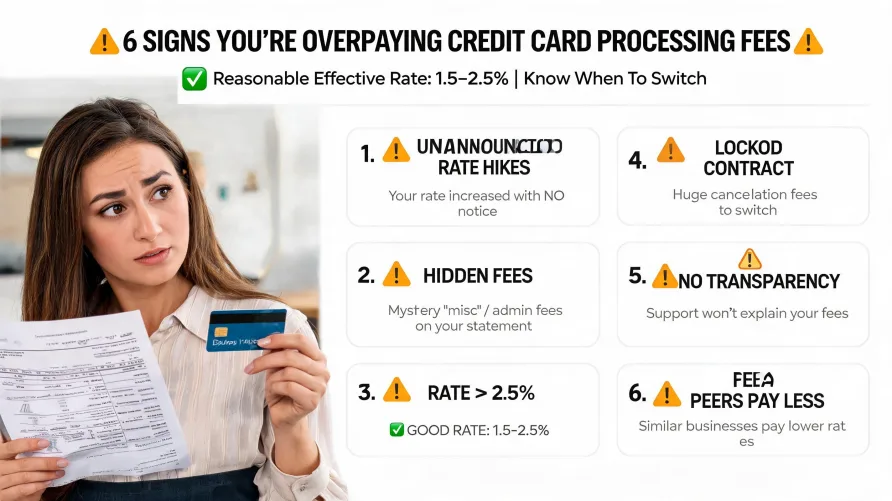
Your Effective Rate Tells the Real Story Before you can answer whether you're being overcharged on credit card processing, you need one number: your effective rate. Divide the total fees on your monthly statement by your total processing volume for that month. If you processed $40,000 and paid $1,100 in fees, your effective rate is 2.75%. That single calculation accounts for interchange, processor markups, monthly charges, PCI fees, and every other cost your processor bundles or buries. I've reviewed hundreds of merchant statements over the past twenty years, and the effective rate is the first thing I calculate every time. Most business owners have never calculated theirs. That's not an accident. Processors don't make it easy to see the total picture. Statements break charges across multiple pages, use abbreviations that don't match any published rate table, and sometimes split interchange and markup across separate line items in a way that obscures the actual cost. The effective rate cuts through all of that. It gives you one number you can compare against published benchmarks, competing quotes, and your own historical costs month over month. This article covers six warning signs that your processing costs are higher than they should be, what a reasonable effective rate looks like by business type, and when the evidence is strong enough to justify switching processors entirely. Signs You're Being Overcharged on Credit Card Processing Not every expensive statement is evidence of overcharging. Interchange rates set by Visa and Mastercard fluctuate based on card type, transaction method, and merchant category code. But certain patterns point to processor-side markups that have nothing to do with interchange, and they tend to appear together in accounts that haven't been reviewed in a while. Your effective rate exceeds benchmarks for your business type. For card-present retail businesses, an effective rate above 2.5% deserves scrutiny. For e-commerce or card-not-present transactions, that threshold sits closer to 2.9% to 3.1%, depending on your average ticket size and card mix. If your rate consistently runs above these ranges and your processor can't explain the gap with specific interchange data, the markup is likely the problem. The Nilson Report has tracked average U.S. merchant discount rates declining over the past decade, even as interchange rates have held relatively steady. Processor competition should be pushing your costs down. If that isn't happening on your statements, someone is keeping the difference. You're on tiered pricing when your volume justifies interchange-plus. Tiered pricing bundles transactions into qualified, mid-qualified, and non-qualified buckets. Your processor decides which transactions land in which bucket, and the definitions are rarely transparent. A rewards credit card might qualify at the lowest rate with one processor and get downgraded to mid-qualified with another, and you'd never know the difference without reviewing interchange data directly. For businesses processing more than $10,000 per month, interchange-plus pricing almost always results in lower total costs because you see the actual interchange rate and a fixed markup on top. If your processor has kept you on tiered pricing without ever suggesting a switch, that's a revenue decision on their end, not a service decision made in your interest. Multiple monthly fees are compounding without clear justification. A statement fee, a batch fee, a gateway fee, a monthly minimum, and a "regulatory compliance" fee can add $50 to $150 per month before a single transaction processes. Some of these are legitimate. Many aren't. Statement fees are a legacy charge from paper-statement processing. If your processor charges $10 to $15 per month for a statement you access online, that's pure margin. Monthly minimum fees were designed to protect processors from unprofitable micro-accounts, but they've become standard line items applied regardless of volume. Pull each fee out individually and ask your processor what service it pays for. The ones that can't be explained clearly are the ones padding your cost. Your rates increased without written notification. Card network rules from both Visa and Mastercard require processors to notify merchants before rate changes take effect. In practice, many processors bury notifications in fine-print addendums mailed separately from statements, or they rely on contract language that permits unilateral rate adjustments after the initial term expires. If your effective rate has crept up over 12 to 18 months and you never received a clear notice explaining why, you're likely absorbing margin increases that have nothing to do with interchange adjustments. Pull your last six statements and calculate the effective rate for each. A steady upward trend without a corresponding change in your card mix or transaction method is a red flag that shouldn't be ignored. You're being charged PCI non-compliance fees while maintaining compliance. The PCI Security Standards Council requires businesses that accept card payments to meet specific data security standards. Most processors charge a monthly PCI compliance fee of $5 to $15 to support certification. That's standard. What isn't standard is a $19.95 to $99 monthly non-compliance fee charged to merchants who have completed their Self-Assessment Questionnaire and are fully compliant. Some processors apply this fee by default and require merchants to prove compliance through a proprietary portal before removing it. Others simply never remove it. If you've completed your PCI SAQ and still see a non-compliance surcharge on your statement, you're paying for a problem that doesn't exist. Your equipment lease has outlived the hardware. Payment terminal leases are among the most expensive financing arrangements in small business. A terminal that costs $300 to purchase outright can cost $2,400 or more over a 48-month lease, and many leases include auto-renewal clauses that extend the agreement unless the merchant cancels within a narrow window, sometimes as short as 30 days. If you're still making monthly payments on a terminal that's three or more years old, you've almost certainly paid more than the device was ever worth. Older terminals may also lack support for current security standards or contactless payment methods, which means you're paying for hardware that's actively limiting how customers can pay you. What a Reasonable Effective Rate Looks Like Effective rates vary by industry, average ticket size, card-present vs. card-not-present mix, and whether your business processes a high volume of rewards cards or corporate cards. There's no single number that works universally. But there are reference ranges that should anchor your expectations. Card-present retail with an average ticket under $50 should typically see effective rates between 1.9% and 2.4%. Restaurants and quick-service businesses often land in a similar range, though tip adjustments and card-not-present delivery orders can push the number higher. E-commerce businesses processing primarily consumer credit cards should expect 2.5% to 3.0%, reflecting the higher interchange rates that card networks charge for transactions where the card isn't physically present. Businesses with high average tickets, such as contractors, furniture retailers, or specialty equipment suppliers, can sometimes negotiate below 2.0% because interchange costs on large transactions include a smaller per-transaction fixed component relative to the percentage fee. For a business processing $30,000 per month, the difference between a 2.3% effective rate and a 2.9% effective rate works out to roughly $2,160 per year. That's real money that compounds every month you don't address it. If your effective rate sits more than half a percentage point above these ranges and your card mix doesn't explain the gap, the processor markup is the most likely cause. According to Federal Reserve Payments Study data, average merchant fees per transaction have remained relatively stable in recent years. Dramatic increases on your statement are more likely processor-driven than network-driven. When the Warning Signs Add Up Any one of these signs in isolation might have an explanation. A slightly high effective rate could reflect a month with an unusual card mix. A PCI fee might be a billing error corrected with a phone call. An equipment lease might have terms you agreed to knowingly. Three or more signs appearing together tell a different story. That's the threshold I use when talking with business owners: one sign means investigate, two signs mean negotiate, and three or more mean it's time for a full audit of your processing agreement. The audit itself isn't complicated. Pull your last three monthly statements, calculate the effective rate for each, list every line-item fee, and compare your pricing model against current market options. If the numbers confirm what the warning signs suggest, you have the data to act on. When to Switch Credit Card Processors Switching isn't a decision to take lightly. There are real costs: potential early termination fees, equipment transitions, gateway migrations for online businesses, and setup time for a new account. But those costs are almost always a fraction of what you'll save over 12 to 24 months if your current arrangement is overpriced. The clearest signal that it's time to switch is when your current processor can't or won't match the pricing you've been quoted elsewhere. If you present a competing interchange-plus offer and your processor responds with vague promises or a temporary rate reduction that expires in six months, the relationship has told you what it is. A processor that values your business will put a written counteroffer in front of you. One that's banking on your inertia won't. Before making the move, read the termination clause in your current agreement carefully. Some contracts include flat early termination fees of $200 to $500. Others calculate the penalty based on remaining months multiplied by an average monthly fee, which can run significantly higher if you're early in a three-year term. Knowing this number upfront lets you factor it into a real cost comparison rather than discovering it after you've already committed to a new provider. The credit card processing market has enough competition that no business should stay locked into a relationship that consistently costs more than it should. If the warning signs are there, the math confirms them, and your processor won't adjust, the only remaining question is timing.
Warning Signs You're Being Overcharged on Processing