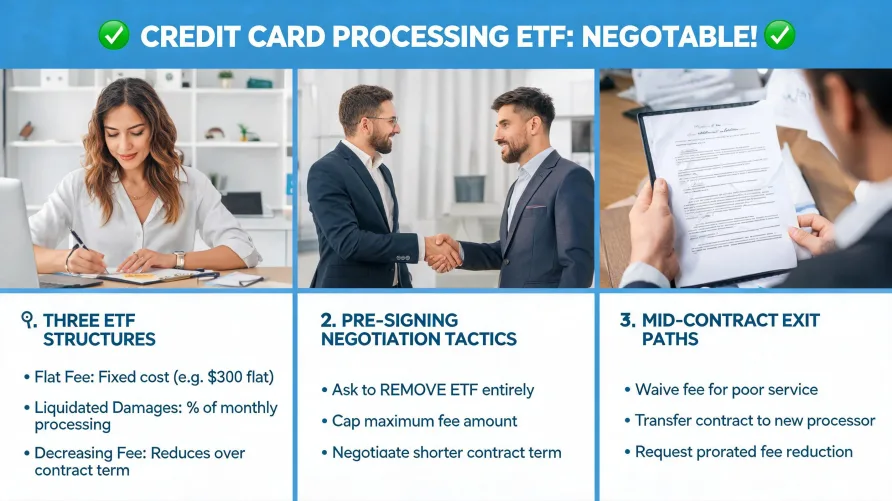
A credit card processing early termination fee is one of the most expensive surprises in merchant services, and it's also one of the most negotiable. I've reviewed processing agreements for more than two decades, and ETFs remain the single contract provision that catches business owners off guard most often. These fees typically range from $250 to $500 as a flat charge, though some contracts calculate penalties based on your estimated monthly revenue multiplied by the months remaining on your term. That formula can push the real cost well past $1,000. Whether you're about to sign a new processing agreement or already locked into one you want to leave, the tactics below can help you reduce or eliminate a fee that, in many cases, you shouldn't have to pay. What a Credit Card Processing Early Termination Fee Actually Costs Not all ETFs work the same way, and the structure of yours determines both how much you'll owe and how much room you have to negotiate. The most common version is a flat fee set at a fixed dollar amount, usually between $250 and $500, that applies regardless of when during the term you cancel. Some contracts set this figure as high as $750 or $1,000 for accounts processing higher monthly volumes. From a negotiation standpoint, the flat fee is the easiest structure to challenge or cap entirely. Liquidated damages clauses take a more aggressive and unpredictable approach to calculating what you owe. Instead of a fixed number, the contract estimates the revenue the processor would have earned over the remaining term and charges you a percentage of that amount. If your account generates $800 per month in processing fees and you have 18 months left, a liquidated damages clause could produce a penalty north of $14,000. Some contracts apply a discount factor to that calculation, but the formula still tends to produce numbers that dwarf any flat fee. I've seen liquidated damages provisions exceed $20,000 on high-volume accounts with long remaining terms. Prorated ETFs fall somewhere between those two structures and are the most transparent of the three. The penalty starts at a higher amount early in the contract and decreases as months pass, sometimes reaching zero in the final year. A three-year agreement might set the ETF at $600 in year one, $400 in year two, and $200 in year three. This structure at least acknowledges that the processor's actual loss decreases as the contract matures, and it gives you a clearer picture of your financial exposure at any point during the term. The structure shapes your strategy. Flat fees are easier to waive outright because the dollar amount is defined and modest. Liquidated damages clauses require you to challenge the formula's reasonableness under contract law. Prorated fees give you stronger negotiating room the closer you are to the end of the agreement. How to Negotiate a Credit Card Processing Early Termination Fee Out Before Signing The strongest time to eliminate an ETF is before you sign. Processors expect negotiation at this stage, and a surprising number will agree to modified terms rather than lose your account. Your best starting move is to ask for month-to-month terms. Many processors offer them but don't advertise the option upfront. A month-to-month agreement eliminates the ETF question entirely because there's no fixed term to break. You'll sometimes pay a slightly higher per-transaction rate for this flexibility, but for most small businesses processing under $30,000 per month, that tradeoff costs far less than a surprise termination penalty eighteen months later. The difference is often a few basis points on your effective rate, which might add $20 to $40 per month on a typical small-business volume. Over a year, that's $240 to $480 in extra processing costs versus a potential $500 to $5,000 termination fee. The math favors flexibility almost every time. Get the month-to-month confirmation in writing as part of the signed agreement, not as a verbal promise from a sales representative. If the processor won't agree to month-to-month, push for a shorter contract. A one-year term with a $250 flat ETF carries a fraction of the risk of a three-year agreement with liquidated damages. Shorter terms also force the processor to earn your renewal, which tends to keep rate creep in check. When you can't eliminate the ETF entirely, negotiate a cap. Even processors that insist on liquidated damages language will sometimes agree to a maximum dollar amount the fee can't exceed. A cap of $500 on what would otherwise be an open-ended formula gives you a defined worst case. That number belongs in the signed contract itself, not in an email or side conversation. Three contract provisions worth requesting before you sign: an ETF cap or waiver written into the agreement, a clause allowing penalty-free cancellation if the processor raises your rates beyond a stated threshold, and a 30-day written-notice cancellation window that doesn't trigger the ETF after the initial term expires. These aren't unusual asks. Processors grant them regularly for accounts they want to win. How to Escape a Credit Card Processing Early Termination Fee Mid-Contract Already locked into an agreement with an ETF you didn't negotiate out? Your options are narrower than they would have been at the signing stage, but several paths still exist. Start by checking your agreement for a material breach provision, which most processing contracts include. These clauses allow either party to terminate without penalty if the other side fails to meet its contractual obligations. If your processor has raised your rates without proper notice, failed to deliver services outlined in the agreement, or changed fee structures outside the contract terms, that may constitute a breach. Document the issue in writing and reference the specific contract section. A formal letter citing material breach often prompts the processor to waive the fee rather than risk a legal dispute. Rate increases you didn't agree to are the most common mid-contract exit path available to merchants. Many agreements include language allowing you to cancel without penalty within a set window, often 30 to 90 days, after a rate increase takes effect. Processors don't always highlight this provision, and rate changes sometimes appear buried in monthly statements rather than communicated directly. Review your statements each month for any fee adjustments, then check the corresponding contract language. If the increase triggers a cancellation window, you have a clean exit. Your new processor may also help offset the cost of leaving. Some processors offer account credits, signing bonuses, or direct ETF reimbursement as part of their merchant acquisition programs. This isn't charity on their part, it's a customer acquisition cost they've already budgeted for. Ask any prospective processor whether they offer ETF buyout or reimbursement, and get the specific terms in writing before you cancel your existing account. One approach that doesn't work: closing your bank account or simply stopping card acceptance and hoping the processor writes it off. That's a mistake. Unpaid ETFs routinely go to collections, and some contracts include provisions allowing the processor to recover the fee from your processing reserves or withhold final settlement funds. A clean exit protects your business credit and eliminates ongoing liability. When Early Termination Fees Aren't Legally Enforceable Not every ETF will hold up if challenged. Courts across multiple states have examined termination fee provisions in merchant services agreements, and several patterns make these clauses vulnerable. Liquidated damages must bear a reasonable relationship to the processor's actual anticipated loss. Under the Uniform Commercial Code, which governs commercial contracts in every U.S. state, a liquidated damages clause that functions as a penalty rather than a genuine pre-estimate of harm is void. Section 2-718 of the UCC specifically requires that liquidated damages be reasonable in light of the anticipated or actual harm caused by the breach. If a processor charges $10,000 to terminate an account that generated $200 per month in processing fees, the math doesn't support the claim, and no court is likely to enforce that figure. Courts have struck down disproportionate termination penalties in commercial service contracts on exactly this basis, particularly when the contract offered no opportunity for the merchant to negotiate the amount. The burden of proving reasonableness typically falls on the party seeking to enforce the clause, which means the processor, not you, has to justify the number. Auto-renewal provisions in processing contracts create another potential opening for merchants. Many processing agreements include automatic renewal clauses that extend the contract for additional years unless you cancel within a narrow notification window, sometimes as short as 30 days. Several states now regulate automatic renewal terms in commercial contracts, requiring clear disclosure and conspicuous notice before the renewal date. California, New York, and Illinois have been particularly active in this area, though requirements vary by state and continue to evolve. If your processor auto-renewed your contract without meeting applicable disclosure requirements, the renewed term and its associated ETF may not be enforceable. Unconscionability offers a broader legal defense that doesn't depend on specific contract math. If the ETF clause was buried in dense legal language, presented on a take-it-or-leave-it basis with no real opportunity to negotiate, and produces a result grossly disproportionate to the processor's actual loss, a court may decline to enforce it. This argument doesn't succeed automatically, but it carries weight when combined with other issues like improper disclosure or disproportionate damages. Filing a complaint with your state attorney general's office or the FTC won't void your contract directly, but it creates a formal record. The CFPB accepts complaints related to financial service providers, and a pattern of complaints against a processor can trigger regulatory scrutiny that produces broader relief. At minimum, a formal complaint sometimes motivates the processor to settle the dispute rather than accumulate regulatory attention. Protecting Your Business on the Next Contract Every section above points to the same conclusion: your strongest position is before you sign. Once you're inside a contract with an unfavorable ETF, your options narrow and your costs rise. Read the full agreement before signing. That sounds obvious, but the majority of ETF disputes I've encountered stem from provisions the merchant never actually reviewed. Pay specific attention to the termination section, auto-renewal language, rate adjustment clauses, and any references to liquidated damages or early cancellation. Keep every version of the agreement, every rate notification, and every monthly statement. If you need to challenge an ETF later, documentation turns a verbal dispute into a contract interpretation question. That's a much stronger position to be in. The credit card processing market includes processors that offer competitive terms without long-term lock-in. Month-to-month agreements with no ETF are increasingly common, and you don't have to accept a three-year contract with liquidated damages as the price of accepting card payments. If you're evaluating processors now, our credit card processing reviews and rankings cover the contract structures and fee transparency of providers across this market.
Early Termination Fees: How to Negotiate Them Out