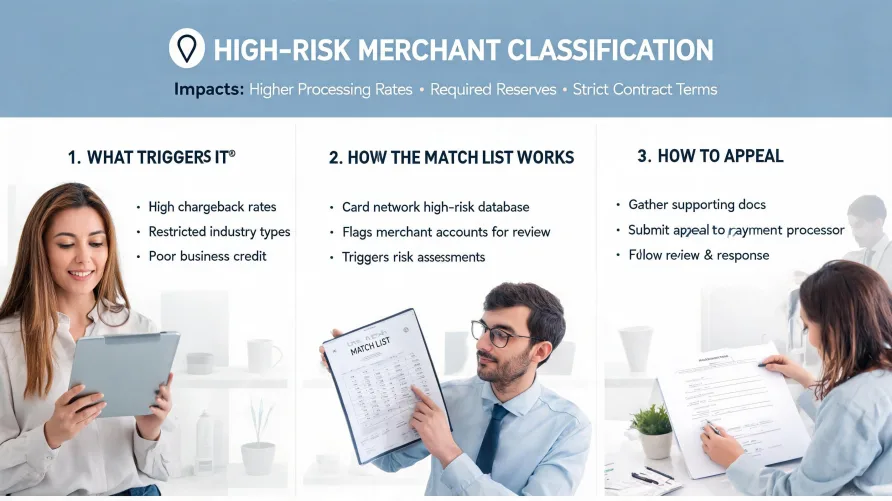
High-Risk Merchant Classification: What It Is and Why It Matters High-risk merchant classification is a designation applied by payment processors and acquiring banks to businesses they consider more likely to generate chargebacks, fraud, or regulatory complications. The label isn't a legal status or a government ruling. It's a risk assessment made by financial institutions based on industry type, transaction patterns, business history, and several other factors that directly affect how much a processor charges you and whether they'll work with you at all. Understanding what triggers this classification, and what you can do about it, is the first step toward managing the costs that come with it. What Triggers a High-Risk Merchant Classification Processors evaluate risk using a combination of factors, and no two underwriting teams weigh them identically. A few criteria appear consistently across the industry, though, and knowing them helps explain why your application may have been flagged. Chargeback ratios sit at the top of the list. Visa's dispute monitoring program flags merchants who exceed a 0.9% chargeback-to-transaction ratio or 100 chargebacks in a single month, whichever comes first. Mastercard's threshold is similar. Once you cross that line, you aren't just classified as high risk. You're placed into a formal monitoring program with escalating penalties, and your processor faces fines from the card networks for continuing to board you without intervention. Even a brief spike above the threshold can trigger consequences that persist for months after the ratio comes back down. Industry classification is the second major factor. Some businesses are considered high risk before they process a single transaction, based entirely on the type of product or service they sell. This isn't arbitrary. Industries with historically high chargeback rates, regulatory scrutiny, or reputational risk for acquiring banks get flagged during underwriting regardless of the individual business's track record. Beyond industry and chargebacks, processors also look at average ticket size (higher tickets mean higher per-dispute losses), subscription or recurring billing models (which generate more "I forgot I signed up" chargebacks), international sales volume, time in business, personal credit history of the business owner, and prior processing history. A new business with no track record, a high average ticket, and a subscription model can land a high-risk designation even in an otherwise low-risk industry. High-Risk Business List: Industries That Draw Extra Scrutiny Card networks and acquiring banks maintain internal classifications for industries that historically produce above-average risk. No single universal "high-risk business list" exists as a public document, but the patterns are well established across the processing industry. Industries commonly classified as high risk include adult entertainment, online gambling and gaming, CBD and cannabis-related products (where legal status varies by state), travel agencies and tour operators, nutraceuticals and supplements, debt collection, firearms and ammunition dealers, telemarketing operations, and tech support services. E-commerce businesses selling high-value digital goods also frequently land on the list, as do companies in the fantasy sports, dating services, and cryptocurrency exchange categories. The common thread isn't legality. Most of these businesses operate entirely within the law. The issue is chargeback frequency, regulatory complexity, or both. A travel agency selling $3,000 vacation packages faces higher per-transaction dispute exposure than a coffee shop processing $5 sales. A supplement company selling recurring subscriptions deals with both "I didn't authorize this" disputes and FTC scrutiny over product claims. Processors assign the high-risk label because these industries, as a category, cost them more in disputes and compliance overhead than standard retail or professional services. The MATCH List: What It Is and How Merchants Get Added MATCH stands for Member Alert to Control High-Risk Merchants. It's a database maintained by Mastercard (though used across all major card networks) that tracks merchants whose processing accounts have been terminated for cause. Before 2016, it was called the Terminated Merchant File, or TMF. The name changed, but the function didn't. Landing on the MATCH list is far more serious than a high-risk classification. A high-risk label means processors charge you more. A MATCH listing means most processors won't work with you at all. According to Mastercard's published standards, a merchant can be added to MATCH for any of several specific reason codes. The most common include excessive chargebacks (reason code 04), fraud conviction (reason code 01), violation of card network standards (reason code 12), and merchant collusion (reason code 02). Other codes cover identity theft, bankruptcy, and illegal transactions. Your acquiring bank is the entity that submits the listing, and they're required to do so under their network agreements when termination meets one of these criteria. Once listed, a merchant remains on MATCH for five years. That's not negotiable through the processor. The listing persists even if the underlying issue has been resolved, the business has changed ownership, or the chargeback problem was a temporary spike caused by a specific event. Five years of restricted access to payment processing can be existential for a small business. How High-Risk Classification Affects Your Processing Terms The financial impact is immediate and measurable. Transaction fees typically run 0.5% to 1.5% higher than standard merchant rates. For a business processing $50,000 per month, that's an additional $3,000 to $9,000 per year in processing costs alone. Some high-risk specialists charge even more for industries at the extreme end of the risk spectrum. Rolling reserves are the second major cost. Processors commonly hold 5% to 10% of each transaction in a reserve account for 180 days as insurance against future chargebacks or fraud losses. On $50,000 in monthly volume with a 10% reserve, you'd have roughly $30,000 locked up at any given time across six months of rolling holds. That's working capital your business can't touch. For businesses operating on thin margins, the reserve alone can create cash flow problems that are harder to manage than the higher transaction fees. Contract terms also shift under a high-risk designation. High-risk accounts often come with longer minimum commitments, early termination fees, and volume caps that trigger automatic review if exceeded. Some processors require personal guarantees from business owners, meaning you're personally liable for chargeback losses that exceed your reserve balance. Approval timelines stretch longer too. Where a low-risk merchant might be processing within 24 to 48 hours, high-risk underwriting can take one to three weeks. Why Am I a High-Risk Merchant When My Business Seems Low Risk This is one of the most common questions business owners ask after receiving a classification they didn't expect, and the answer usually comes down to factors beyond industry type. Your personal credit score matters. Processors run credit checks during underwriting, and a score below 600 raises flags regardless of what you sell. Prior account terminations show up in MATCH database checks. Even if you weren't terminated for chargebacks, any MATCH listing from a previous business venture follows you for five years. Processing history gaps create risk signals too. If you've been in business for three years but only started accepting credit cards six months ago, underwriters see an incomplete picture. High average transaction values relative to your industry norm can trigger scrutiny. So can sudden spikes in processing volume, selling in multiple currencies, or operating with a registered address in a different country than your customer base. Sometimes the classification is an error or an outdated assessment that hasn't been reviewed. Processors aren't always proactive about reclassifying merchants whose risk profile has improved. If your chargeback ratio dropped from 1.2% to 0.3% a year ago, your account might still carry the original designation unless you specifically request a review. The High-Risk Merchant Appeal Process Classification isn't permanent, and most designations can be appealed. The process requires documentation, patience, and persistence, but it's worth pursuing if your risk profile has materially improved. Start with your current processor. Request a formal account review and ask specifically what factors led to the high-risk designation. Processors are required to provide this information under most state consumer protection statutes, though the level of detail varies. Get the explanation in writing. If the classification is based on chargeback ratios, your appeal needs to demonstrate sustained improvement. Three to six months of ratios below the network thresholds (under 0.9% for Visa, under 1.0% for Mastercard) gives you a foundation to request reclassification. Document the specific changes you made: fraud screening tools implemented, customer service process improvements, clearer billing descriptors, refund policy adjustments. Processors want evidence that the improvement is structural, not a temporary dip. For industry-based classifications, the appeal path is narrower. You can't change what you sell, but you can present evidence that your specific business operates differently from the industry norm. Low chargeback history, strong fraud prevention measures, transparent billing practices, and solid financials all help make that case. Some processors will reclassify individual merchants within a high-risk industry when the data supports it, even if the industry label remains. MATCH list removal follows a different process entirely. Only the acquiring bank that submitted the listing can request removal, and they're only required to do so if the listing was made in error. If the listing was accurate at the time it was submitted, it stays for the full five years regardless of how much your business has changed since then. According to Mastercard's published standards, merchants can contact the listing acquirer to dispute the accuracy of a MATCH entry, but there's no independent appeals board or regulatory body that oversees the process. The Electronic Transactions Association has published guidance recommending that acquirers establish clear dispute procedures, though compliance with that guidance isn't mandatory. Reducing Your Risk Profile Over Time Even if you can't escape a high-risk classification immediately, specific actions can improve your terms and position you for eventual reclassification. Monitor chargeback ratios monthly, not quarterly. The card network thresholds are measured monthly, and a single bad month can undo six good ones. Implement address verification and CVV requirements for all card-not-present transactions. Use clear billing descriptors so customers recognize the charge on their statements, which remains one of the most effective ways to prevent "friendly fraud" chargebacks from confused cardholders. Build a paper trail of everything. Keep records of delivery confirmations, customer communications, refund requests and their resolutions, and any fraud screening results. This documentation serves two purposes: it helps you win individual chargeback disputes, and it gives your processor concrete evidence when you request a review. Over 12 to 18 months, a clean record with documented improvements provides strong grounds for renegotiating your rates and reserve terms. Credit card processing providers that work with high-risk merchants approach underwriting and account management differently from traditional processors, and understanding those differences is worth the research before signing a contract.
High-Risk Merchant Classification: Criteria and Appeal