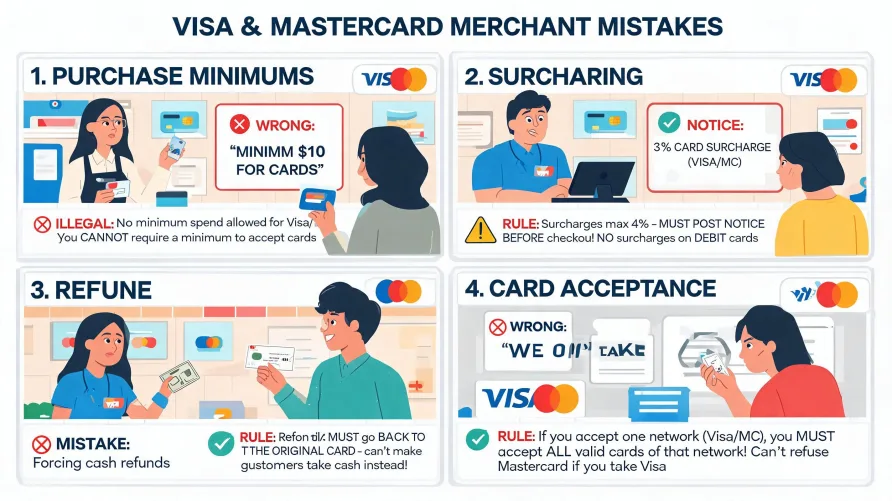
Every business that accepts credit cards agrees to follow Visa and Mastercard merchant rules, whether they've read them or not. These card network operating rules govern everything from minimum purchase amounts to how you handle refunds, and violating them can result in fines, higher processing fees, or losing the ability to accept cards entirely. Most merchants have never opened the actual rulebooks. That's a problem, because several of the most common card acceptance practices in small businesses are either prohibited or only conditionally allowed under current regulations. This guide covers the visa mastercard merchant rules that matter most to everyday business operations, using the actual published network regulations as the source. Where These Rules Come From Visa publishes its requirements in the Visa Core Rules and Visa Product and Service Rules, both updated regularly and available on Visa's public compliance site. Mastercard publishes its equivalent in the Mastercard Rules manual, also publicly accessible. These documents run hundreds of pages each and are written in dense legal and operational language, but they contain the binding terms every merchant implicitly accepts when they sign a processing agreement. Your processor or acquiring bank is the intermediary that enforces these rules. When you signed your merchant agreement, you agreed to comply with both network rules and your processor's own policies. The networks rarely contact merchants directly. Instead, they fine acquirers, who pass those fines down to you. One thing that catches merchants off guard: the rules aren't identical between Visa and Mastercard. They overlap in most areas, but specific thresholds, notification requirements, and enforcement mechanisms differ. If you accept both brands, you need to follow the stricter of the two rules for any given situation. Can You Set a Minimum Purchase Amount for Credit Cards? Yes, you can. Federal law, specifically the Dodd-Frank Wall Street Reform and Consumer Protection Act of 2010, permits merchants to set a minimum transaction amount of up to $10 for credit card purchases. Both Visa and Mastercard updated their rules to align with this provision. The distinction between credit and debit matters here. Under Regulation II (the Durbin Amendment), merchants can't impose a minimum on debit card transactions, including those processed with a PIN or through a signature-debit network. This is a federal prohibition, not a network rule, and it applies regardless of what your processor's terms say. A few states have passed their own laws restricting or clarifying minimum purchase policies, so requirements vary by jurisdiction. If you set a minimum, post clear signage at the point of sale. Both networks require that any minimum be disclosed to customers before the transaction begins. You also can't set different minimums for different card brands. If it's $10 for Visa, it's $10 for Mastercard. The Honor All Cards Rule This is one of the most misunderstood Visa merchant rules in practice. Both Visa and Mastercard require merchants to accept all valid cards within the brand they've agreed to take. If you accept Visa, you must accept all Visa cards: Visa debit, Visa prepaid, Visa credit, and Visa commercial cards. The same applies to Mastercard. You can't refuse a particular card type within the brand. A restaurant that accepts Visa credit cards but turns away Visa prepaid cards is violating the honor-all-cards obligation. This rule exists because cardholders expect consistent acceptance, and the networks enforce it to protect their brand promise. The practical impact for small businesses is significant, because prepaid cards and commercial cards often carry different interchange rates, and some merchants try to avoid them for cost reasons. The networks don't allow it. There's one narrow exception. Following class action litigation (the Merchants Payments Coalition settlement and related cases), merchants gained some ability to decline certain card types under specific conditions, but these exceptions are tightly defined and most small businesses don't qualify for them or benefit from attempting them. Can you refuse to accept credit cards entirely? Yes. No law requires a business to accept card payments at all. But once you agree to accept a network's cards through a merchant agreement, the honor-all-cards rule applies in full. Credit Card Surcharging Rules Surcharging, the practice of adding a fee to credit card transactions to offset processing costs, is permitted in most states but governed by specific card network operating rules that many merchants get wrong. Getting the details right matters, because a surcharging violation can trigger fines from your acquirer and complaints to your state attorney general's office. Visa requires merchants to register their intent to surcharge through their acquirer before they begin. The surcharge can't exceed 3% of the transaction amount, or the merchant's actual cost of acceptance, whichever is lower. Mastercard has a similar cap at 4%, though most merchants are bound by the lower Visa limit if they accept both brands. Both networks prohibit surcharging on debit card and prepaid card transactions, even when those transactions are processed through a credit network. This distinction trips up a lot of merchants, because a card that routes through a credit network isn't necessarily a credit card for surcharging purposes. As of this writing, surcharging is prohibited or restricted by law in several states. Connecticut, Massachusetts, and Puerto Rico have outright bans. Other states have passed disclosure-based surcharge laws that add requirements beyond what the networks mandate. Because state laws change, check your state attorney general's office or current state statutes before implementing a surcharge program. The rules around disclosure are strict. You must post signage at the store entrance and at the point of sale. The surcharge amount must appear as a separate line item on the receipt. And you must inform customers before the transaction is processed, not after. Burying the surcharge in the total without disclosure violates both network rules and most state consumer protection laws. Cash discounting is a different mechanism entirely and carries its own legal and network considerations. Don't assume the two are interchangeable. Refund and Return Policies Under Card Network Rules Both Visa and Mastercard require merchants to clearly disclose their refund and return policies at the point of sale. If your policy restricts refunds, limits returns to store credit, or imposes restocking fees, those terms must be visible to the customer before the transaction. This isn't just good practice. It's a contractual requirement of your merchant agreement, and failing to meet it puts you at a disadvantage in any chargeback dispute. Mastercard rules for merchants are particularly specific on this point. Mastercard requires that the refund policy appear on the transaction receipt itself. If the merchant's refund restrictions aren't printed on the receipt, Mastercard's dispute resolution process will typically side with the cardholder in a refund-related chargeback, regardless of what your in-store signage says. Credit refunds have their own timing rules. Both networks require that refunds be processed back to the original card used for the purchase. You can't issue a refund in cash or store credit when the customer paid with a card, unless your disclosed return policy explicitly states that limitation and the customer agreed to it at the time of purchase. Network rules generally require that credit refunds be processed within a set number of business days, though the exact window depends on the transaction type and your acquirer's policies. This area generates a large share of chargebacks for small businesses. A clear, printed return policy that the customer sees before paying is the single most effective protection against refund-related disputes. Receipt and Transaction Requirements Both networks have specific rules about what must appear on a transaction receipt and how transactions are processed. Some of the most commonly violated Visa merchant rules involve split transactions and receipt data, and the penalties for getting these wrong can be severe. You can't split a single purchase into multiple transactions to stay under a floor limit or avoid authorization requirements. The networks treat artificial splitting as a form of fraud. A legitimate split, where a customer pays part with a card and part with cash, is permitted, but dividing one purchase across two card transactions to circumvent authorization thresholds isn't. Your acquirer can flag patterns of split transactions in your processing history and issue warnings or fines without advance notice. Receipt requirements vary slightly between networks, but both require the merchant name, transaction amount, date, and authorization code on every receipt. Visa also requires that the last four digits of the card number appear on the cardholder's receipt copy. Full card numbers must never be printed. This aligns with PCI DSS requirements for cardholder data protection, but the card network rules impose this obligation independently of PCI compliance. Even if your business hasn't formally undergone PCI validation, you're still bound by the receipt data rules through your merchant agreement. Retain copies of transaction receipts for at least 18 months. In chargeback situations, your acquirer may request a copy of the signed receipt or transaction record as part of the representment process. If you can't produce it, you lose the dispute by default. Signage and Acceptance Mark Requirements If you accept Visa or Mastercard, you're required to display the network's acceptance marks at your point of sale and, in most cases, at your business entrance. These marks signal to customers which cards you accept, and the networks treat proper display as a condition of your merchant agreement. Most merchants get this right by default because their terminal provider includes decals and signage, but the rule is more specific than just putting a sticker on the door. You can't modify the logos or combine them with other messaging that implies limitations on acceptance. Displaying a Visa logo alongside a sign that says "Visa credit only, no Visa debit" contradicts the honor-all-cards rule and violates brand display requirements. For e-commerce merchants, both networks require that acceptance marks appear during the checkout process, typically near the payment entry fields. Online businesses have the same obligations as physical stores for card brand display. How to Actually Read the Network Rulebooks The full Visa Core Rules document is available on Visa's public business site under their rules and compliance section. Mastercard publishes its rules through the Mastercard Rules portal. Both require you to agree to terms of access, but neither charges for the download. These documents aren't written for small business owners. They target acquirers, processors, and payment facilitators. But the sections relevant to merchants are identifiable if you know where to look. Focus on the chapters covering merchant obligations, card acceptance, and point-of-sale requirements. Skip the sections on settlement mechanics and issuer obligations unless you're troubleshooting a specific dispute. The table of contents in each document is organized by topic, and searching for "merchant" within the PDF will surface the most relevant sections quickly. Reading even a few of these sections gives you an advantage over most merchants. You'll understand that these aren't suggestions or best practices. They're contractual obligations that your acquirer can enforce with financial penalties. Staying Compliant Without a Legal Team Most small businesses don't need to memorize 600 pages of card network rules. They need to get five high-impact areas right: minimum purchase policies, surcharging disclosures, refund policy signage, receipt handling, and the honor-all-cards requirement. Those five areas account for the majority of merchant-level violations that lead to fines or chargeback losses. Your processing agreement is the practical enforcement layer. Read it. If it references "network rules" or "association regulations" without defining them, that's pointing to the Visa and Mastercard documents covered here. Understanding even the basics of these visa mastercard merchant rules puts you ahead of most businesses and reduces your exposure to avoidable disputes and penalties. For a closer look at how different processors handle these requirements and which ones make compliance easier for small businesses, see our credit card processing reviews and comparisons.
Visa and Mastercard Merchant Operating Rules: What Every Merchant Should Know