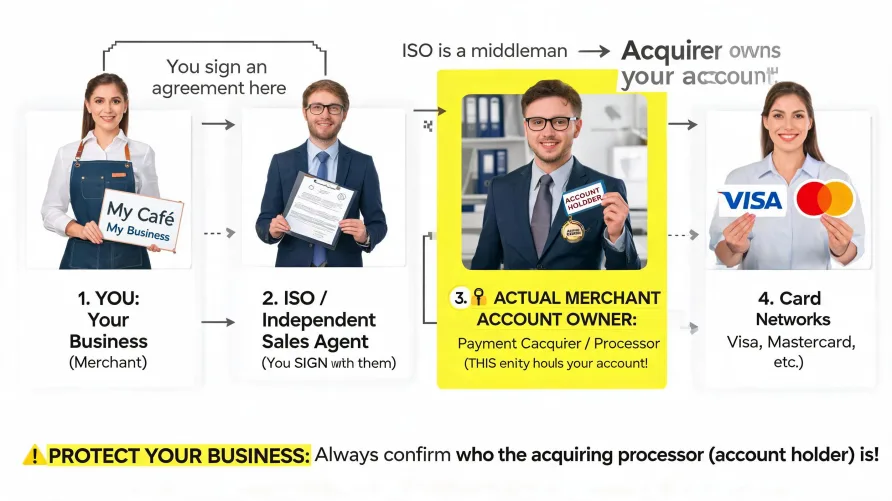
When you sign a credit card processing agreement, you might assume you're working directly with the company whose name is on the sales rep's business card. In most cases, you aren't. The iso agent merchant services model means there's often an intermediary, sometimes two, between your business and the company that actually processes your transactions. I've watched business owners discover this the hard way, usually when a dispute surfaces and they can't figure out who to call. Understanding this distribution chain isn't academic. It directly affects your pricing, your contract terms, and your options if something goes wrong. How the ISO Agent Merchant Services Model Actually Works The payment processing industry operates through a layered distribution model. At the top sits the acquiring processor, the financial institution or licensed entity that holds the direct relationship with card networks like Visa and Mastercard. Below the processor are Independent Sales Organizations, commonly called ISOs. These are registered companies authorized by card networks to resell processing services on behalf of one or more processors. Below the ISO, you'll often find individual sales agents or sub-agents, the people who actually walk into your store or call your office. Here's what this looks like in practice. A processor registers an ISO through the card networks. That ISO recruits and manages a network of merchant services sales agents who find merchants, pitch processing services, and sign contracts. The agent might present themselves as an independent consultant, a payment advisor, or even as a representative of the processor itself. The merchant signs a contract, starts processing, and may never realize that three separate entities are involved in the relationship. Federal Reserve research on payment systems has documented this intermediary structure, noting that the acquiring side of card networks involves multiple layers of service providers between the merchant and the network itself. That structure is by design. The Name on the Card Isn't Always the Name on the Contract This is where confusion starts for most business owners. A merchant services sales agent hands you a business card with their company name on it. Maybe it's a local business name, maybe it's the ISO's brand. You assume that's who you're doing business with. Then you look at your merchant processing agreement and see a completely different company name listed as the acquirer or processor of record. That disconnect isn't accidental. The agent is a reseller. The ISO is a reseller. The processor is the entity that actually moves your money. Your contractual obligations, your rate guarantees, your termination fees, and your liability provisions are governed by the processor's terms, not the agent's promises. I've reviewed processing agreements where the agent's verbal pitch included rate locks and fee caps that appeared nowhere in the signed contract. The actual agreement referenced the processor's standard terms, which included language allowing rate adjustments with 30 days' written notice. The agent's promises had no legal standing because the agent wasn't a party to the contract. What Changes With Each Layer in ISO Agent Merchant Services Each layer in the distribution chain affects your experience as a merchant in concrete ways. Pricing flexibility varies by layer. A direct processor sets its base interchange-plus rates. An ISO negotiates a spread on top of those rates, then marks them up before they reach the agent. The agent adds their own margin on top of that. By the time pricing reaches you, it has passed through two or three markup layers. This doesn't mean agent pricing is always worse. Some ISOs and agents compete aggressively on margin, and a good agent can sometimes offer better effective rates than a processor's standard direct pricing. But the structure creates more room for hidden fees and less transparency about where your money goes. Service quality depends on who you're actually dealing with. A direct processor relationship means your support calls go to the processor's team. With an ISO or agent, your first line of support is typically the agent or ISO office. If they can't resolve the issue, they escalate to the processor on your behalf. That extra step adds time and introduces the possibility that information gets lost or distorted in translation between organizations with different systems and different incentive structures. For routine questions about statements or batch timing, this works fine. For account holds, fund freezes, or chargeback disputes where days matter, that extra layer can cost you real money. Contract terms deserve the closest attention of anything in this chain. The agent may quote you a month-to-month arrangement, but the processor's terms might include a three-year commitment with an early termination fee ranging from a flat $295 to a liquidated damages calculation based on your remaining months. The contract that governs your account is the one between you and the processor, or the ISO acting as merchant acquirer under the processor's sponsorship. Verbal agreements from the agent don't override written contract terms in most states. The CFPB has received complaints from small business owners who discovered contractual obligations they weren't told about during the sales process, including equipment leases with terms longer than the processing agreement itself, PCI non-compliance fees that appear months after signing, and liquidated damages clauses that weren't part of the original conversation. These obligations can add hundreds or thousands of dollars to your effective annual processing cost if you're locked into terms you didn't knowingly agree to. How to Find Out Who Your Merchant Account Is Actually With If you already have a processing account and aren't sure who the actual processor is, there are several ways to identify them. Check your merchant processing agreement first. The first or second page should identify the "acquiring bank," "processor," or "member bank." That's the entity with the card network relationship. The ISO, if one is involved, will usually be identified separately, sometimes in the recitals section at the top of the contract. Look at your processing statements next. The company name on your monthly statement is usually the processor or the ISO, not the agent. If the name on your statement doesn't match the name of the person who sold you the account, that's your clearest sign that an intermediary is involved. Check your bank deposits. The entity name attached to your daily batch deposits often reveals the processor. It won't always match the brand name your agent used during the sale. You can also call the number on your statement and ask directly: "Are you the acquiring processor, or are you an ISO?" They're required to tell you. Ask for the name of the sponsoring bank, which is the financial institution whose banking license underpins the entire processing relationship. The card networks maintain registration programs that require ISOs to register formally, and those registrations are sometimes searchable through the network's member inquiry tools. Why This Matters When Something Goes Wrong For day-to-day processing, the layered model works well enough. Transactions clear. Deposits arrive. Most merchants don't think about who's behind the curtain until a problem forces them to. That changes fast. If your account gets held or terminated, you need to know who made that decision. Was it the agent, the ISO, or the processor? The answer determines who you contact, who has the authority to reverse the action, and what your appeal rights are. An agent can't override a processor's risk decision. An ISO might advocate on your behalf, but they don't control the processor's underwriting or risk department. Contract disputes follow the same pattern. If you're trying to cancel and the processor says you owe an early termination fee, arguing with the agent won't change anything. The agent didn't write those terms. You need to engage directly with the entity named in your agreement. The FTC's guidance on unfair business practices applies here, and state attorney general offices in many states have consumer protection divisions that handle merchant services complaints, though the specific protections and filing procedures vary by state. This also matters for PCI compliance. The PCI Security Standards Council's requirements apply to entities that store, process, or transmit cardholder data. If you don't know who your processor is, you can't verify that you're meeting the right validation requirements or reporting to the right entity during your annual compliance cycle. Protecting Yourself Before You Sign Before signing any processing agreement, ask three direct questions. First, who is the acquiring processor or sponsoring bank? Get the legal entity name, not a brand name. Second, is the person or company selling you this account an ISO, a sub-agent, or a direct representative of the processor? Third, whose terms and conditions govern this contract? Read the full agreement, not just the rate sheet the agent provides. The rate sheet is a summary. The terms and conditions document is the contract. If there's a conflict between what the agent promised verbally and what the contract says, the contract wins every time. Keep copies of everything you sign, including the application, the terms and conditions, the rate schedule, and any equipment lease agreement. If the agent makes promises about rate locks, fee caps, or cancellation flexibility, ask for those commitments in writing as an addendum to the contract, signed by someone with authority at the ISO or processor level. A verbal promise from an agent who may move to a different ISO next quarter isn't worth the paper it isn't printed on. The direct processor vs ISO distinction isn't about one model being inherently better. ISOs and agents serve a real function in the market by providing local service, customized pricing packages, and faster onboarding for many small businesses. But you need to know who you're actually signing with, because if the relationship goes sideways, that knowledge is the difference between having recourse and having a runaround.
ISO Agent vs Direct Processor: Know Who You're Actually Signing With