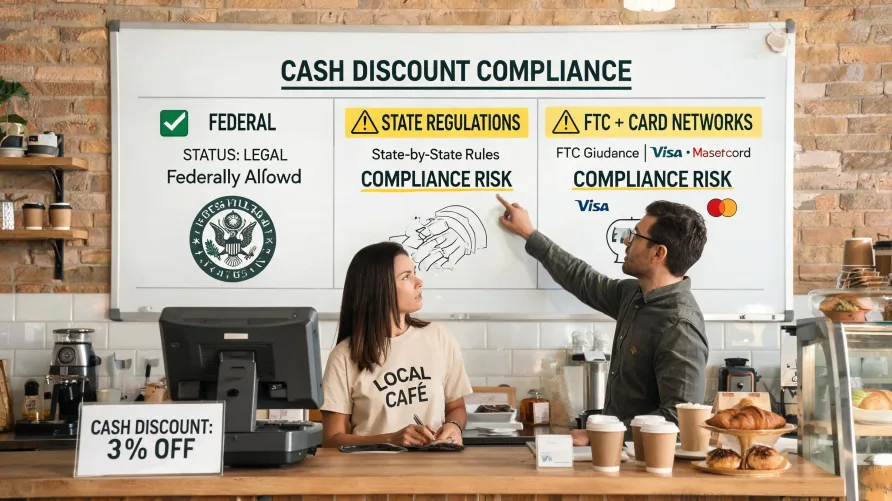
Cash Discount Programs: The Legal Nuances A cash discount program is legal under federal law, and most states permit it when properly structured. But the boundary between a lawful cash discount and an illegal surcharge is thinner than many business owners realize. Federal statutes, state regulations, card network rules, and FTC guidance all draw that line in slightly different places, even though the financial outcome for the customer is identical either way. Understanding where cash discount program legal boundaries sit means examining each regulatory layer on its own terms. What Makes a Cash Discount Program Legal Under Federal Law The federal legal foundation for cash discounts traces back to the Cash Discount Act of 1981, which amended the Truth in Lending Act. That law explicitly permitted merchants to offer discounts to customers who pay with cash, check, or debit instead of credit cards. Congress drew a clear line: offering a lower price for cash is a discount. Adding a higher price for credit is a surcharge. One is encouraged. The other was restricted. The Dodd-Frank Wall Street Reform Act of 2010 reinforced this framework through the Durbin Amendment, which addressed interchange fee regulation and confirmed that merchants could offer discounts for different payment methods. Federal law doesn't cap the size of a cash discount or limit which payment types qualify for one. What it does require is that the posted price, the one advertised and displayed to customers, must be the regular price. The discount gets applied at the point of sale as a reduction from that posted amount. That last point is where most compliance problems start. Cash Discount vs. Surcharge: Why the Legal Distinction Matters The economic outcome is identical. A $100 item with a 3% cash discount costs $97 in cash and $100 by card. A $97 item with a 3% surcharge costs $97 in cash and $100 by card. Same math. Same customer expense. The legal treatment isn't the same at all. A cash discount starts from a higher posted price and reduces it for cash customers. A surcharge starts from a lower posted price and adds a fee for card customers. The distinction rests on which price the merchant presents as the "regular" price. If the sticker price is the card price and cash customers get a reduction, that's a discount. If the sticker price is the cash price and card users pay more, that's a surcharge. This isn't just a labeling exercise. The U.S. Supreme Court examined this distinction directly in Expressions Hair Design v. Schneiderman (2017), a case challenging New York's anti-surcharge statute. The Court held that anti-surcharge laws regulate how merchants communicate prices to customers, making them speech regulations subject to First Amendment scrutiny. The ruling didn't declare surcharges universally legal, but it established that the framing of the price, not just the arithmetic, carries constitutional weight. For businesses operating a cash discount program, the practical takeaway is direct: how you present the price to customers matters as much as the price itself. A program structured around "discounting from the posted price" occupies fundamentally different legal ground than one structured around "adding a fee to the posted price," even when the customer's total is the same in both cases. State Rules and Cash Discount Compliance Federal law permits cash discounts, but states add their own regulatory layer. This is where cash discount compliance gets complicated quickly. As of this writing, most states allow properly structured cash discount programs. Several states historically banned surcharging outright, including Connecticut, Kansas, Maine, Massachusetts, New York, Oklahoma, and Texas, though enforcement actions and constitutional challenges have reshaped the picture in recent years. Some of those bans have been struck down on First Amendment grounds following the Expressions Hair Design decision. Others remain on the books but have seen reduced enforcement activity. The real issue for cash discount programs at the state level isn't whether discounts are permitted. They almost always are. The risk is that a state attorney general interprets a poorly structured cash discount program as surcharging in disguise. If a merchant posts a low "cash price" as the headline number and then adds a fee at the register for card payments, the AG's office may treat that as a surcharge regardless of what the receipt label says. Several state enforcement actions have targeted exactly this pattern, where the economic structure of the program contradicts the "discount" framing the merchant claims. The attorney general doesn't need to prove the merchant intended to surcharge. The test is whether the program functions as a surcharge from the customer's perspective, based on how prices were presented and how the transaction was processed. Merchants who rely on vendor-supplied signage or boilerplate program descriptions without verifying their state's specific requirements have been caught in this gap repeatedly. States also vary on disclosure requirements. Some require specific signage at the entrance and at the point of sale. Others mandate that receipts show the discount as a separate line item with particular language. Requirements aren't uniform across state lines, and a program that's fully compliant in one state may fall short in another. Businesses operating in multiple states face the most exposure, because a single program structure won't automatically satisfy every jurisdiction's rules. FTC Guidance on Cash Discount Pricing The Federal Trade Commission hasn't issued a standalone rule specifically governing cash discount programs. But the FTC's authority under Section 5 of the FTC Act, which prohibits unfair or deceptive acts or practices, applies directly to how merchants present pricing to consumers. The FTC's position centers on advertised price accuracy. If a merchant advertises a price, that price must be the price a customer can reasonably expect to pay using a commonly accepted payment method. Running a cash discount program where the advertised or posted price is actually a cash-only price, while card-paying customers discover a higher amount at the register, can constitute deceptive pricing under FTC standards. The Commission's enforcement history on deceptive pricing predates the modern cash discount trend, but the principles apply directly. A price that appears on a sign, a menu board, a website, or a social media ad sets the customer's expectation. If the actual card price is higher than the advertised figure without clear, upfront disclosure, the merchant has a deceptive pricing problem regardless of whether the internal program documentation calls it a "discount." The label doesn't override the customer experience. The compliant approach under FTC guidance is consistent with how federal law defines cash discounts: post the regular (higher) price as the standard price, then clearly disclose the cash discount at the point of sale. The customer should see the card price first and the discount second. Reversing that order, where the customer encounters a low advertised price and then learns the real card price is higher, creates exactly the kind of deceptive pricing the FTC has historically targeted. This matters for online advertising too. If a business promotes prices on its website or in digital ads, those prices should reflect what card-paying customers will actually pay. Advertising the cash-discounted price without clear qualification risks an FTC enforcement action or state-level consumer protection complaint. Signage, Receipt, and Disclosure Requirements Card networks impose their own rules on top of federal and state requirements, and these rules differ from surcharging requirements in important ways. Visa and Mastercard both permit cash discounts without requiring advance notification to the network. Surcharges, by contrast, require merchants to notify the card brand and their acquiring bank before implementation, follow specific fee caps (currently 3% for Visa in most cases), and display signage at both the point of entry and the register. Cash discounts carry lighter network-level requirements because they're framed as a customer benefit rather than a penalty for choosing a particular payment method. That said, networks still expect merchants to present the transaction correctly. The amount charged to the card should match the posted regular price. The discount should appear as a separate adjustment on the receipt, not as a reduction of the listed price before the transaction processes. If a merchant processes the card transaction at the lower cash price and then adds a line-item fee, the network may reclassify the arrangement as a surcharge, triggering a different set of compliance obligations entirely. Receipt requirements at the state level add another dimension. Several states require the cash discount to appear as a named line item. Others require the receipt to display both the regular price and the discounted amount. The specifics vary by jurisdiction, but the underlying principle is consistent: the customer should be able to see exactly what the discount was and how it was applied. No hidden math. Clear signage at the point of sale is a practical necessity even in states that don't explicitly mandate it. A posted notice explaining that displayed prices reflect the standard card rate and that cash payments receive a specific percentage discount reduces customer disputes and strengthens the merchant's legal position if the program is ever challenged by a regulator or in court. Dual Pricing: A More Transparent Evolution Dual pricing represents the next iteration of the cash discount concept, and it's gaining traction with merchants and regulators alike. Instead of posting a single price and applying a discount at the register, dual pricing displays two prices simultaneously: one for cash and one for card. The customer sees both before making a purchase decision. This model directly addresses the core transparency concern that regulators, card networks, and consumer advocates focus on. There's no surprise at the register. No ambiguity about which price applies. The customer makes an informed choice before the transaction begins, which neutralizes the "bait-and-switch" argument that state attorneys general have used against poorly implemented cash discount programs. From a legal standpoint, dual pricing legality generally sits on stronger ground than a traditional single-posted-price cash discount program. The FTC's deceptive pricing concerns are mitigated when both prices are clearly visible before the purchase. Card network objections lose force when the card price is prominently displayed rather than hidden behind a "regular price minus discount" calculation that happens at checkout. Dual pricing still depends on state-level rules. Some states have specific requirements about how dual prices must be displayed, including minimum font sizes, placement rules, and which price must be more prominent. A few states require the card price to be displayed at least as prominently as the cash price, preventing merchants from using the lower cash figure as the visual anchor while minimizing the card figure. The technology has caught up too. Modern point-of-sale systems can calculate and display both prices automatically at the register and on printed receipts, eliminating the compliance risk of inconsistent manual discount application. That automation doesn't remove the legal obligation to structure the program correctly, but it does reduce the operational errors that have historically turned compliant programs into enforcement targets. Where Cash Discount Programs Still Carry Legal Risk The biggest risk isn't that cash discount programs are illegal. They aren't, in most circumstances. The risk lives in execution. A program that posts the cash price as the headline and adds a fee for cards is a surcharge by another name, regardless of the label. A program that doesn't disclose the discount clearly at the point of sale may violate state consumer protection statutes. A program where the signage says one thing and the receipt shows another can trigger card network reclassification and potential fines. Third-party vendors that install cash discount programs for merchants sometimes contribute to these problems. If the vendor's system processes card transactions at the cash price and adds a line-item fee for card usage, the merchant may be running a surcharging program without realizing it. The legal liability in that scenario typically falls on the merchant, not the vendor. Businesses considering a cash discount program should verify three things before launch: that their state allows the specific program structure they're using, that their signage and receipts meet both state and network requirements, and that the posted price is the card price with the cash discount applied as a reduction from that amount. Getting the price presentation backward is the single most common compliance failure in this space. The federal legal framework supports cash discounts. Card networks permit them. Most states allow them. The compliance risk isn't in the concept. It's in how the program is built and presented to customers at the point of sale.
Cash Discount Programs: The Legal Nuances