
The Infrastructure Play Behind the Payment Button
Most payment processors want a piece of your transaction volume. Finix wants something more structural: to become the payment infrastructure underneath your business. That distinction matters if you’re a SaaS company, marketplace, or platform trying to own your payment stack rather than rent access to someone else’s. We score Finix 8.0 out of 10 in the credit card processing category, a rating that reflects real infrastructure strength and an expanding feature set, tempered by geographic limits and platform pricing that requires a sales conversation to evaluate.
Finix is best understood as two products in one. If you’re building a vertical SaaS platform or marketplace and want to own the payments layer, including onboarding, risk controls, payouts, and the economics of each transaction, the PayFac-as-a-service model is the core story. If you’re a single business processing meaningful volume, the value proposition shifts to transparent interchange-plus pricing and deeper fee visibility than flat-rate providers offer, provided the monthly subscription makes sense at your scale. Both tracks share the same underlying infrastructure; the use case determines which parts of it matter most to you.
Finix was co-founded in 2015 by Richie Serna and Sean Donovan in San Francisco. Serna, who studied government at Harvard before working in investment banking and management consulting, came to payments through a conviction that the industry’s legacy infrastructure was a ceiling for companies trying to grow. The company spent years building its technical foundation before reporting full-stack acquirer processor status in 2023, with network-level connectivity and operational ownership of key processing functions including onboarding, reconciliation, disputes, and payouts, rather than routing transactions entirely through third-party rails. Finix has raised $210 million across ten funding rounds, including a $75 million Series C in October 2024 led by Acrew Capital and co-led by Lightspeed Venture Partners and Leap Global. That round brought in Citi Ventures and Tribeca Venture Partners as new institutional investors. Per the Series C announcement, the team had approximately 118 employees at that time and the company reported closing more new deals in 2024 than in its entire prior history.
How Finix Works in Practice
At its core, Finix provides a universal payments API and a growing suite of no-code tools that let businesses accept in-person and online payments, manage payouts, and handle the full operational mechanics of processing: onboarding, reconciliation, dispute management, and detailed fee reporting. The architecture is modular, which matters when you’re deciding how much of it to use versus build yourself.
For SaaS platforms and marketplaces, the central offering is the PayFac-as-a-service model. Rather than registering independently as a payment facilitator with the card networks, a process that takes months and requires significant capital reserves, a platform can use Finix’s infrastructure to become the payment intermediary for its own customers. That means the platform can onboard merchants, configure pricing, manage risk, and capture a share of the processing economics that would otherwise flow entirely to a processor. Finix handles the compliance layer behind the scenes, including automated underwriting, PCI compliance tooling, and fraud prevention.
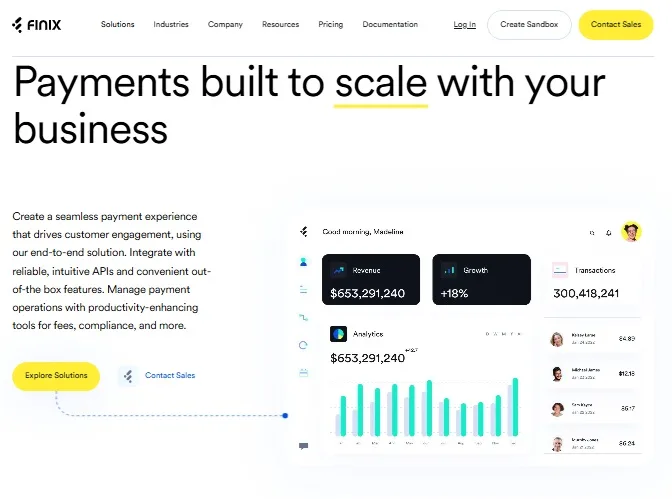
The dashboard is clean and generally intuitive, but teams encountering merchant management workflows for the first time often face a configuration learning curve. Fields like merchant underwriting parameters and payout split settings are capable but take some orientation to use confidently, particularly for non-payment specialists administering the system on behalf of a platform. That’s a fair trade-off for the depth on offer, but it’s worth factoring in for teams without prior payments experience.
The No-Code Expansion
Finix spent 2024 expanding the product’s accessibility considerably. The July 2024 launch of Recurring Billing is the most consequential addition: a no-code dashboard tool that lets businesses configure subscription plans, installment payment schedules, membership fees, and donation setups without developer involvement. The solution includes smart retry logic, network tokenization, and an account updater that automatically refreshes expired card data, capabilities that typically require custom engineering work to build cleanly.
That’s a meaningful shift for the types of businesses Finix targets. A SaaS platform with subscription-based customers can now manage recurring billing logic directly in the dashboard rather than building that layer independently. Other no-code tools released in the same period include Checkout Pages, Payment Links, Tokenization Forms, Virtual Terminals, Payout Links, and Merchant Onboarding Forms. Taken together, these additions give Finix a usable no-code presence for common payment scenarios, not just a developer-first API.
Finix Credit Card Processing Costs
Pricing for direct merchants is subscription-based and transparent. The starting rate is $79 per month, with per-transaction fees applied on top of interchange: $0.08 for in-person transactions and $0.15 for online. Common line-item fees such as PCI compliance and setup are bundled into the platform rather than billed separately, though confirm the specifics in your quote, as terms can vary. There are no long-term contracts, and volume discounts apply once a business reaches $1 million in annual card processing volume.
The subscription model makes the most sense at scale. A business processing $10,000 per month would pay $948 in annual subscription fees alone, before interchange costs and per-transaction charges. That math works once interchange savings offset the fixed monthly cost, but it tips against lower-volume operations where flat-rate predictability is more valuable than cost optimization. For a business processing $80,000 per month, well past the $1 million annual threshold for volume discounts, the per-transaction economics improve considerably over flat-rate alternatives. Note that these illustrations exclude interchange variability, chargebacks, refunds, and any optional payout acceleration add-ons.
Platform pricing operates differently. For SaaS companies and marketplaces adopting the PayFac-as-a-service model, pricing is negotiated directly with Finix and not published. The structure depends on processing volume, merchant count, and the specific features a platform needs. That’s standard practice for infrastructure-level payment deals, but it means committing time to a sales conversation before any cost analysis is possible.
Who Gets the Most Out of Finix Credit Card Processing
The clearest use case is a vertical SaaS company that has reached the point where payments are central to its product, not incidental to it. Consider a property management platform serving hundreds of landlords: each property owner collects rent, distributes funds to maintenance vendors, and processes security deposits. A platform embedding Finix’s infrastructure can apply a markup, say 30 basis points above the pass-through cost, across every transaction flowing through its product. At $5 million in monthly platform payment volume, that’s roughly $15,000 in additional monthly revenue the platform captures that would otherwise go entirely to the processor. That’s the argument Finix makes, and it holds for platforms with sufficient transaction volume to justify the integration investment.
The direct merchant path is more targeted. It works best for businesses processing more than $5,000 per month who want cost transparency over flat-rate simplicity. Finix is also positioned as more flexible than many mainstream processors for certain higher-risk business categories; eligibility depends on underwriting and your specific situation.
The fit breaks down at low transaction volume, for teams that need deep native accounting software integrations, and for companies with significant transaction volume outside the US and Canada.
Where Finix Stops
Two gaps stand out within the credit card processing scope. Finix doesn’t prominently market native integrations with accounting software like QuickBooks or Xero. Many teams bridge this with CSV exports or a middleware step into their general ledger, which adds some operational overhead for finance teams managing volume across multiple merchants.
The in-person hardware catalog is also limited. Finix offers card terminals for in-store transactions, but the physical selection doesn’t match the depth available from processors with a stronger POS focus. For businesses with complex multi-location in-store setups, that’s worth investigating before committing.
The Bottom Line
Finix occupies a distinct position in the credit card processing space. The path from payments infrastructure startup to full-stack acquirer processor with network-level connectivity, completed in 2023 and reinforced by the 2024 Series C, is meaningful evidence that Finix is building something durable. The October 2024 fundraise drew in Citi Ventures alongside technology-focused investors, a coalition spanning traditional financial services and growth-stage capital that doesn’t typically assemble around undifferentiated payment intermediaries.
Users running platforms through the system consistently describe service quality that’s unusual for a processor at this stage. Direct access to the Finix team during onboarding surfaces repeatedly in platform operator feedback, and the product roadmap has visibly accelerated through 2024 into 2025. The no-code suite built out during this period shows that Finix is broadening its accessible audience while preserving the API depth that attracted platform clients in the first place.
The trade-offs are real but bounded. Platform pricing opacity creates a barrier to independent evaluation before a sales conversation. Geographic coverage is primarily North America, which caps the addressable market for platforms with global ambitions. The accounting integration gap creates genuine overhead for finance teams that rely on QuickBooks or Xero. None of these disqualify Finix for the right customer, but they shape who that customer actually is. For platforms ready to monetize payments, Finix has built the infrastructure to do that without standing up a payment operation from scratch. That’s a specific value, and for businesses at the right stage, it’s a real one.