
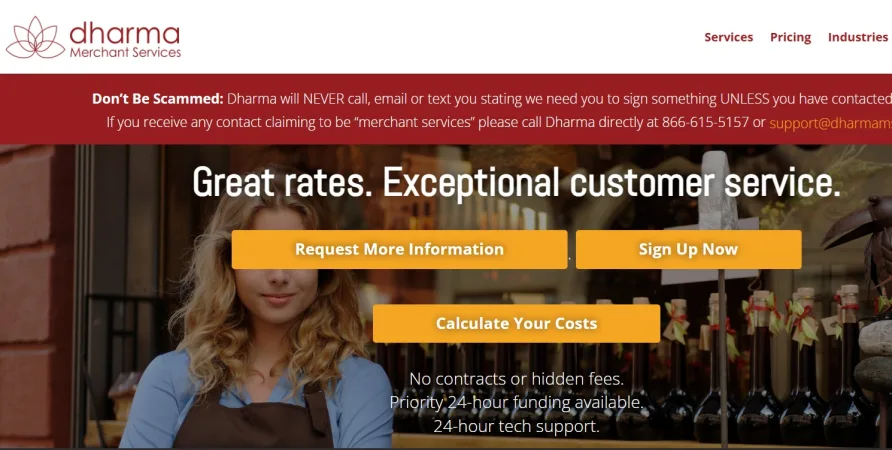
Processing Built With Nonprofits in Mind
Most nonprofit organizations don't think about credit card processing until they have to, and by that point, they're often stuck with whatever their bank offered or a flat-rate processor that quietly takes 2.9% off every donation. Dharma Merchant Services has spent nearly two decades positioning itself as the alternative for organizations that care about where their processing fees go and how much they're actually paying. We score Dharma 7.6 out of 10 in the credit card processing category, with its strongest marks in pricing transparency and trust, and its most significant limitations in geographic reach and support availability.
The service operates on an interchange-plus pricing model, which means every transaction fee is broken into two visible pieces: the base interchange rate set by Visa, Mastercard, or the card network, and Dharma's fixed markup on top. For nonprofits, that markup drops to just 0.10% plus $0.08 per in-person transaction. That's the lowest published nonprofit processing rate we've found from any traditional merchant account provider.
Dharma was a certified B Corporation from 2009 through recent years, and the principles behind that certification still define how the company operates. Founded in 2007 by Jeff Marcous and his daughter Alexia in San Francisco, the company was built with the explicit goal of running a payment processor around social responsibility rather than adding it as an afterthought. Dharma earned its B Corp certification from B Lab in 2009, though the company's own website now indicates it is no longer a certified or registered B Corp. The values haven't changed: Dharma still operates as a registered ISO of Synovus Bank, employs non-commissioned salespeople, donates more than $100,000 annually to nonprofit organizations, and publishes every fee it charges directly on its website. It's a small, privately held operation with roughly a dozen employees, which keeps overhead low but also limits some of the infrastructure you'd get from a larger processor.
How Dharma's Interchange-Plus Model Works for Nonprofits
Interchange-plus pricing is the most transparent model in payment processing, and Dharma applies it exclusively across all account types. Here's why that matters for a nonprofit: with flat-rate processors, you pay the same percentage regardless of the card type or transaction method. A debit card donation at a fundraising gala and a corporate Amex charge entered online both cost you the same rate. With interchange-plus, you pay the actual interchange rate for each card type (which varies) plus Dharma's fixed markup. Debit cards carry lower interchange than corporate rewards cards, so your effective rate on those transactions drops significantly.
Dharma's nonprofit markup sits at interchange plus 0.10% and $0.08 for in-person (card-present) transactions, and interchange plus 0.10% and $0.11 for virtual or keyed-in transactions. Standard business accounts pay 0.15% plus $0.08 for in-person and 0.20% plus $0.11 for online. The nonprofit discount represents a 33% reduction on the percentage markup for in-person transactions and a 50% reduction for online, which adds up over thousands of transactions annually. Nonprofits classified under Merchant Category Code 8398 (Charity or Social Service) also qualify for reduced interchange rates from Visa and Mastercard themselves, creating a double discount that stacks Dharma's lower markup on top of already-reduced base rates.
Every Dharma account includes the MX Merchant platform at no additional gateway fee. MX Merchant provides a virtual terminal for keying in phone donations, a customer database for storing donor card information securely, online payment links you can embed on your website, and reporting tools that filter by deposit date, customer, or transaction type. The platform also supports the MX Merchant Express mobile app for iOS and Android, so you can accept keyed payments at events without purchasing additional hardware. If you need recurring billing for monthly donors, that's an add-on at $10 per month through the MX Invoicing App.
What You'll Actually Pay: Annual Cost Math
Dharma's nonprofit monthly account fee is $15 ($20 for standard business accounts). That's the fixed cost before any transaction fees apply. For a nonprofit processing $10,000 per month in credit card donations, here's what the annual cost structure looks like. The $15 monthly fee totals $180 per year. If your average transaction is $50 and 60% of donations come in person at events while 40% arrive online, you'd process roughly 120 in-person and 80 online transactions per month. The markup cost on in-person transactions works out to $0.13 per transaction (0.10% of $50 is $0.05, plus the $0.08 fixed fee), and online transactions run $0.16 per transaction (0.10% of $50 plus $0.11). That puts your monthly Dharma markup at about $28.40, or roughly $341 per year in markup fees plus $180 in monthly fees, for a total of around $521 per year above interchange. The actual interchange portion paid to card networks would add another layer, but that cost is identical regardless of which processor you choose.
For a larger nonprofit processing $25,000 per month with the same transaction mix, the annual Dharma markup fees scale to roughly $852 plus the same $180 in monthly fees, totaling about $1,032 per year above interchange. The monthly fee becomes a smaller percentage of your overall cost as volume increases, which is exactly why Dharma's pricing works best for nonprofits processing at least $7,500 per month. Below that threshold, the $15 fixed monthly fee represents a disproportionate share of your total processing cost, and a flat-rate mobile processor with no monthly fee might save you money despite the higher per-transaction rate.
There are a few other fees to know about. Chargebacks cost $25 each. If you close your account, there's a one-time $49 closure fee, which Dharma distinguishes from an early termination fee since there's no long-term contract. PCI non-compliance triggers a $39.95 monthly charge if you don't complete the required compliance survey within 90 days of account setup. You won't pay PCI compliance fees, annual fees, batch fees, or address verification fees. That's a cleaner fee structure than most traditional merchant account providers offer.
The MX Merchant Platform in Practice
MX Merchant is where you'll spend most of your time managing transactions. The platform's QuickPay virtual terminal lets you enter a donor's card number and immediately generate a receipt, which you can email or text to the donor. One detail that takes a moment to find: the customer database stores card information but the navigation path to pull up a returning donor and charge their card on file isn't immediately obvious from the main dashboard. You need to go to the Customers section, select the individual, and then initiate a payment from their profile rather than starting from the payment screen. It's functional once you learn the workflow, but new users sometimes miss it.
For nonprofits that need to accept donations through their website, MX Merchant includes a payment link generator. You create a hosted payment page with custom fields, set a fixed or variable amount, and embed the link on your site. All SSL certificates and hosting are handled by the MX platform. This isn't a full donation management system with campaign tracking and donor CRM features, but it gets the basic online giving function working without additional software costs. For organizations that need more sophisticated fundraising tools, Dharma partners with 4aGoodCause, a fundraising platform that connects directly to your Dharma merchant account and provides campaign pages, recurring giving, event registration, and donor tracking.
The mobile app works well for events. You can key in transactions or pair the app with a Walker CX3 Bluetooth card reader ($149) for swipe, dip, and tap payments. Users who primarily handle phone-in donations report that the virtual terminal is quick to learn. A common observation from long-term users is that the reporting tools, while comprehensive, export only basic CSV files rather than offering direct accounting software integration. If you need QuickBooks sync, that's available through the MX QuickBooks Sync add-on.
Who Should Choose Dharma (and Who Shouldn't)
Picture a regional food bank that processes $15,000 per month across a mix of in-person event donations, online giving through their website, and phone pledges from their annual campaign. They need a virtual terminal for phone entries, a payment link for the website, and occasional mobile processing at community events. Dharma fits this organization well because the nonprofit interchange-plus rate reduces their per-transaction cost below what they'd pay with flat-rate processing, the MX Merchant platform covers all three acceptance channels, and the $15 monthly fee is modest relative to their volume. The company's social mission alignment also matters to their board and donors.
Now consider a small neighborhood arts collective that runs a gallery shop and takes in $3,000 per month in card sales, mostly from walk-in visitors buying prints and admission tickets. Dharma wouldn't be the right fit here. The processing volume falls well below the point where Dharma's pricing makes sense, the $15 monthly fee would eat into thin margins, and a simple mobile-first processor with no monthly commitment would serve them better at that scale.
Dharma also isn't a fit for organizations that process internationally, need account-level phone support around the clock, or operate in industries that traditional processors classify as high-risk (cannabis-adjacent nonprofits, political organizations in some cases, or businesses with high chargeback rates). The company is transparent about these limitations and will refer merchants to other providers when the fit isn't right.
What Dharma Doesn't Cover
Within the scope of credit card processing, Dharma has a few notable gaps. Dharma's own team is available by phone Monday through Thursday from 9:00 AM to 4:00 PM and Friday from 9:00 AM to 2:00 PM Eastern Time. Outside those hours, 24-hour technical support is available through the platform and terminal providers, and you can submit email tickets through Dharma directly. For a nonprofit running a Saturday evening fundraiser where you need account-level help beyond basic terminal troubleshooting, that's a real gap.
The hardware selection is narrower than what you'd find from larger processors. Dharma primarily offers Verifone terminals and Clover POS systems, plus the Walker CX3 mobile reader. If you need specialized hardware for a specific use case, your options are limited. The company can reprogram some existing terminals from other processors, but compatibility isn't guaranteed.
International processing doesn't exist with Dharma. US-based merchants only. And while MX Merchant handles basic online payment acceptance, it doesn't include shopping cart integrations natively. If you run an online store alongside your nonprofit operations, you'd need the Authorize.net gateway add-on ($10/month plus $0.05 per transaction) for full e-commerce integration.
Recent Developments
In July 2025, Dharma expanded its surcharging capabilities to support Clover POS systems through a partnership with Priority Payments. The MX Advantage surcharging feature, which lets merchants pass credit card processing fees to customers as a checkout fee, was previously limited to Dejavoo terminals and the MX Merchant virtual terminal. Clover support opens this option to a much wider range of Dharma merchants. Dharma has also introduced the ValorPay VL100 Pro terminal and continued expanding its NFC payment acceptance capabilities as tap-to-pay adoption accelerates.
The Final Word
Dharma Merchant Services occupies a distinct position in the payment processing market: a small, values-driven processor that delivers genuinely low rates for nonprofits, backs up its ethical claims with its B Corp heritage and annual charitable giving, and publishes every fee on its website for anyone to review before signing up. The 4.8 out of 5 rating across 140-plus reviews on Trustpilot and A+ BBB standing with virtually no complaints aren't accidental; they reflect a company that's selective about the merchants it takes on and consistent in how it treats them. The tradeoff is that you're working with a small team that keeps limited business hours for account-level support, serves only US merchants, and can't match the hardware variety or global reach of larger processors. For a nonprofit processing $7,500 or more per month that values knowing exactly what every fee is and where every dollar goes, Dharma earns its reputation as one of the most trustworthy options in an industry that doesn't always deserve that word.