
What Percentage-Based Fees Actually Cost You
Most businesses don't realize how much they're losing to percentage-based credit card processing fees until they run the numbers on a full year. Stax, formerly known as Fattmerchant, flips the traditional model by charging a flat monthly subscription with zero markup on interchange rates, so the savings grow as your volume grows. We score Stax 7.5 out of 10 for the credit card processing category, a rating that reflects a genuinely innovative pricing approach held back by a mobile experience that hasn't kept pace and a cost structure that only pays off once you cross a meaningful processing threshold.
Founded in 2014 in Orlando, Florida, by sibling co-founders Suneera Madhani and Sal Rehmetullah, Stax reached unicorn status in 2022 after a $245 million funding round pushed its valuation past $1 billion. The company has since gone through significant leadership transitions, with John Cimba taking over as CEO in early 2026 following the departure of Paulette Rowe. Greater Sum Ventures holds a controlling stake. Stax currently serves more than 39,000 businesses across the U.S. and Canada and processes over $23 billion in payments annually. A string of acquisitions over the past several years, including CardX for surcharging, Payment Depot, Fusebill (now Stax Bill), and most recently BlockChyp, has expanded its capabilities well beyond its original subscription processing roots.
How the Subscription Model Actually Works
The concept behind Stax credit card processing is simple enough to explain in a sentence: you pay a fixed monthly fee, and in return, every transaction runs at the true wholesale interchange rate with no percentage markup added on top. The only variable cost is a small per-transaction fee of 8 cents for in-person card-present transactions and 15 cents for online or keyed-in transactions.
This "interchange plus zero" structure matters because interchange rates, the fees set by card networks like Visa and Mastercard, are the same for every processor. What changes between providers is what they charge on top of interchange. Flat-rate providers bundle everything into a single percentage. Interchange-plus providers add their own percentage markup. Stax adds nothing beyond those per-transaction cents.
For a business running 500 in-person transactions per month, the per-transaction cost is a flat $40 regardless of whether the average ticket is $25 or $250. That predictability is the draw.
In October 2025, Stax completed a multi-year transition to become a full-stack payment processor with the launch of Stax Processing. Built through the integration of acquired companies APPS and BlockChyp, this shift gives Stax direct control over significantly more of the transaction lifecycle, from origination and tokenization through clearing and settlement. The practical impact for merchants is tighter integration across the payment flow, which should improve transaction speed and give Stax more pricing flexibility going forward. The company now manages most of the processing infrastructure on its own rather than relying as heavily on third-party processing relationships, though card network and banking relationships still underpin the system as they do for every processor.
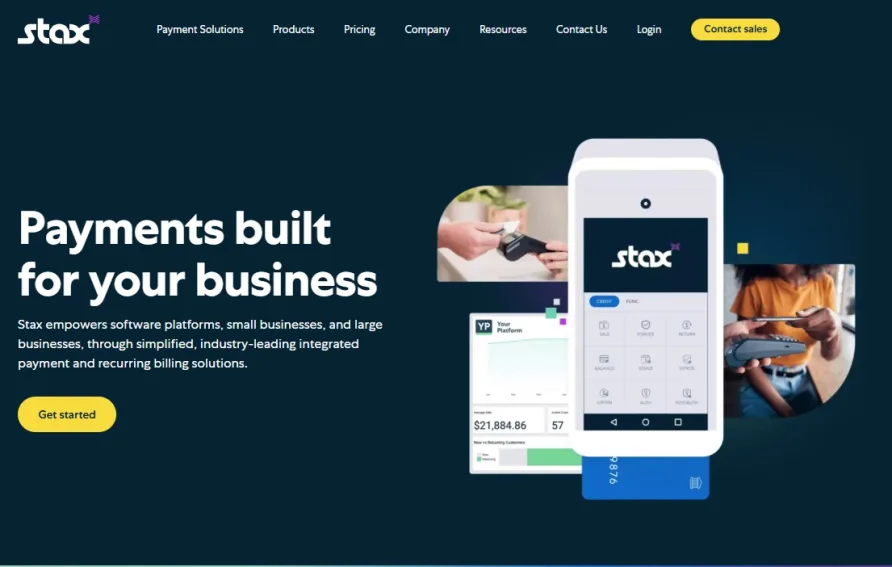
The Stax Pay dashboard serves as the central hub, providing real-time analytics on sales volume, new versus returning customers, and customer lifetime value calculations. You can process payments through a virtual terminal, send digital invoices via email or text, and manage recurring billing from a single interface. The platform connects with over 200 pre-built integrations and more than 7,000 additional apps through Zapier, covering accounting tools, CRM systems, and e-commerce platforms.
One area where the dashboard feels less polished is in initial navigation. The volume of features crammed into the left-hand menu, from invoicing and reporting to customer management and payment links, can feel crowded when you're first getting oriented. Users who've worked with simpler processors may need a few sessions before the layout clicks. The payoff is having everything consolidated, but expect a learning curve during your first week or two.
Stax is equipment-agnostic. You aren't locked into proprietary hardware. The platform works with Clover terminals, Dejavoo devices, and SwipeSimple mobile readers, and if you already own compatible POS hardware, you can likely reprogram it to work with Stax rather than purchasing new equipment.
Stax Credit Card Processing Fees in Real Numbers
Every Stax account comes with a monthly subscription, and the tiers break down by annual processing volume: up to $150,000 per year at $99/month, $150,000 to $250,000 per year at $139/month, and over $250,000 per year at $199+/month with custom quotes available for significantly higher volumes. On top of the subscription, you'll pay the wholesale interchange rate plus 8 cents per in-person transaction or 15 cents per online/keyed transaction. A $10 monthly PCI compliance fee applies to every account. If you want to pass processing costs to customers through compliant surcharging via CardX, that adds another $99 per month.
The annualized math is where the model proves itself or doesn't. Take a solo consultant processing $8,000 per month in online payments with an average ticket of $150. That's roughly 53 transactions monthly. At the $99/month base subscription, 53 transactions at 15 cents each ($7.95), plus the $10 PCI fee, fixed costs total about $116.95 per month, or approximately $1,403 annually. Interchange on $8,000 in card-not-present volume typically averages around 2.0% to 2.2%, adding roughly $160 to $176 per month. Total annual cost lands somewhere between $3,327 and $3,515. At this volume, the savings over a flat-rate model charging 2.6% plus 30 cents per transaction are modest but present.
Scale that to a retail store processing $20,000 per month across 800 in-person transactions. The subscription stays at $99/month, the per-transaction fee on 800 swipes is $64, and PCI adds $10, so fixed costs run $173/month or $2,076 annually. At an average in-person interchange rate of 1.7% to 1.9%, interchange adds $340 to $380 per month. Total annual cost: approximately $6,156 to $6,636. At this volume, the gap between Stax and a flat-rate processor widens significantly, and the subscription cost becomes a small fraction of overall spend.
Below $5,000 per month, the math flips. The $99 subscription eats into any savings from the lower per-transaction pricing, and a simpler flat-rate model may cost less overall.
Who Saves Money With Stax (and Who Doesn't)
Consider a dental practice collecting copays and elective procedure payments. The front desk processes 40 to 60 card transactions per day, most of them card-present, with ticket sizes ranging from $25 copays to $2,000+ for cosmetic or restorative work. At that volume, a flat-rate processor taking 2.6% on a $2,000 payment collects $52 in processing fees. Stax charges the interchange rate, roughly $34 on a standard rewards card, plus 8 cents. That's a difference of nearly $18 on a single transaction, and it compounds across every high-ticket payment throughout the month. For practices processing $30,000 or more monthly, the annual savings can reach several thousand dollars.
The model works similarly for professional services firms, including law offices, accounting practices, and consulting agencies, that process a smaller number of larger invoices. When your average transaction exceeds $200, the absence of a percentage markup makes a measurable difference on every payment.
Where Stax doesn't fit is the other end. A food truck running 200 transactions per day at a $12 average ticket sees minimal benefit from the subscription model. The per-transaction savings are negligible at that ticket size, and the $99 monthly fee likely exceeds what a percentage-based alternative would charge.
Users managing multiple payment channels frequently note that the analytics dashboard helps them pinpoint which revenue streams perform best and where customer retention is strongest, insight that carries value beyond the processing savings alone.
What Stax Doesn't Cover
Stax doesn't manufacture its own POS hardware. You'll select terminals from a catalog of third-party devices or bring compatible equipment you already own. That's a trade-off: you get flexibility to choose your hardware, but there's no tightly integrated proprietary device where the terminal software, processing engine, and merchant dashboard are engineered as a single product.
Chargeback and incidental fees aren't prominently disclosed on the website. You'll find the subscription tiers and per-transaction costs clearly listed, but the costs associated with chargebacks, batch processing, and other exception scenarios require a conversation with a sales representative or a close read of the merchant agreement. For a company that leads with pricing transparency, this gap stands out.
The mobile app experience lags well behind the web platform. App store ratings sit below 3.0 on both iOS and Android, with users citing slow performance and limited functionality compared to the desktop dashboard. If your business relies heavily on mobile payment collection, test the app thoroughly before committing. This is a known weak point.
Next-day funding isn't guaranteed on all plans and may require an additional fee depending on your tier and processing history.
Final Assessment
Stax credit card processing solves a specific math problem: once your monthly volume is high enough, paying a flat subscription and getting wholesale interchange rates will always beat paying a percentage markup on every dollar. The acquisition strategy that brought CardX surcharging, recurring billing through Stax Bill, and now full-stack processing under one roof has produced a platform that does more than just move money. For a retail store processing $15,000+ per month, a healthcare practice handling high-ticket payments, or a professional services firm sending large invoices, the savings are measurable and the analytics tools add operational insight that many credit card processors don't provide.
The weak spots are concentrated but real: a mobile app that frustrates more than it helps, pricing opacity around incidental fees, and a cost floor that prices out early-stage and low-volume businesses. If your monthly volume clears $5,000 and you've outgrown the simplicity of flat-rate processing, Stax is built for exactly that transition.