
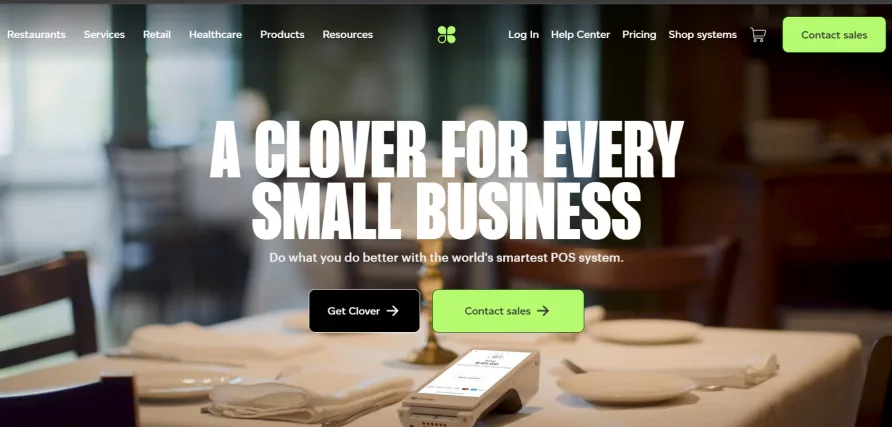
A Point-of-Sale System That Happens to Process Payments
Most credit card processing services sell you a rate and leave the rest to you. Clover does something different: it sells you an entire point-of-sale ecosystem: hardware, software, and payment processing bundled under one roof. That approach has made it one of the most widely deployed POS platforms among U.S. small businesses, and we score Clover 7.4 out of 10 in the credit card processing category. The score reflects genuine strength in its integrated hardware and software, pulled down by processor lock-in and the complexity that comes with its reseller distribution model.
Clover was founded in 2010 and acquired by First Data in 2012. When Fiserv completed its landmark acquisition of First Data in 2019, Clover became a centerpiece of the combined company's small business strategy. Fiserv (NYSE: FI) is now one of the world's largest financial technology companies, with more than $15 billion in annual revenue and a spot on the S&P 500. That backing matters. Clover's gross payment volume is approaching $300 billion annually, surpassing the volume processed through several major competitors, and the platform generated $2.7 billion in revenue during 2024 alone. It isn't a startup hoping things work out. It's a core growth engine for a Fortune 500 company that's investing billions to expand it further.
Clover's Hardware Lineup, Device by Device
What separates Clover from most credit card processing services is that you're not just buying a rate. You're buying into a hardware family designed and manufactured specifically for the platform. Every Clover device runs the same operating system, connects to the same cloud dashboard, and processes payments through Fiserv. That consistency means your Clover Go at a farmer's market and your Station Duo at the main register share the same reporting, inventory data, and customer records.
The current lineup includes six devices. The Clover Go ($199 with a software plan) is a compact Bluetooth card reader for mobile payments. The Flex ($599-$749, depending on plan) is a handheld device with a 5-inch touchscreen and built-in receipt printer, ideal for table-side payments in restaurants or line-busting in retail. The Mini ($799) packs a full countertop POS into an 8-inch tablet form factor with an integrated receipt printer and barcode scanner. The Station Solo ($1,349-$1,699) is the full-size countertop unit with a 14-inch display, while the Station Duo ($1,799) adds a customer-facing screen for order confirmation and tipping. Clover also recently introduced the Kiosk for self-service ordering in quick-service restaurants, and the Compact, a simpler, button-based terminal for businesses that don't need a full touchscreen POS.
Hardware quality is a clear strength. The white-and-silver industrial design feels premium, and the devices are built to handle high-volume retail and restaurant environments. Feedback from restaurant operators consistently highlights the Flex as a standout. Its built-in printer and wireless connectivity let servers close tabs at the table without walking back to a fixed terminal, which turns tables faster during peak hours.
POS Software and the Clover App Market
Clover's software plans are structured by business type rather than a one-size-fits-all tier system. You'll find separate plan tracks for retail, quick-service restaurants, full-service dining, professional services, personal services, and home/field services. Each track offers Starter, Standard, and Advanced tiers with progressively more features. Starter plans handle basic payment acceptance and sales tracking. Standard adds inventory management, customer engagement tools, and enhanced reporting. Advanced opens the full suite, including detailed analytics, loyalty programs, and comprehensive employee management.
The base POS software is capable on its own. You get a clean, tab-based interface with separate sections for orders, transactions, inventory, reporting, and employee management. Setting up tax rates, creating item categories, and configuring tip settings are all handled through an intuitive dashboard that's accessible from any web browser, not just from the Clover device itself. That's a practical detail that matters when you're updating menus or pulling reports from home at night.
Then there's the App Market. Clover hosts roughly 280 third-party apps from nearly 200 independent software vendors, covering everything from advanced inventory management and accounting integrations (QuickBooks, Xero) to delivery platform connections (DoorDash, Uber Eats, Grubhub) and customer loyalty programs. The marketplace is the most extensive cloud-based app catalog among dedicated POS platforms. Not every app is free, though. Users managing multi-location operations frequently note that the apps they actually need, like advanced scheduling, deeper inventory control, accounting sync, carry their own monthly subscription fees that add up. A loyalty app at $47/month plus a scheduling app at $40/month plus an accounting connector at $30/month can quietly add over $1,400 per year to your operating costs beyond what Clover itself charges.
What Clover Credit Card Processing Costs in Practice
Clover's processing fees follow a flat-rate model when purchased directly from Clover. In-person card transactions cost between 2.3% and 2.6% plus 10 cents per transaction, depending on your plan tier and business type. Restaurant plans generally get the lower end of that range. Keyed-in (card-not-present) transactions cost 3.5% plus 10 cents across all plans, a rate that's noticeably higher than what some flat-rate competitors charge for online or phone orders.
Here's what those rates mean in real dollars. A retail business processing $15,000 per month in card-present sales on the Standard plan at 2.6% plus 10 cents, with an average transaction of $30, or about 500 transactions, pays roughly $390 in processing fees per month plus $50 in per-transaction fees, totaling $440 monthly or $5,280 annually in processing alone. Add the $14.95 monthly software fee ($179.40/year) and a one-time Mini hardware purchase of $799, and your first-year all-in cost lands around $6,258. Year two drops to about $5,459 once the hardware is paid off, but processing fees remain the dominant expense. A restaurant processing $25,000 per month at the lower 2.3% rate with an average ticket of $20 (1,250 transactions) would see processing costs of $575 plus $125 in per-transaction fees, totaling $700 monthly, or $8,400 per year. That's before the Station Solo hardware ($1,699) and software ($89.95/month, or $1,079.40/year).
Rapid Deposit is available if cash flow is tight. It lets you select specific transactions for same-day funding at a 1.75% fee on the deposited amount. Standard deposits arrive in one to three business days, with most businesses receiving funds the next business day at no extra charge.
The Fiserv Factor: Processing Lock-In and Reseller Risk
This is the section that matters most if you're evaluating Clover for the long term. Every Clover device is tied to Fiserv's processing network. You can't take a Clover Mini or Station Duo and connect it to a different payment processor. If you decide two years from now that you want better rates from another provider, you're not just canceling a software subscription. You're replacing every piece of hardware you own. That's the single biggest commitment you make when choosing Clover, and it's the primary reason our Pricing & Value and Transparency scores are lower than the platform's other marks.
Compounding this is the reseller model. Clover is sold directly through its website, but it's also distributed through hundreds of independent sales organizations (ISOs), banks, and authorized resellers. Each reseller can set their own processing rates, contract terms, and fee structures. A business that buys directly from Clover gets the published flat rates. A business that signs up through a bank partner or third-party reseller might get interchange-plus pricing (potentially cheaper at high volumes), or they might get tiered pricing with qualified/non-qualified surcharges that are far more expensive than advertised.
The practical risk is real. Long-term users report rate increases over time that can push effective processing costs well above the initial agreement. Some resellers bundle hardware leases at $150/month for 36 or 48 months, far more than the hardware's purchase price, with early termination fees that make leaving painful. If you're going the Clover route, buying hardware outright and purchasing directly from Clover's website gives you the most predictable cost structure.
Is Clover the Right Processor for Your Business?
Clover fits best when a business wants a turnkey, single-vendor solution and plans to stay with it for the long haul. Consider a neighborhood bakery doing $8,000 to $12,000 per month in card sales, with a small team of three to five employees. The owner wants to accept cards, track which pastries sell best by time of day, run a simple loyalty program, and not think about whether the POS talks to the card reader. Clover's Mini with a Standard retail plan gives them all of that in one box. The processing fees are predictable, the interface is clean enough that a new hire can learn it during a morning shift, and the built-in reporting means they don't need a separate analytics tool.
It also works for full-service restaurants that want table-side payment. A 60-seat restaurant with three servers can equip each server with a Clover Flex for table-side checkout while running the primary register on a Station Duo. Orders, inventory, and reporting all sync automatically. That eliminates the gap between taking the check to the table and running back to a fixed terminal.
Clover is a harder sell for businesses with high card-not-present volume. If you're running a service business where most payments come over the phone or through invoices, that 3.5% plus 10 cents keyed-in rate will erode margins quickly compared to processors that offer lower card-not-present fees. It's also less ideal for businesses that need maximum processing flexibility. High-volume operations that want to negotiate interchange-plus rates or switch processors as their volume grows will find the hardware lock-in restrictive.
Where Clover Falls Short on Processing
Clover doesn't offer interchange-plus pricing through its direct channel. Businesses processing high volumes, typically above $20,000 to $25,000 per month, often save money on interchange-plus models, where they pay the actual card network cost plus a small markup rather than a flat percentage. Some Clover resellers do offer interchange-plus, but that introduces the reseller risk described above.
There's also no ability to choose or change your payment processor without replacing hardware. This is a significant limitation in a category where processing relationships typically aren't permanent. Businesses outgrow their processor, find better rates, or need features (like multi-currency support or specialized high-risk processing) that their current provider doesn't offer. With most processing services, switching is an account-level change. With Clover, it's a capital expense.
The Virtual Terminal, Clover's tool for processing keyed-in payments from a web browser, works fine for occasional phone orders, but its 3.5% rate and basic feature set aren't competitive for businesses that process a significant share of revenue through non-card-present channels.
What's Changed on the Platform Recently
Clover's development pace has accelerated under Fiserv's increased investment. In 2025, the platform rolled out the Flex Gen 4 with improved speed and security, introduced the Flex Pocket for portable transactions across the U.S., UK, and Canada, and launched the Clover Compact as a simpler, semi-integrated payment terminal for businesses that don't need a full POS touchscreen. On the security side, Clover integrated 3D Secure authentication for card-not-present transactions and implemented PCI DSS v4.0 compliance requirements ahead of industry deadlines. The platform also added age-restricted item management tools that flag products like alcohol and tobacco at checkout and during order fulfillment, which addresses a compliance gap that previously required a third-party app. Fiserv acquired a portion of TD Bank's merchant processing business in Canada during October 2025, further expanding Clover's international footprint alongside existing operations in the UK, Ireland, Germany, and Latin America.
Final Take
Clover's appeal comes down to a simple value proposition: one vendor handles your hardware, your POS software, and your credit card processing, and all three are designed to work together from day one. For a brick-and-mortar business that values simplicity over flexibility, that's a compelling offer. The hardware is well-built, the software is intuitive, the app marketplace fills most gaps, and the Fiserv backing means the platform isn't going anywhere. At the same time, this is a committed relationship. You're buying proprietary hardware that only works with one processor, and the total cost of ownership (hardware, software, processing fees, and app add-ons) can climb higher than the sticker price suggests. The reseller channel adds another variable that buyers need to manage carefully. For businesses that buy direct, plan to stay long-term, and primarily process in-person transactions, Clover earns its position as one of the stronger integrated POS and processing platforms available. For businesses that value processor flexibility or rely heavily on card-not-present sales, the lock-in is a serious constraint worth weighing before you commit to the hardware investment.