
Chasing the Lowest Rate in Credit Card Processing
If you've spent any time comparing credit card processing companies for your small business, you've probably noticed that most of them won't tell you what they charge until you're on a sales call. National Processing took the opposite approach. Since 2007, this Utah-based processor has published its rates directly on its website and backed them with a rate-lock guarantee that prevents the creeping fee increases small business owners have come to expect. We score National Processing 7.3 out of 10 for the credit card processing category, with its strongest marks in pricing transparency and its weakest in user reputation consistency across review platforms.
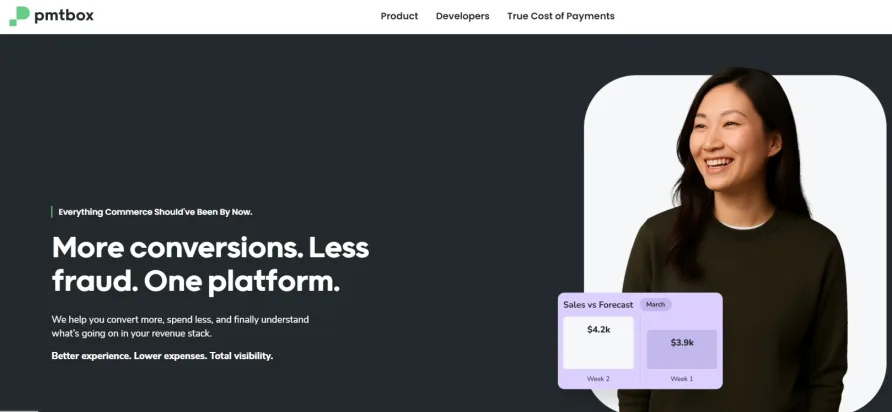
Founded by Wayne Hamilton and headquartered in Orem, Utah, National Processing operates as a registered ISO (Independent Sales Organization) of Commercial Bank of California and Chesapeake Bank. The company is privately held, bootstrapped without outside venture funding, and employs a team of roughly 50 people. It has served thousands of merchants since its founding in 2007, with particular strength in small retail, restaurant, and ecommerce accounts. In November 2025, National Processing rebranded to pmtbox (Payment Box) as part of a broader technology platform expansion, though the ownership, team, and merchant terms remain unchanged.
How National Processing Handles Your Payments
National Processing is a full-service credit card processor that covers the three transaction types most small businesses need: in-person card swipes and taps, online payments through an ecommerce gateway, and manually keyed-in transactions for phone orders or invoices. The company also offers ACH and eCheck processing as a separate plan, giving businesses a lower-cost option for recurring billing or large-ticket transactions where card fees would eat into margins.
On the hardware side, National Processing doesn't manufacture its own terminals. You'll use Clover devices (the Flex, Go, Mini, or Station) or PAX terminals, which the company resells. Every plan includes a free SwipeSimple Bluetooth card reader, and merchants processing $10,000 or more per month can qualify for a free countertop terminal. If you're switching from another processor and already own compatible equipment, National Processing will reprogram it at no charge.
The company's proprietary payment gateway handles online transactions, connecting to major shopping carts including Shopify, WooCommerce, BigCommerce, and Ecwid. Merchants who already use Authorize.Net can keep that gateway and have it reprogrammed to route through National Processing instead. The virtual terminal, powered by SwipeSimple, lets you accept card-not-present payments, store customer information, and track purchase history from a browser. It's functional but basic. Users who manage more than a few dozen recurring customers per month report that the search and filtering tools feel limited once your client list grows beyond a couple hundred entries.
One area where National Processing stands apart from many processors its size is high-risk merchant support. The company works with multiple sponsoring banks that have higher risk tolerance, which means businesses in industries like firearms, vape products, subscription services, and high-volume ecommerce can get approved where they'd be declined elsewhere. High-risk accounts receive custom pricing quotes, so the published rates won't apply, but the option itself matters for business owners who've been turned away by other providers.
What National Processing Costs in Practice
The rate-lock guarantee is the first thing you'll notice about National Processing's pricing, and it deserves to be. In an industry where processors routinely raise rates after the first year, National Processing locks your transaction fees for the duration of your account. The company even runs a $500 gift card challenge: if they can't beat your current processor's rates, they'll hand you $500. That challenge only applies to merchants processing $10,000 or more per month, but it signals real confidence in their pricing position.
For the Basic In-Person plan, you'll pay $9.95 per month plus 2.5% and $0.10 on every card-present transaction. The Basic eCommerce plan is the same $9.95 monthly fee with higher per-transaction rates of 2.9% plus $0.30, which reflects the added fraud risk of card-not-present sales. Keyed-in transactions on either plan cost 3.5% plus $0.15. An Advanced plan lowers the in-person rate to 2.4% plus $0.10 but carries a higher monthly fee plus a $29 gateway charge. Businesses processing over $30,000 per month can request custom interchange-plus pricing, which passes through the actual card network costs with a fixed markup on top.
Here's what those numbers mean in annual terms. A solo operator running $8,000 per month in card-present sales on the Basic In-Person plan would pay roughly $2,519 per year: $119.40 in monthly fees ($9.95 times 12) plus approximately $2,400 in transaction fees (assuming an average ticket of $40 across 200 transactions monthly). A retail shop processing $20,000 per month with a five-person team using the Advanced plan would spend approximately $7,524 annually once you factor in the monthly plan fee, gateway charge, and per-transaction costs. Those figures are competitive against flat-rate processors, though interchange-plus providers can undercut them for businesses with high debit card volume.
The fees you won't see on the pricing page matter too. There's an annual PCI compliance fee of approximately $79. If you fail to submit your PCI compliance documentation, the penalty jumps to $99 per month until you do. That's aggressive compared to some processors that charge $20 to $40 for non-compliance. And while National Processing markets month-to-month billing, an early termination fee of up to $295 applies if you leave for a competitor without first giving National Processing a chance to match or beat their offer. The company says it waives the fee if you close or sell your business, but user feedback suggests the waiver process isn't always smooth.
The pmtbox Rebrand and What It Means for Merchants
On November 1, 2025, National Processing officially rebranded to pmtbox (Payment Box). The company's pricing page, parts of its website, and new merchant communications now redirect to pmtbox.com. If you visited nationalprocessing.com expecting the same site you'd seen before, the redirect likely caught you off guard. That's a legitimate concern for prospective merchants doing their research.
The underlying business hasn't changed. Wayne Hamilton, who founded National Processing in 2007, remains CEO. The team, the corporate address in Orem, Utah, and the sponsoring bank relationships (Commercial Bank of California and Chesapeake Bank) are all the same. Existing merchant agreements, billing terms, and pricing carry over. The rebrand reflects an expansion into a broader technology platform: pmtbox is positioning itself around unified commerce, machine-learning fraud prevention, and developer-focused APIs. Those capabilities are forward-looking and largely unavailable to current merchants as of this writing.
For existing customers, the practical impact is cosmetic. Your statements, emails, and support contacts now display the pmtbox name. For prospective customers, the timing creates a research headache. Older reviews reference National Processing, newer materials point to pmtbox, and the two brands coexist across the web. We're reviewing the service under the National Processing name because that's what the overwhelming majority of search traffic still targets and what most merchants will recognize. As the pmtbox identity matures and its expanded technology becomes available, we'll update this review accordingly.
Is National Processing Right for Your Business?
Imagine you run a brick-and-mortar retail shop doing $12,000 to $15,000 in monthly card sales, and your current processor just sent a notice that your rates are going up for the third time in two years. You don't want to sign a multi-year contract, you don't need a full POS ecosystem with inventory management and employee scheduling, and you're tired of calling support lines that route overseas. That's the merchant National Processing was built for. The locked rates, published pricing, and U.S.-based support team line up with what a cost-frustrated small business owner actually needs.
The service also works well for businesses that have been turned down elsewhere. A vape retailer, a firearms dealer, or a subscription box company operating in a category that most processors flag as too risky can get an account with National Processing where the application process alone would be a dead end with many flat-rate providers. The rates will be higher on a custom quote, but having a functional processing account matters more than saving 20 basis points when you can't get approved at all.
Where the fit breaks down is with businesses that need an all-in-one platform. National Processing handles payments. It doesn't offer built-in inventory management, staff scheduling, customer loyalty programs, or advanced reporting dashboards. If you want a single vendor for your terminal, your POS software, and your payment processing, you'll be assembling pieces from multiple providers. The Clover hardware helps bridge some of that gap, but you're still managing separate relationships. High-growth ecommerce operations processing well above $30,000 per month may also find that dedicated interchange-plus providers deliver lower effective rates once volume discounts kick in.
Where National Processing Falls Short
The biggest gap is data portability. Per company security policy, National Processing doesn't readily support exporting your customer payment data if you decide to switch processors. If you've stored card-on-file information for recurring customers through their gateway, that data stays behind. You can work around this by using a third-party gateway like Authorize.Net from the start, but it's a limitation worth knowing before you build your customer database inside their system.
The fee disclosure issue is real. Multiple user reports mention discovering the PCI compliance fee, the PCI non-compliance penalty, and the early termination fee only after signing up. These fees are in the contract, and they aren't illegal, but they undercut the transparency message that National Processing leads with in its marketing. A processor that builds its brand on published pricing should publish all its fees, not just the per-transaction rates.
Customer support quality is inconsistent. Users who connect with their assigned account manager tend to have positive experiences. Users who call the general support line, particularly during the pmtbox transition period, report long hold times and inconsistent answers. A recurring theme in user feedback is that initial setup and onboarding are excellent, but ongoing support for billing disputes or technical issues can feel like a different company entirely.
Our Assessment
National Processing does one thing well that most small processors get wrong: it tells you what you'll pay before you sign up, and it locks that rate so you aren't scrambling to renegotiate every 12 months. For a small business owner who's been burned by rate creep, hidden surcharges, or opaque tiered pricing, that's a genuine differentiator. The service covers the core transaction types, the rates are competitive for the flat-rate model, and the high-risk acceptance opens a door that stays shut at most other providers.
The tradeoffs sit in the details that don't make the marketing page. The PCI non-compliance penalty is steep. The early termination fee exists despite the no-contract positioning. The pmtbox rebrand, while cosmetically simple, creates a moment of uncertainty for merchants who chose National Processing partly because of its track record dating back to 2007. If the expanded pmtbox platform delivers on its promises around fraud prevention and unified commerce, this score will likely improve. Right now, we're reviewing what's available today, and what's available is a reliable, competitively priced processing service with a few fine-print caveats that deserve your attention before you commit. We score National Processing 7.3 out of 10 for the credit card processing category.