
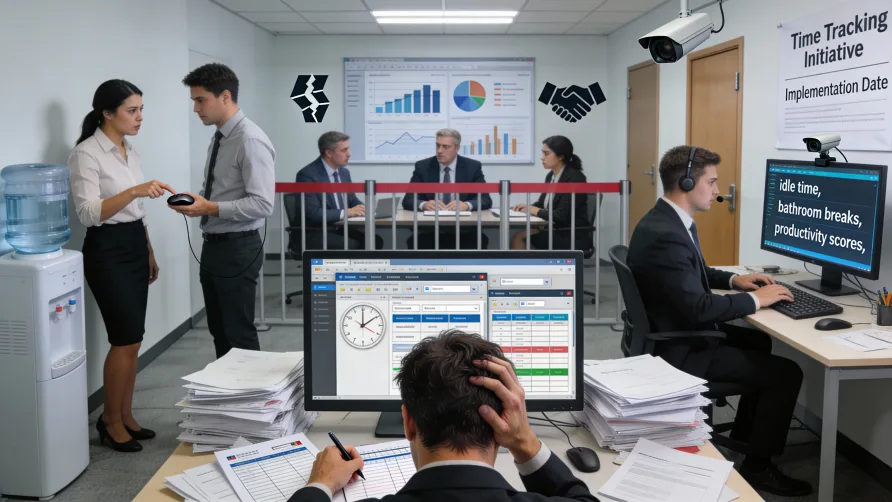
Time tracking carries significant downsides that often outweigh its benefits, particularly for knowledge work environments and creative roles. While tracking has legitimate uses in billing and project management, many organizations implement it poorly, creating surveillance cultures that damage trust, reduce autonomy, and incentivize employees to game the system rather than do their best work.
The problems with time tracking aren't just about the technology—they're fundamental issues with how monitoring affects human psychology, organizational culture, and the quality of knowledge work. Understanding these downsides helps you make informed decisions about whether time tracking makes sense for your business.
Time Tracking Erodes Trust
The most damaging effect of time tracking is how it fundamentally changes the trust relationship between employers and employees.
When you implement time tracking, you send an implicit message: "We need to verify you're actually working." This signal undermines the professional respect that knowledge workers expect. You're essentially telling educated, experienced professionals that you don't trust them to manage their own time without documentation.
Research on workplace trust shows that employees who feel monitored perform worse on complex cognitive tasks compared to those given autonomy. The monitoring creates a psychological shift from intrinsic motivation (doing good work because it matters) to extrinsic compliance (proving you're working to avoid consequences).
This trust erosion affects retention. Studies consistently show that employees cite micromanagement and lack of autonomy as top reasons for leaving jobs. Time tracking represents a visible, daily reminder of that micromanagement. Every time someone starts a timer or fills out a timesheet, they're reminded that their employer doesn't trust them.
The damage compounds in high-trust organizations. If you've built a culture based on results and autonomy, introducing time tracking contradicts everything you've established. Employees wonder what changed—did leadership lose confidence in the team? Is the company in trouble? Is this the first step toward more invasive monitoring?
Once trust erodes, rebuilding it takes years. The efficiency gains you hoped to achieve through time tracking get consumed by decreased engagement, higher turnover, and reduced discretionary effort from employees who now view their relationship with the company as purely transactional.
The Administrative Burden Is Real
Time tracking consumes hours every week across your organization—hours that could go toward productive work.
Consider a 50-person company where each employee spends 10 minutes daily on time entry. That's 500 minutes per day, or over 40 hours weekly spent documenting work instead of doing it. Across a year, you've consumed more than 2,000 hours of productive capacity on timesheet administration.
But the burden extends beyond time entry. Managers spend hours reviewing timesheets, following up on incomplete entries, and correcting miscategorized time. Finance teams reconcile time data against project budgets. HR investigates discrepancies. The administrative overhead ripples throughout the organization.
These hours represent direct costs. When you pay people to fill out timesheets instead of doing their actual jobs, you're accepting reduced output in exchange for data that may not even be accurate. The ROI calculation often comes out negative when you factor in the full burden.
The interruption cost exceeds the raw time spent. Every time someone stops work to categorize and log their time, they break focus. For deep work that requires concentration, these interruptions significantly reduce productivity. Research on workplace interruptions shows it takes an average of 23 minutes to fully regain focus after a disruption. Even a two-minute time entry can cost 25 minutes of productive capacity.
People universally describe time tracking as their least favorite administrative task. The tedium of categorizing work, remembering what you did hours or days ago, and dealing with unclear category structures creates friction that wears on morale. It's make-work that nobody finds meaningful.
Time Tracking Incentivizes Gaming Behaviors
When you measure something and attach consequences to it, people optimize for the metric rather than the underlying goal. Time tracking is particularly vulnerable to this dynamic.
Billable hour inflation happens when compensation or performance evaluation depends on tracked hours. Employees pad time entries, round up generously, or attribute personal time to client projects. They're not being dishonest in their own minds—they're responding rationally to incentive structures that reward higher numbers.
Category manipulation emerges when different project codes carry different political implications. Time gets attributed to projects with remaining budget rather than where work actually occurred. People avoid charging time to projects led by difficult managers or those already over budget, even when that's where they spent their day.
Activity theater replaces actual productivity. When hours tracked becomes the metric that matters, people optimize for documented activity rather than results. They attend more meetings (easy to track), send more emails (visible activity), and avoid deep thinking time (hard to categorize).
Risk aversion increases because people fear how time data might be used against them. They avoid admitting when tasks take longer than estimated, leading to inaccurate data that undermines the entire purpose of tracking. They hesitate to experiment with new approaches because time spent learning or failing looks bad in timesheet reports.
The fundamental problem is that time tracking converts quality work into quantity metrics. Knowledge work doesn't scale linearly with hours. Someone might solve a problem in 30 minutes that another person can't solve in 30 hours. But time tracking systems treat those as vastly different levels of contribution, incentivizing people to work slowly rather than effectively.
These gaming behaviors corrupt the data you're collecting, making it unreliable for the very purposes you implemented tracking to achieve. You end up with numbers that look precise but reflect strategic reporting rather than reality.
Time Tracking Reduces Autonomy and Intrinsic Motivation
Autonomy—the sense of control over how you structure your work—is one of the strongest predictors of job satisfaction and performance, particularly for knowledge workers. Time tracking directly undermines this autonomy.
When you require people to categorize and justify how they spend every hour, you're asserting organizational control over their daily workflow. The implicit message is that management, not the individual, determines what constitutes valuable use of time. This removes the professional discretion that most knowledge workers consider fundamental to their roles.
Research on motivation shows that autonomy, mastery, and purpose drive performance for cognitive work. Time tracking interferes with all three. It reduces autonomy directly, makes people feel their mastery is questioned (or else why monitor them?), and shifts focus from purpose to compliance.
The effect is particularly pronounced for creative and strategic work. These activities require unstructured thinking time, exploration of dead ends, and periods of apparent inactivity that are actually essential to the creative process. Time tracking systems don't accommodate this reality. They demand that every hour be categorized and justified, forcing people to shoehorn creative thinking into taskable buckets.
People respond by avoiding the ambiguous, difficult work that creates the most value. Why spend two hours thinking through a strategic problem with nothing to show for it when you could spend two hours on well-defined tasks that look good on a timesheet? The metrics push people toward legible, trackable activities and away from the messy, valuable work that's hard to categorize.
Privacy and Surveillance Concerns Are Valid
Employee monitoring raises legitimate privacy questions that make people uncomfortable, even when they have nothing to hide.
Time tracking software increasingly includes invasive features: screenshot capture, keystroke logging, website monitoring, application tracking, mouse movement detection. These tools cross the line from project management into surveillance. Employees reasonably object to their employer collecting detailed data about their digital activity.
Even basic time tracking creates discomfort. People want boundaries between work and personal life. When time tracking extends to remote workers, the line blurs. Are bathroom breaks tracked? Personal phone calls? The time you spent helping your kid with homework during lunch? The ambiguity creates anxiety.
The permanence of digital records concerns employees. Time tracking data sits in databases indefinitely. If the company gets acquired, who has access? If there's a lawsuit, will your timesheet entries from three years ago be scrutinized? The data you collect today might be used in ways you never intended.
Control over personal data matters to people. Time tracking takes information about how someone spends their days—information that feels private—and stores it in systems the individual doesn't control. This power imbalance troubles people, regardless of whether the data gets misused.
Employees often don't trust assurances that monitoring data won't be used punitively. They've seen metrics shift from "just for project planning" to performance evaluation criteria. Once the data exists, the temptation to use it for other purposes proves irresistible for management. People aren't paranoid—they're observant.
Inaccuracy Undermines the Whole Point
Time tracking promises accurate data for better decisions, but the data quality is often poor enough to make those decisions worse than educated guesses.
Recall bias affects manual time entry significantly. Studies on memory show that people consistently misremember task duration. They underestimate brief tasks and overestimate longer ones. They forget entirely about some activities. When people fill out timesheets at the end of the day or week, they're not recording facts—they're reconstructing approximations.
Category ambiguity means different people interpret the same task categories differently. One person's "client communication" is another's "project management." Multiplied across teams and months, these inconsistent interpretations make aggregate data meaningless.
Incomplete capture happens because people skip entries when they're busy, forget to start timers, or can't figure out which category fits. They batch-enter data later with even less accuracy. The result is Swiss cheese data with important holes.
Psychological rounding affects how people report time. Nobody wants to look like they spent three hours on something that should take one hour, so numbers get adjusted. Time spent learning new skills or recovering from mistakes gets redistributed to more defensible categories.
These accuracy problems mean you're making decisions based on fiction dressed up as data. You might actually get better results from having experienced managers estimate project needs based on intuition than from consulting systematically corrupted time tracking reports.
Time Tracking Doesn't Fit Many Types of Work
Certain work roles and activities resist meaningful time tracking, making the practice frustrating and low-value for significant portions of your workforce.
Strategic and creative work doesn't break down into trackable tasks neatly. How do you categorize two hours thinking about a problem while walking? Time spent reading industry news that sparks an insight three weeks later? The shower where you finally figured out the solution? These activities create value but don't fit timesheet structures.
Collaborative and multitasking work creates categorization nightmares. When you're in a two-hour meeting that covers five projects, which one do you charge? When you're answering Slack messages about three different issues while writing a document, how do you split that 30 minutes? The attempt to force precise categorization onto inherently messy reality produces arbitrary data.
Learning and professional development get minimized because they're awkward to track and justify. People skip conference sessions, avoid taking online courses, or don't spend time mastering new tools because the time investment looks unproductive in tracking systems designed around billable work.
Managerial and leadership work involves context-switching, interruptions, and supporting team members throughout the day. Effective managers are available, responsive, and handle whatever comes up. Time tracking penalizes this flexibility, pushing managers toward scheduled, trackable activities instead of the informal coaching and problem-solving that creates value.
For these roles, time tracking adds administrative burden without generating useful information. You're annoying people and collecting junk data simultaneously.
What Are the Disadvantages of Time Tracking?
Summarizing the core problems with time tracking:
Cultural damage from surveillance dynamics and trust erosion affects morale, engagement, and retention more than most organizations anticipate. The cost shows up in turnover, reduced discretionary effort, and difficulty attracting top talent who have options to work elsewhere.
Administrative overhead consumes substantial hours across the organization—hours that could go toward productive work instead of documenting it. This burden hits hardest at small organizations where people wear multiple hats and every hour matters.
Poor data quality from gaming behaviors, recall bias, and category ambiguity means you're making decisions on systematically corrupted information. Bad data produces bad decisions, undermining the entire justification for tracking.
Reduced innovation happens when people avoid ambiguous, difficult work that's hard to track and justify. Organizations get more legible activity and less creative problem-solving.
Legal and privacy risks emerge from collecting employee data, particularly with invasive monitoring features. Regulatory requirements around data protection continue to expand, creating compliance burdens.
Wrong incentives shift focus from results to documented hours, from quality to quantity, from effectiveness to the appearance of activity. People optimize for metrics rather than outcomes.
Why Do People Hate Time Tracking?
The visceral negative reaction many employees have to time tracking stems from several factors.
It feels infantilizing. Professionals with years of experience and proven track records resent being asked to justify every hour like children proving they did their homework. Time tracking treats adults like they can't be trusted to manage themselves.
It's tedious make-work. Nobody finds categorizing their time meaningful or engaging. It's a chore that interrupts more important work, and everyone knows it.
It signals distrust. The daily requirement to document time reminds people that management views them as potentially shirking responsibilities rather than professionals pursuing shared goals.
It introduces anxiety about judgment. People worry how their time data will be interpreted and whether they'll be criticized for how long tasks took or what they worked on.
It creates lose-lose situations. If tasks take less time than expected, people worry they'll be seen as not working enough. If tasks take more time than expected, they worry they'll be seen as inefficient. The tracking creates no-win dynamics.
It rarely benefits employees directly. Time tracking serves management and organizational goals. Individual workers bear the burden without gaining anything themselves, creating resentment about one more administrative requirement that makes their jobs harder.
When Time Tracking Isn't Appropriate
Several contexts make time tracking particularly problematic:
High-trust cultures built on results and autonomy see the most damage from introducing time tracking. The practice contradicts your cultural foundation and signals a fundamental change in how the organization operates.
Creative and innovation-focused teams find time tracking antithetical to how breakthrough work happens. Tracking works for production and execution but fails for exploration and invention.
Senior and executive roles involve strategic thinking, relationship building, and unstructured problem-solving that resists categorization. Forcing these roles into time tracking structures misunderstands how they create value.
Small teams with clear outcomes don't need time tracking for accountability. When you can directly observe results and everyone knows what everyone else is working on, tracking adds no useful information.
Organizations without clear purpose for time data shouldn't collect it. If you're not going to analyze patterns, improve processes, or make resource decisions based on the data, don't burden people with documenting it.
How to Avoid These Problems
If your business requires some form of time tracking, several approaches minimize the downsides:
Limit scope to where it's genuinely necessary. Track time only for client billing or specific project types, not universally across all work. Exempting roles and activities that don't benefit from tracking reduces burden and resentment.
Be transparent about purpose and use. Explain exactly why you're collecting data and what decisions it will inform. Show people the data and insights regularly so they see it serves a real purpose.
Keep it simple with minimal categories and easy processes. Reduce the administrative burden as much as possible. If time entry takes more than a few seconds, simplify further.
Focus on projects, not surveillance. Frame tracking as project management and resource planning rather than employee monitoring. This isn't just rhetoric—it should reflect actual usage.
Give employees access to their own data and let them use it for personal productivity insights. When people benefit from tracking, they resist it less.
Never tie it directly to compensation or performance evaluation. Remove incentives for gaming behaviors by keeping time data separate from review processes.
Review necessity regularly and eliminate tracking that isn't producing value. Time tracking should justify its ongoing burden, not continue from inertia.
The Bottom Line on Time Tracking Downsides
Time tracking creates real problems: trust erosion, administrative burden, gaming behaviors, reduced autonomy, privacy concerns, and poor data quality. These downsides often exceed the benefits, particularly for knowledge work, creative roles, and organizations with strong existing cultures.
The decision to implement time tracking should start with clear business necessity, not assumptions that visibility always helps. Many successful organizations operate without time tracking because they recognize the cultural costs outweigh operational benefits.
If you do implement tracking, acknowledge these downsides honestly and design systems that minimize harm. Poor implementation turns tracking into expensive surveillance theater that damages culture while producing unreliable data. The worst outcome is bearing all the costs while achieving none of the benefits—unfortunately, that's the most common result.