
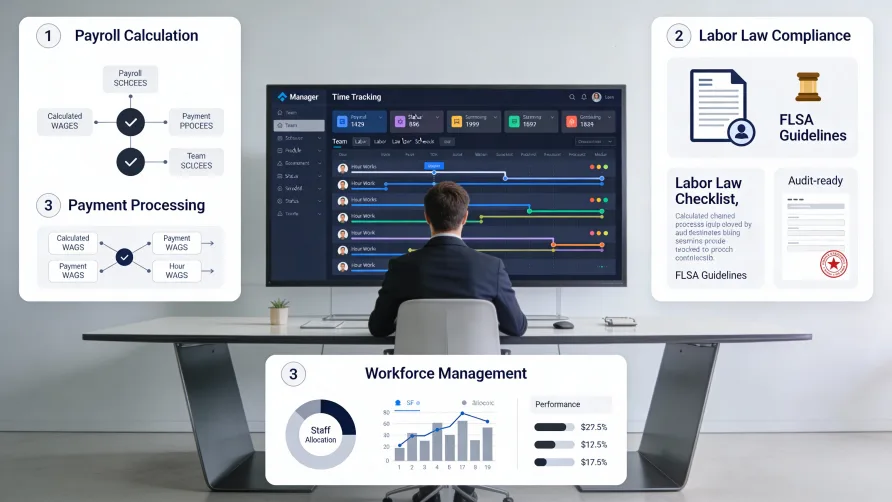
Employee time tracking is the practice of recording when workers start, stop, and take breaks from work to ensure accurate payroll, comply with labor laws, and manage workforce productivity. For employers, this means maintaining documented records of hours worked by staff members, particularly those paid by the hour or eligible for overtime. The employee time tracking meaning extends beyond simple attendance monitoring to encompass legal compliance, labor cost management, and operational visibility.
Why Do Employers Track Employee Time?
Businesses track employee hours for several interconnected reasons, ranging from legal obligations to operational efficiency.
Legal Compliance
Federal law requires employers to maintain accurate records of hours worked for non-exempt employees. The Fair Labor Standards Act mandates that businesses document daily and weekly hours, pay rates, and overtime calculations. Failure to keep proper records can result in penalties, back pay obligations, and legal liability if employees dispute their compensation.
Beyond federal requirements, many states impose additional recordkeeping obligations. Some require longer retention periods. Others mandate specific documentation around meal breaks or rest periods. Employers operating in multiple states must track which rules apply to which workers.
Payroll Accuracy
Tracking employee hours directly determines how much workers get paid. For hourly employees, every recorded hour translates to wages. Overtime calculations depend on accurate weekly totals. Even small errors compound over time, leading to underpayments that create legal exposure or overpayments that inflate labor costs.
Accurate time records also support proper tax withholding, benefits calculations, and retirement contribution tracking. Payroll touches nearly every aspect of the employment relationship, and workforce time tracking provides the foundation.
Labor Cost Management
Understanding where labor hours go helps businesses control their largest expense category. Time tracking data reveals how many hours each department consumes, which projects require more staffing than anticipated, and where overtime concentrates. Managers use this visibility to adjust schedules, redistribute workloads, and make informed hiring decisions.
Without tracking, labor costs remain a black box. You know the total payroll amount, but not how those dollars distribute across activities, locations, or customer accounts.
Productivity Visibility
Employee time management goes beyond counting hours to understanding how those hours produce results. When employees track time against projects or tasks, managers can measure productivity in concrete terms. Which team members complete similar work faster? Where do projects bog down? How does actual effort compare to original estimates?
This visibility supports coaching conversations, resource allocation, and process improvement. The goal is not surveillance but informed management.
Is Employee Time Tracking Required by Law?
The short answer is yes, for most employers and most employees. However, the specifics depend on how workers are classified and where they work.
Federal Requirements Under the FLSA
The Fair Labor Standards Act requires employers to maintain records of hours worked for all non-exempt employees. Non-exempt workers are those entitled to minimum wage and overtime protections, which includes most hourly workers and some salaried employees earning below certain thresholds.
The FLSA does not prescribe a specific tracking method. Paper timesheets, spreadsheets, time clocks, and software all satisfy the requirement as long as the records are accurate and accessible. What matters is that you can demonstrate the hours each non-exempt employee worked during each workweek.
Required records include: employee identification information, hours worked each day and each week, regular hourly rate, total overtime earnings, additions to or deductions from wages, and total wages paid each pay period. These records must be retained for at least three years, with supporting documents like timesheets kept for at least two years.
State-Level Variations
Many states add requirements beyond federal law. California mandates daily overtime pay for hours exceeding eight in a single day, which means employers there must track daily totals, not just weekly. New York requires employers to provide wage notices and obtain signed acknowledgments. Several states mandate specific meal and rest break documentation.
Where state law exceeds federal requirements, employers must follow the stricter standard. Organizations with employees in multiple states need tracking systems flexible enough to accommodate different rules for different locations.
Exempt vs. Non-Exempt Distinctions
Exempt employees, typically salaried workers in executive, administrative, or professional roles meeting certain criteria, are not covered by FLSA overtime and minimum wage provisions. The law does not require employers to track their hours.
However, many organizations still track exempt employee time for operational reasons. Professional services firms need to know how salaried consultants allocate hours across client matters. Project-based businesses want visibility into where effort concentrates. And tracking provides documentation if an employee's exempt status is ever challenged.
The classification itself carries legal significance. Misclassifying a non-exempt worker as exempt to avoid overtime obligations creates substantial liability. When in doubt, consulting with employment counsel about proper classification is advisable.
Tracking Employee Hours: Hourly vs. Salaried
The practical approach to employee time tracking differs based on how workers are compensated.
Hourly Employee Tracking
For hourly workers, time tracking directly determines pay. Every recorded hour generates wages, and every hour over 40 in a workweek typically triggers overtime at 1.5 times the regular rate. Accurate tracking protects both parties: employees receive proper compensation, and employers avoid overpayment or legal claims for unpaid wages.
Hourly tracking usually involves clock-in and clock-out systems that capture exact start and end times. Many employers also track breaks to ensure compliance with state meal period requirements. The data flows directly into payroll calculations with minimal interpretation required.
Salaried Employee Tracking
Salaried exempt employees receive the same base pay regardless of hours worked in a given week, which changes the tracking calculus. Legal compliance does not require hour-by-hour documentation for this group.
Still, many employers track salaried employee time for business purposes. Billable-hour industries need to know which clients received service from which employees. Project managers need actual-versus-estimated comparisons. Capacity planning requires understanding how current staff members spend their days.
The tracking approach for salaried workers often emphasizes project or task allocation over precise clock times. Rather than recording that someone arrived at 8:47 and left at 5:23, the system captures that they spent four hours on the Johnson account and three hours in internal meetings.
Benefits for Employers and Employees
Effective workforce time tracking serves both organizational and individual interests.
Employer Benefits
Compliance protection stands at the top of the list. Documented time records defend against wage and hour claims by providing evidence of actual hours worked and wages paid. In disputes, employers with complete records fare better than those who cannot demonstrate compliance.
Operational efficiency improves when managers see where labor hours concentrate. Data-driven scheduling reduces overtime costs. Identifying productivity patterns helps allocate work to the right people at the right times.
Financial accuracy matters too. Precise labor cost tracking by project, client, or department supports pricing decisions, profitability analysis, and budgeting. You cannot manage what you do not measure.
Employee Benefits
Workers benefit from accurate pay. When time records are precise, paychecks reflect actual work performed. Disputes become easier to resolve because both parties can reference documented records.
Transparency builds trust. Employees who can see their own time records know exactly what the company has documented. This visibility reduces suspicion that hours are being undercounted or manipulated.
For professional development, time tracking data can highlight accomplishments. An employee preparing for a performance review can point to concrete hours invested in successful projects rather than relying on memory and general impressions.
Common Concerns and How to Address Them
Employee time tracking sometimes generates pushback. Understanding common concerns helps employers implement tracking in ways that achieve business objectives while maintaining workforce trust.
Privacy Concerns
Some employees worry that time tracking represents invasive surveillance. This concern intensifies when tracking systems include features like GPS location monitoring, screenshot capture, or keystroke logging.
Address this by being transparent about what you track and why. If you record clock-in times and project assignments but not browsing activity or physical location, say so clearly. Limit data collection to what actually serves business needs. Avoid collecting information that has no legitimate purpose.
Some states require employers to notify workers about monitoring practices. Connecticut and New York, for example, mandate written disclosure. Even where notification is not legally required, transparency reduces anxiety and builds trust.
Micromanagement Perception
Workers may view time tracking as a sign that management does not trust them to work without constant oversight. This perception can damage morale and engagement.
Frame tracking around business needs rather than distrust. Explain that accurate time records support proper payroll, enable project planning, and satisfy legal requirements. Avoid using time data to criticize minor variations in daily schedules when overall productivity meets expectations.
Focus on outcomes alongside inputs. Time tracking should inform management decisions, not replace judgment about whether work is getting done effectively.
Administrative Burden
Employees sometimes resist tracking because it adds friction to their workday. Remembering to clock in, switching timers between tasks, and submitting timesheets all take time away from actual work.
Choose tracking methods that minimize disruption. Simple clock-in systems impose less burden than detailed task tracking. Automated tracking that runs in the background requires less employee attention than manual timesheets. Find the right balance between data granularity and ease of use.
Compliance Considerations
Implementing employee time tracking responsibly requires attention to legal requirements beyond basic recordkeeping.
Biometric Data Regulations
If you use fingerprint scanners, facial recognition, or other biometric authentication for time clocks, be aware that several states regulate the collection and storage of biometric information. Illinois, Texas, and Washington have specific laws governing consent, disclosure, and data protection for biometric identifiers. Violations can result in significant penalties.
Before implementing biometric time tracking, understand the legal requirements in each state where you operate. In regulated states, you typically must provide written disclosure explaining what data you collect and how you will use and store it, then obtain employee consent.
Off-the-Clock Work
The FLSA requires payment for all hours worked, including time employees spend working before or after their scheduled shifts. If an employee answers work emails from home in the evening or arrives early to prepare for the day, that time may be compensable.
Time tracking systems should capture all work time, not just scheduled shifts. Train employees to report all hours worked, and train managers not to discourage reporting. "Off the clock" work that goes unreported and unpaid creates legal liability.
Meal and Rest Breaks
Many states require employers to provide meal periods and rest breaks, with specific rules about duration, timing, and documentation. California, for example, requires a 30-minute meal break for shifts exceeding five hours, with detailed requirements about when that break must occur.
Time tracking should document that required breaks were provided. Automatic meal deductions can be problematic if they subtract time even when employees worked through breaks. In states with strict break requirements, tracking actual break times rather than assuming compliance is safer.
Building a Time Tracking Approach That Works
Successful employee time tracking balances legal compliance, operational needs, and workforce acceptance. Start with clear objectives: what business problems are you trying to solve? Match your tracking approach to those goals rather than implementing the most feature-rich system available.
Communicate openly with employees about what you track, why it matters, and how the data will be used. Transparency reduces resistance and builds the trust that makes tracking sustainable over time.
Review your practices periodically. Labor laws evolve, business needs change, and tracking technology advances. What worked three years ago may need updating to remain compliant and effective.
The organizations that handle employee time tracking well treat it as workforce infrastructure rather than a grudging compliance exercise. Good data supports good decisions, accurate pay supports employee satisfaction, and proper documentation supports legal protection. When tracking serves everyone's interests, it becomes a routine part of how work gets done.