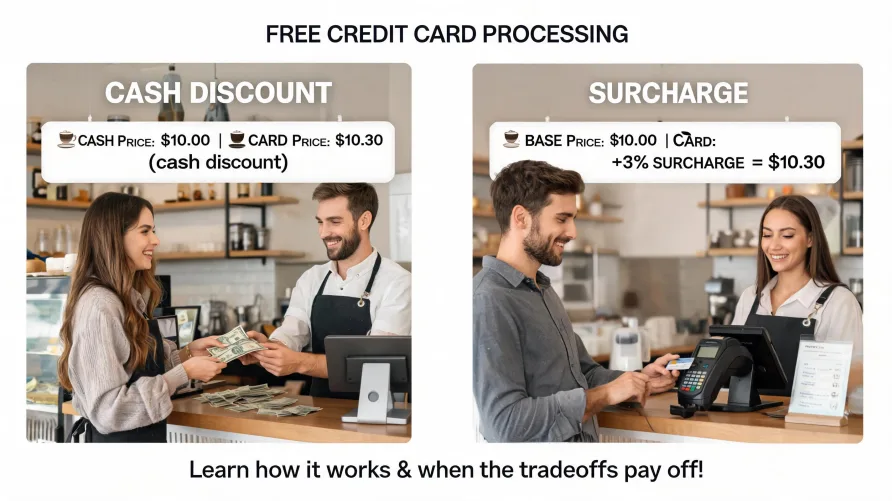
Free credit card processing doesn't eliminate processing fees. It shifts them. Every program marketed as "free" or "zero fee" works by passing the cost of card acceptance to your customers, either through a surcharge added at checkout or a cash discount program that raises posted prices and then reduces them for non-card payments. I've evaluated dozens of these programs over the years, and the marketing consistently outpaces the reality. Here's what you need to know before signing up. How Zero Fee Credit Card Processing Works The basic mechanics are simple. A processor sets up your account so that when a customer pays with a credit card, a fee of typically 3% to 4% is added to the transaction total. That fee covers the interchange, assessment, and processor markup that would normally come out of your revenue. Your statement shows zero or near-zero processing costs because the customer absorbed them instead. Two distinct models get marketed under the "free processing" umbrella, and they work differently from both a legal and an operational standpoint. The first is surcharging. Under a surcharge program, you add a clearly disclosed fee to credit card transactions at the point of sale. The customer sees the fee as a separate line item on their receipt. Debit card transactions can't be surcharged under current card network rules, which means those still process at your standard rate. This is a critical detail that many sales pitches gloss over. The second is a cash discount program. Here, your listed prices are higher by default, and customers who pay with cash or debit receive a discount that brings the price back down to the "real" amount. The legal distinction matters: you aren't charging extra for using a card, you're rewarding customers for paying without one. This model faces fewer state-level restrictions, which is one reason it's become popular with processors marketing no fee credit card processing to small businesses. Both models produce the same financial result for you as the merchant. The difference is in how the customer sees the transaction and which regulations apply. The Legal Framework Behind Surcharging Surcharging is legal in most states, but not all. As of this writing, a handful of states either prohibit or restrict credit card surcharges, and the rules have shifted considerably over the past decade following court challenges and legislative changes. Checking your state's current law before implementing a surcharge program isn't optional. Card networks impose their own requirements on top of state law. Visa and Mastercard both require merchants to register their surcharge program before adding fees, cap the surcharge percentage (currently 3% for Visa), and mandate that the surcharge be clearly disclosed to the customer before the transaction is completed. The surcharge must also appear as a separate line item on the receipt. These aren't suggestions. Violations can result in fines from the card networks, loss of processing privileges, or both. I've seen businesses assume their processor handled all of this on their behalf, only to find out the registration was never filed. If your processor tells you they'll "take care of it," ask for documentation that the network registration is complete. Cash discount programs face fewer legal hurdles because they're structured as a discount rather than a fee. Federal law has protected the right to offer cash discounts since the Cash Discount Act of 1981. That said, implementation still has to be clean. Your signage, receipts, and posted prices all need to reflect the discount structure accurately. If your receipt shows a "service fee" or "non-cash adjustment" instead of a legitimate cash discount, regulators and card networks may treat it as a disguised surcharge, and that puts you back under the rules you were trying to avoid. Compliant Programs vs. Programs That Expose You This is where things get messy. The surge in demand for zero fee credit card processing has attracted processors and resellers who cut corners on compliance. A few red flags to watch for: Your processor adds a flat percentage to all card types, including debit. Card network rules prohibit surcharging debit transactions. If your program applies the same fee to debit and credit cards, it isn't compliant. The fee shows up as a "service fee" or "technology fee" on receipts instead of as a clearly labeled surcharge or a properly structured cash discount. Vague labeling doesn't satisfy network disclosure requirements. No network registration was filed. If your processor can't show you confirmation that your surcharge program was registered with Visa and Mastercard, you're running unregistered. That's a violation regardless of your state's laws. The program was sold as requiring "no changes" to your point-of-sale setup. Compliant surcharging requires specific receipt formatting, customer-facing signage, and transaction-level disclosure. If nothing changed when you signed up, the compliance work likely wasn't done. Non-compliant programs create real risk. Card networks can fine your acquiring bank, which passes that cost to you. Your merchant account can be terminated. In states with surcharge restrictions, you could face enforcement from the state attorney general's office. The money you thought you were saving evaporates when a compliance issue surfaces. What Your Customers Actually Experience The financial math might work in your favor, but the customer experience is a separate question entirely. When a customer sees a 3% to 4% surcharge added at checkout, their reaction depends heavily on context. In some industries, surcharging has become common enough that customers expect it. Government offices, utilities, and certain professional services have conditioned many consumers to see card fees as normal. If your business operates in one of these categories, the friction is minimal. In retail, restaurants, and personal services, the reaction tends to be different. Customers in these settings often view a surcharge as a penalty for using their card, even when the fee is clearly disclosed. That perception affects return visits, online reviews, and overall satisfaction. I've talked with business owners who saved $2,000 a month on processing but lost more than that in reduced customer spending and negative word of mouth. The math only works if your customers stick around to keep paying, and a visible fee gives some of them a reason not to. Cash discount programs can soften this reaction because the psychology is different. Customers feel they're getting a deal for paying cash rather than being punished for using a card. The financial outcome is identical, but the framing matters. Still, any program that increases the visible cost of a transaction creates friction you have to weigh against the processing savings. When Free Credit Card Processing Works for Your Business The model works best when three conditions line up. First, your average transaction value is high enough that customers absorb the fee without it becoming a deal-breaker. A 3% surcharge on a $500 invoice hits differently than 3% on a $12 sandwich. Second, your competitive environment allows it. If every similar business in your area accepts cards without a visible fee, adding one puts you at a disadvantage that no amount of signage can overcome. Third, your customer base already skews toward cash, debit, or check payments, which means the surcharge affects a smaller portion of your total transactions. When all three conditions are present, the savings are real and the risk to your customer relationships is low. When even one of them doesn't hold, the tradeoffs start to outweigh the benefits. Service businesses, B2B companies, professional firms, and trades like plumbing or electrical work tend to see the best results. The transactions are larger, the customer relationship is less price-sensitive at the point of sale, and the fee is proportionally small relative to the total bill. A contractor invoicing $3,000 for a bathroom remodel won't lose the job over a $90 card fee, especially when the alternative is waiting for a check to clear. When It Doesn't Retail, food service, and any business competing primarily on price or convenience should think carefully before adopting a surcharge or cash discount model. In these settings, even a well-disclosed fee creates checkout friction that can push customers to competitors who absorb the cost. That's a real loss. Businesses with a high volume of small transactions face a different problem. The per-transaction surcharge on an $8 coffee order is barely noticeable on a receipt, but the principle of being "charged extra" sticks. And because debit transactions can't be surcharged, you're still paying standard processing rates on a significant portion of your volume, which erodes the savings the program promised. If more than half your transactions are debit, the free processing pitch doesn't hold up mathematically. You'll still carry real processing costs while dealing with all the customer experience tradeoffs. Making an Informed Decision Free credit card processing is a real option for the right business, but it isn't the universal cost-elimination tool that some marketing makes it out to be. Before committing, get clarity on three things: whether your state allows surcharging, whether the program is properly registered with the card networks, and what your actual debit-to-credit transaction split looks like. The processors marketing these programs aren't doing anything wrong in most cases. They're offering a legitimate fee structure that shifts costs from the merchant to the cardholder. The risk comes from sloppy implementation, non-compliant receipt formatting, or a failure to register with the networks. Those details are your responsibility as the merchant, not just your processor's. If you're evaluating providers that offer zero fee or surcharge programs, our credit card processing reviews cover how individual providers handle compliance, pricing, and the customer-facing experience.
The "Free Credit Card Processing" Claim: What It Really Means