
What CardX by Stax Does — and Why It Exists
Most credit card processing fees are invisible to the customer and fully absorbed by the merchant. CardX by Stax flips that model. It scores 7.6 out of 10 in our credit card processing review, and it earns that score by doing something most processors don't: eliminating the merchant's processing cost on credit card transactions entirely through automated, compliant surcharging.
Before going further, a quick distinction worth making: surcharging means a fee is added to the posted price when a customer chooses to pay by credit card. That's different from a cash discount model, where the posted price already includes the cost of card acceptance and cash-paying customers receive a discount off that price. CardX operates as a surcharging solution — the base price stays the same and credit card users pay a transparent fee on top of it.
When a customer pays by credit card, a surcharge — typically 3% — is added to their transaction total. The merchant receives the full sale amount. When a customer pays by debit card, no surcharge applies and the merchant pays the standard debit rate. CardX handles the compliance work that makes this legal: calculating the surcharge correctly, displaying the required signage, formatting receipts to card network specifications, and keeping pace with state-specific surcharging rules as they evolve.
The pitch is simple enough. Sell $100 on a credit card, deposit $100. For businesses where credit card fees have become a meaningful operating expense — service companies billing $10,000+ monthly, B2B suppliers, specialty retailers — that math changes the income statement.
Company Background and Ownership
CardX was founded in 2013 by Jonathan Razi, a Harvard Law graduate who recognized that a 2013 rule change finally gave U.S. merchants the same surcharging rights that universities and government entities had long held. Razi's legal background isn't just founder biography — he authored the CardX amicus brief on surcharging legality, which is part of why the company's compliance infrastructure is treated as a core product capability rather than a secondary feature.
In November 2021, Stax Payments acquired CardX and folded it into its broader payment platform. Stax, founded in 2014 and headquartered in Orlando, Florida, now processes $20 billion or more in annual volume across 40,000+ small and mid-size businesses. CardX operates as a distinct product under the Stax umbrella, serving 5,000+ customers directly while also licensing its technology to 200+ payment processors and ISOs that embed surcharging into their own offerings. Since 2023, CardX by Stax reports having delivered $55 million in processing savings to its merchant base — a figure that reflects both adoption growth and the volume of credit card transactions running through the platform.
How the Surcharging Compliance Engine Works
The compliance challenge with credit card surcharging isn't just knowing that it's legal in a given state. Card networks — Visa, Mastercard, Discover, Amex — each have their own disclosure rules, surcharge caps, and registration requirements. States add another layer. The practical result is that a business trying to implement surcharging on its own faces a moving target of requirements that can shift as regulations evolve. Getting it wrong creates exposure to card network violations and, depending on the state, potential legal liability.
CardX's core technology automates this. Its patent-pending Intelligent Rate system identifies card type at the moment of transaction — distinguishing between credit and debit in under a second — and applies the correct treatment automatically. Credit card transactions get the surcharge; debit transactions don't. For government and education customers, the Intelligent Rate system goes further, calculating the precise cost of each card type rather than applying a flat fee, which means lower-cost cards don't subsidize higher-cost rewards cards. The system assists with card network registration requirements as part of the onboarding process rather than leaving those tasks to the merchant.
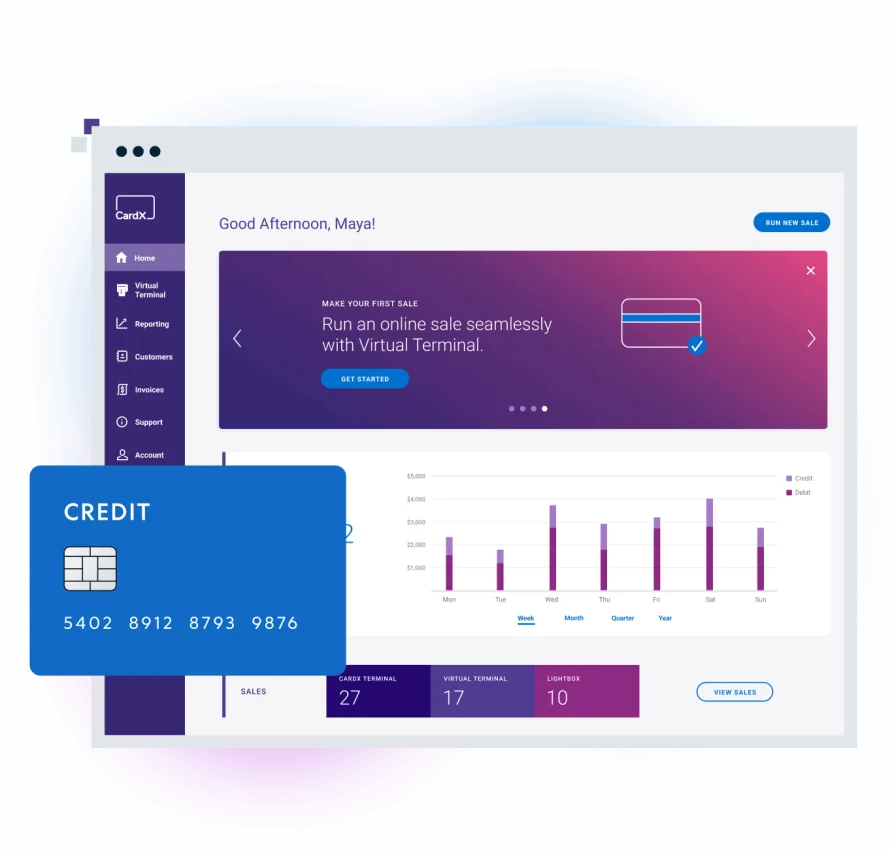
One UX observation worth noting: the CardX portal is functional and clear for transaction management and reporting, but the onboarding experience is sales-assisted rather than fully self-serve. New merchants will have a conversation with a sales representative before going live, which adds a human touchpoint but also means pricing specifics and contract details are negotiated individually rather than published in a checkout flow. For merchants accustomed to instant signup with some processors, that process feels slower. For merchants who want someone to verify their specific state's rules before they go live, it's reassuring.
Pricing and Annual Cost Math
CardX's pricing starts at $99 per month for either in-person terminals or in-office and online virtual terminal access. That fee covers the surcharging infrastructure, compliance management, and platform access. The credit card processing rate for the merchant is, as advertised, 0% — the customer's 3% surcharge offsets the interchange and processing costs entirely.
Debit card transactions are where cost complexity enters the picture. Debit pricing varies by platform and card type — the standard rate runs around 1.25% plus $0.25 per transaction, but commercial debit cards may be assessed at 2.91% on some processor configurations, and certain key-entered debit transactions may not qualify for the 1.25% rate at all. If your business runs significant debit volume, confirming the exact debit terms in your agreement before signing is worth the extra step.
Run the annual math at two volumes: a solo practitioner processing $5,000 per month in credit card transactions at a typical 2.5% effective rate would otherwise pay roughly $125 per month in processing fees, or $1,500 per year. At $99 per month, CardX costs $1,188 per year — and the merchant keeps 100% of every credit card sale. The break-even point sits below $4,000 in monthly credit card volume at that rate. For a retail shop running $30,000 per month in credit card sales, the savings comparison becomes more compelling: $750 per month in absorbed fees vs. the $99 monthly cost of CardX. These examples assume a typical card mix and exclude refunds, chargebacks, and any terminal rental costs. Even accounting for debit volume, businesses with meaningful credit card throughput tend to come out ahead.
Where CardX Works Best — and Where It Doesn't
Consider a dental practice billing $60,000 per month, with roughly 70% of payments coming by credit card. At typical processing rates, that practice is absorbing $1,000+ per month in fees on the credit card volume alone. If patients in that state can be surcharged, and most can — CardX is available in 48 states and the District of Columbia — the practice receives full payment on every credit card charge and manages the $99 monthly cost as a predictable fixed expense rather than a variable one tied to revenue.
The same logic applies to service businesses with larger average tickets: HVAC contractors, flooring companies, commercial cleaning operations billing corporate clients, or law firms handling retainer payments. In these contexts, the surcharge is a line item on an invoice, customers expect to see fees, and the business-to-business dynamic reduces the behavioral concern about surcharge-driven cart abandonment.
High-volume consumer retail is a different calculation. A coffee shop where customers make $6 purchases on credit cards will face a very different reaction to a visible surcharge than a flooring contractor presenting a $4,000 project invoice. For consumer-facing, low-ticket businesses in competitive retail environments, the customer experience consideration weighs more heavily. Surcharging isn't illegal, but it can influence buyer behavior at the margin — some customers will switch to debit, reducing the merchant's processing cost but not eliminating it. Others may react negatively to the fee. Users managing customer-facing retail locations report that this is worth modeling honestly before switching.
Geographic Availability and State Rules
CardX isn't available everywhere. Connecticut and Massachusetts both prohibit credit card surcharging under state law, which is why CardX doesn't serve merchants in those states at all. Maine and New York are available but come with additional terms. In New York, a 2024 amendment to the state's price disclosure law requires merchants to display either a dual price (card price and cash price) or a single all-in price — meaning the compliance signage and checkout flow requirements are stricter there than in most other states. Any business with New York locations should confirm the specific disclosure setup CardX uses to stay compliant under that rule before going live.
What CardX Doesn't Cover
CardX is purpose-built for surcharging compliance. It doesn't aspire to be a full merchant services platform on its own. ACH payment processing, recurring billing, and advanced POS integrations aren't part of the standalone CardX product. Merchants who need those capabilities will need to layer them through Stax's broader platform or a separate provider. That said, for businesses whose primary goal is eliminating credit card processing fees, the absence of those features doesn't represent a gap in the core use case.
Our Verdict on CardX by Stax
CardX by Stax is a focused solution for a specific problem, and it solves that problem well. The compliance automation is the real product — not the payment terminal or the online form. A business that tried to implement surcharging on its own would need to track card network rules, maintain proper signage, manage state-by-state legality, and assist with registration requirements itself. CardX absorbs all of that into a $99 monthly fee and keeps the merchant's processing cost on credit cards at zero.
The limitations are real but not hidden. Geographic restrictions affect two states entirely and add complexity in two more. Debit card volume still carries a merchant cost, and the exact rate depends on your specific agreement. The customer-facing visibility of a surcharge will matter more in some business environments than others. For businesses where those factors are manageable — higher average tickets, B2B relationships, service industries, or markets where surcharging is increasingly normalized — CardX offers a genuinely different financial outcome than conventional processing. Our 7.7 score reflects a service that delivers its core promise reliably while carrying the practical constraints that come with operating in a legally complex, geography-dependent category.