
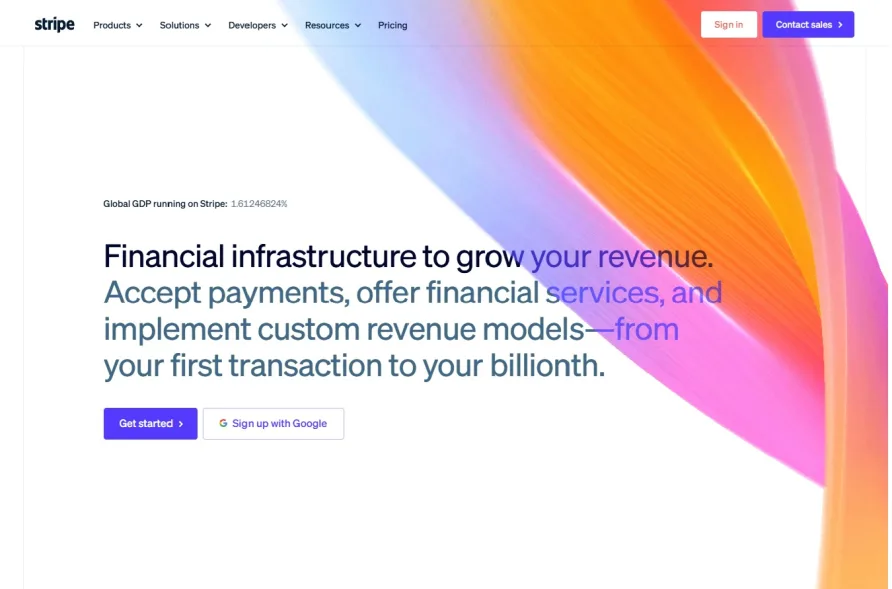
The Platform Developers Build On First
Most credit card processing services sell convenience. Stripe sells control. Built from the ground up as an API-first payment platform, Stripe gives businesses the tools to embed credit card processing directly into their websites, apps, and custom workflows with a level of flexibility that most traditional processors can’t match. We score Stripe 8.4 out of 10 for credit card processing, reflecting an exceptionally strong core product paired with limitations that matter most to non-technical users and high-volume merchants.
Patrick and John Collison, two brothers from rural Ireland, launched Stripe in 2010 with the premise that accepting payments online shouldn’t require weeks of paperwork and bank negotiations. Fifteen years later, the company is headquartered in San Francisco and Dublin, employs roughly 8,500 people, and processes payments in 46+ countries across 135+ currencies. In 2024, businesses on Stripe generated $1.4 trillion in total payment volume, a 38% year-over-year increase representing approximately 1.3% of global GDP. The company reached profitability in 2024 and was valued at $91.5 billion through a February 2025 tender offer. These aren’t startup numbers. Stripe is used by companies ranging from early-stage SaaS businesses to household names, and more than 100 of its customers process over $1 billion annually on the platform.
How Stripe Credit Card Processing Works in Practice
Stripe's core proposition is simple: accept credit card payments online with no monthly fees, no setup costs, and no long-term contracts. You pay per transaction. For domestic card payments, that's 2.9% plus 30 cents. In-person payments through Stripe Terminal run 2.7% plus 5 cents. Manually keyed transactions cost 3.4% plus 30 cents.
The real differentiation sits behind those rates. Stripe isn't just a payment gateway. It's a programmable financial infrastructure layer that lets businesses embed payment processing directly into websites, mobile apps, and custom workflows. The API documentation is widely regarded as the best in the payment industry, and that reputation is earned. Developers can build custom checkout flows, manage recurring billing through Stripe Billing, handle multi-party payments via Stripe Connect, and implement machine-learning fraud detection through Stripe Radar, all through a single integration. When a credit card hits Stripe's network, there's a greater than 92% chance the system has seen that card before, allowing it to compare the transaction against prior behavior patterns and flag anomalies in real time.
For business owners who aren't developers, Stripe offers no-code options. Stripe Checkout provides a pre-built hosted payment page, and Payment Links lets you create shareable URLs that accept payments without any website at all. These tools work for basic use cases. But they're limited compared to what the full API can do. You won't get dynamic currency displays or advanced checkout customization without writing code or hiring someone who can.
Stripe's Optimized Checkout Suite uses more than 100 real-time signals to adjust payment methods and form fields for each customer, improving conversion rates in the background. That kind of intelligence runs on every transaction, and it's the sort of feature you don't appreciate until you see your authorization rates climb.
One detail that catches new users off guard: the Dashboard packs an enormous amount of functionality into a single interface. The first time you toggle between payments, billing, connected accounts, and reporting, the sheer density of options can feel overwhelming. The learning curve flattens within a few weeks, but that initial adjustment is real.
Stripe Credit Card Processing Fees in Practice
No monthly fees. That's Stripe's most compelling pricing feature for small and growing businesses. You don't pay until you process a transaction, which eliminates the fixed overhead that interchange-plus processors typically require.
Here's what the numbers look like annualized. A solo consultant processing $5,000 per month in online card payments at the standard 2.9% plus 30 cents rate, assuming an average transaction of $100, would pay roughly $2,100 per year in processing fees. Scale that up: a small e-commerce store processing $25,000 monthly across 500 transactions pays approximately $9,300 annually. A business pushing $100,000 per month in online volume would spend around $37,200 per year on standard Stripe fees alone. At that last tier, an interchange-plus pricing model from a traditional processor could save thousands annually depending on your card mix. Stripe acknowledges this gap and offers custom negotiated rates for businesses processing $80,000 or more per month.
International transactions add up quickly. An international card adds 1.5% to the base rate, and currency conversion tacks on another 1%. A $100 international transaction costs $5.70 in total fees, more than double the domestic rate.
Disputes deserve attention. Stripe charges $15 when a customer files a chargeback. As of June 2025, Stripe also charges a $15 counter fee when you contest that chargeback. Win the dispute and both fees are returned. Lose it and the total cost is $30 per dispute on top of the lost revenue. That adds up.
ACH Direct Debit is a bright spot at 0.8% per transaction, capped at $5. For businesses that can route customers toward bank payments instead of cards, this offers meaningful savings on high-value transactions.
Who Gets the Most From Stripe
Consider a SaaS company launching a subscription product with customers in twelve countries. The development team needs to embed payment collection directly into the app, handle prorated upgrades and downgrades, manage dunning for failed payments, and report revenue by geography. Stripe handles all of this through its Billing and Payments APIs without requiring a separate subscription management platform, a separate fraud tool, or a separate international payment processor. That's the sweet spot.
Stripe delivers the most value to businesses that are online-first, technically capable or willing to hire technical help, and scaling across borders. E-commerce stores running custom storefronts, marketplace platforms splitting payments between buyers and sellers through Stripe Connect, and SaaS companies managing recurring revenue all fit naturally. The platform is used by roughly half the Fortune 100 alongside hundreds of thousands of startups, and that range exists because the API scales from a single developer's side project to enterprise-grade transaction volumes without requiring a platform migration.
Stripe fits less naturally for brick-and-mortar businesses that rely primarily on in-person transactions. Terminal works, and the 2.7% plus 5 cents rate is reasonable, but it requires either custom app development or a third-party POS integration. There's no turnkey counter-ready system out of the box.
Users managing high transaction volumes consistently report that Stripe's real-time reporting and Dashboard analytics help them spot payment failures and revenue leakage faster than previous processors allowed. A recurring theme among mid-market SaaS companies is that the combination of Billing and Radar reduces involuntary churn by recovering failed payments that would've been lost elsewhere.
Gaps in Stripe's Credit Card Processing
Stripe doesn't offer interchange-plus pricing on its standard plans. Every domestic online transaction pays 2.9% plus 30 cents regardless of whether the customer uses a basic debit card or a premium rewards credit card. Interchange-plus processors pass through the actual interchange cost and add a fixed markup, which typically results in lower fees for high-volume businesses or those with a favorable card mix. Custom rates partially address this, but they require reaching a volume threshold and negotiating directly with Stripe's sales team.
The account stability issue deserves direct discussion. As a payment aggregator, Stripe doesn't underwrite individual merchant accounts the way traditional processors do. Account holds, reserves, and even terminations can happen with limited warning. Businesses processing in industries with higher risk profiles or experiencing sudden volume spikes are more likely to encounter this. The pattern appears repeatedly in user feedback: the platform works smoothly until a hold is placed, and then communication from the support team feels slow and opaque. Stripe has improved its communication around holds in recent years, but this remains the single most common source of frustration among users, and it shows clearly in the divergence between Stripe's strong ratings on developer-focused platforms and its much lower scores on general merchant review sites.
Customer support for standard accounts is another gap. Chat and email support are available, and response times are generally reasonable for routine questions. For urgent issues like account holds or payout delays, users without premium support plans report longer wait times and less direct access to decision-makers.
What's Changed Recently
Stripe's product velocity in 2025 has been aggressive. Between its May Sessions event and September Tour in New York, the company announced more than 80 combined product updates.
The most significant for everyday credit card processing is Authorization Boost, an AI-driven feature that automatically updates expired cards, routes transactions across networks, and retries failed payments to improve approval rates. Stripe's AI systems recovered $6 billion in false declines across the network in 2024, a 60% year-over-year increase. Smart Disputes, which launched in preview during mid-2025, uses AI to automatically compile and submit evidence for eligible chargebacks, reducing the manual burden of dispute management. And Smart Refunds proactively identifies transactions likely to result in disputes and recommends refunding them before the chargeback is filed, catching 26% more fraud in early pilots.
Stripe also co-developed the Agentic Commerce Protocol with OpenAI in September 2025. It's an open standard that lets AI agents discover products, initiate checkout, and complete purchases programmatically. Early-stage, but it signals where Stripe sees online transactions heading.
The Bottom Line
The tradeoffs here are specific enough to matter for certain businesses. Non-technical teams will face a steeper learning curve than they'd encounter with simpler processing tools. High-volume merchants paying flat-rate fees will eventually overpay relative to interchange-plus alternatives. And the aggregator model means account stability depends on Stripe's risk algorithms rather than a dedicated underwriting relationship. If you're in an industry with higher dispute rates, the $30-per-dispute cost structure amplifies that risk.
For online businesses with technical resources, though, Stripe's credit card processing platform is difficult to match. The API is best-in-class. The breadth of payment methods, currencies, and financial tools built into a single integration gives you room to grow without stitching together multiple vendors. The pay-as-you-go model removes upfront risk for new businesses, and custom pricing keeps Stripe competitive as you scale. The pace of product development, particularly around AI-powered fraud prevention and authorization optimization, suggests the platform is extending its lead rather than resting on it. If your business lives online, Stripe belongs on your shortlist.