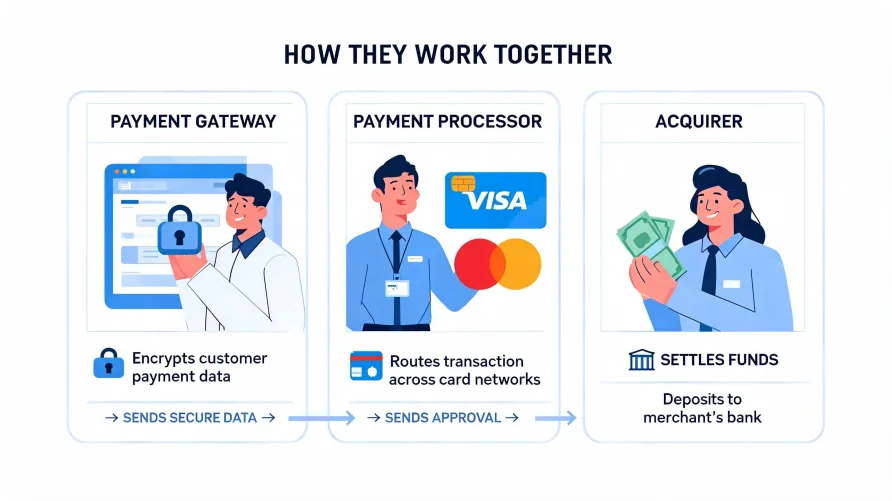
A payment gateway, payment processor, and acquirer handle three distinct jobs in every card transaction. The gateway encrypts and routes payment data from the point of sale. The processor moves the transaction across card network rails. The acquirer is the bank that settles funds into your merchant account. They aren't interchangeable, and understanding the difference between gateway and processor, and where the acquirer fits, determines whether you're paying for overlapping services or missing a critical piece of your payment infrastructure. What a Payment Gateway, Processor, and Acquirer Actually Do These three components form the infrastructure layers that move a card payment from the moment a customer taps, swipes, or types a card number to the moment cash lands in your bank account. Each operates at a different stage, and each has a different relationship with your business. The Payment Gateway The gateway is the front door. When a customer enters card details on your website or taps a card at a terminal, the gateway captures that data, encrypts it, and sends it to the next step in the chain. For online transactions, the gateway is the technology layer between your checkout page and the financial system behind it. Gateways handle several critical functions beyond simple data capture. They tokenize card numbers so your systems never store raw card data, which is a core requirement under PCI DSS. Tokenization replaces the actual card number with a random string that has no value if intercepted, and the token maps back to the real number only inside the gateway's secure vault. Gateways also run initial fraud screening before the transaction ever reaches the processor, checking velocity filters that flag unusual purchase patterns, address verification that compares billing data against the card issuer's records, and card security codes that confirm physical card possession. On top of that, gateways route transactions to the correct processor, which matters if your business uses different processors for different card types or currencies. For brick-and-mortar businesses, the gateway function is often embedded in the payment terminal itself. You don't see it as a separate layer because the hardware handles encryption and routing internally. For e-commerce businesses, the gateway is a distinct, visible piece of your payment stack, and one you'll evaluate and pay for separately. The Payment Processor The processor is the engine that moves the transaction. Once the gateway has captured and encrypted the payment data, the processor takes that information and communicates with the card networks and the banks on both sides of the transaction. Processing happens in two stages. The first is authorization: the processor sends the transaction details through the card network to the cardholder's issuing bank, which checks the account for sufficient funds, applies fraud rules, and sends back an approval or decline. This entire exchange typically takes one to three seconds. The second stage is settlement, which happens later, usually in a batch at the end of the business day. The processor submits all authorized transactions for clearing through the card network, and funds move from issuing banks to the acquiring bank. Batch timing matters for cash flow: most processors close their daily batch between 9 PM and midnight, and transactions authorized after the cutoff roll into the next day's settlement. According to Federal Reserve data on retail payment systems, card-based settlement in the U.S. averages one to two business days for standard domestic transactions, though some processors offer next-day or same-day funding for an additional fee. The processor doesn't hold your money. It moves information and instructions between financial institutions. Think of it as the logistics layer, coordinating messages between banks without ever touching the cargo. The Acquiring Bank The acquirer, sometimes called the acquiring bank or merchant bank, is the financial institution that holds your merchant account and receives settled funds on your behalf. When the processor completes settlement, the money flows into the acquirer, which then deposits it into your business bank account. Acquirers take on financial risk. If a customer disputes a charge and wins, the acquirer is responsible for returning those funds to the card network, then recovering the money from you. This risk exposure is why acquirers underwrite merchants before approving accounts. They review your business type, processing volume, chargeback history, and industry risk profile. A high-risk business will face stricter underwriting and higher reserve requirements than a low-risk retailer. The acquirer also has a direct relationship with the card networks. Visa and Mastercard don't work with individual merchants directly. They work with member banks, and your acquirer is that member bank. According to Visa's core rules, every merchant must be sponsored by a member acquirer to accept Visa-branded cards. How a Payment Gateway vs Processor vs Acquirer Work Together in a Transaction Here's how all three layers interact during a single card payment. A customer buys something on your website for $150. The gateway captures the card number, expiration date, and CVV. It tokenizes the data, runs preliminary fraud checks, and forwards the encrypted transaction to the processor. The processor takes that data and routes it through the appropriate card network to the customer's issuing bank. The issuing bank checks the account balance, applies its own fraud filters, and sends an authorization response back through the network to the processor, then back through the gateway to your checkout page. The customer sees "approved." That night, the processor batches your day's authorized transactions and submits them for settlement through the card network. The issuing bank transfers funds to your acquirer, minus interchange fees. The acquirer deposits the net amount into your bank account, minus its own markup. The entire settlement cycle typically takes one to two business days for domestic transactions. Three layers. Three jobs. One transaction. Is the Acquirer the Same as the Processor? No, but the confusion is understandable. Many companies in the payments industry operate as both processor and acquirer, which blurs the line. When a single provider handles processing and holds your merchant account, you're dealing with one company filling two roles. That doesn't make them the same role. The processor moves data and instructions. The acquirer holds the financial relationship with the card networks and assumes settlement risk. A processor that isn't also an acquirer can't settle funds to your account directly. It needs a banking partner on the back end. An acquirer that doesn't process transactions needs a technology partner to handle the authorization and settlement messaging. Some providers are registered as both. Some are only one. When you evaluate a payment partner, understanding which functions they own versus which they outsource helps you assess where risk, pricing markups, and support responsibilities actually sit. Do You Need a Gateway If You Already Have a Processor? If you accept payments online, yes. The processor can't receive raw card data directly from your website. Something needs to capture, encrypt, tokenize, and route that data before it reaches the processor. That's the gateway's job. If you only accept in-person payments at a physical terminal, the gateway function is built into the hardware. You won't shop for a standalone gateway because the terminal handles it. The distinction matters most for businesses running both channels. Your in-store terminal has gateway functionality embedded, but your e-commerce checkout needs a separate gateway integration. Some processors include a gateway as part of their service. Others don't, which means you'd source one independently and connect it to your processor through an API. Why Some Providers Bundle Gateway, Processor, and Acquirer Together All-in-one providers combine all three layers into a single service. You sign one contract, pay one set of fees, and interact with one support team. The appeal is obvious: simpler setup, less technical integration work, and a single point of accountability when something goes wrong. Bundled providers are especially common among services targeting small businesses. The provider handles gateway technology, processing, and merchant account underwriting under one roof. You don't need to understand where one function ends and another begins because the provider manages the entire chain. For a business processing under $500,000 annually with standard transaction patterns, bundling often makes sense. The convenience trade-off is worth the potential cost premium. The downside of bundling is reduced flexibility. If you want to switch processors but keep your gateway, a bundled setup doesn't allow that. If the provider's fraud screening doesn't meet your needs, you can't swap in a different gateway without changing your entire payment stack. When Separating Your Payment Gateway, Processor, and Acquirer Makes Sense Larger or more complex businesses often unbundle these components deliberately. A business processing several million dollars annually might select one company for gateway technology, a different company for processing, and establish a direct acquiring relationship with a bank. The reasons vary. Unbundling lets you negotiate pricing at each layer independently, which creates opportunities for cost savings at higher volumes. It gives you the ability to swap one component without disrupting the others. If your gateway provider raises prices, you can replace it without migrating your processor or merchant account. Unbundling also lets you choose best-in-class technology at each layer rather than accepting a single provider's version of all three. The trade-off is complexity. You're managing multiple vendor relationships, multiple contracts, and potentially multiple support channels. Integration between separate gateway and processor requires technical resources. If something breaks in the transaction chain, identifying which provider owns the problem takes more effort than calling one bundled support line. For most small businesses, the complexity of unbundling outweighs the savings. For businesses with high volume, specialized needs, or technical teams capable of managing integrations, unbundling can reduce costs and increase control over the payment experience. Choosing the Right Payment Infrastructure for Your Business The right setup depends on your transaction volume, your sales channels, and how much control you want over each layer. Small businesses processing standard transactions typically benefit from a bundled solution that handles everything in one relationship. Growing businesses that start hitting friction with their all-in-one provider, whether on pricing, flexibility, or fraud tooling, may explore separating components to reduce costs or improve control. What matters most is understanding what you're paying for at each layer and whether your current provider actually owns the functions you think they do. Some providers market themselves as full-stack but outsource processing or acquiring to a third party, adding a margin at each handoff. Asking a prospective provider whether they are the registered acquirer, whether they process on their own platform, and whether the gateway is proprietary tells you a lot about where your money goes. If you're evaluating credit card processing providers, our reviews cover how different companies in this market handle these infrastructure layers and what that means for pricing, support, and long-term flexibility.
Payment Gateway vs Payment Processor vs Acquirer