
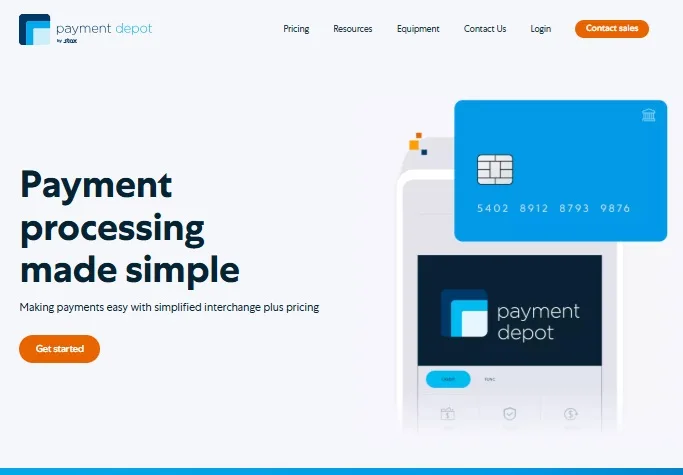
A Subscription Model for Merchants Tired of Percentage Cuts
For a business owner watching 2% to 3% of every sale disappear into processing fees, the search for a cheaper way to accept credit cards can feel endless. Payment Depot has built its reputation on a simple promise: give merchants direct access to interchange rates without inflating them with hidden percentage markups. We score Payment Depot 7.2 out of 10 in the credit card processing category, a reflection of genuinely competitive pricing offset by a feature set that hasn't fully kept pace with its parent company's broader platform.
Payment Depot isn't the scrappy startup it was a decade ago. Danny Choi founded the company in 2013 out of Orange County, California, positioning it as a registered ISO of Wells Fargo Bank with a then-novel membership pricing model. Think of it as the warehouse club approach to payment processing: pay a flat monthly fee, get wholesale interchange rates with zero percentage markup. That model attracted enough attention that Stax Payments acquired Payment Depot in 2021, folding it into a portfolio that already included CardX and Fusebill. Stax itself secured a $245 million funding round in 2022, has processed more than $30 billion in cumulative transactions, and serves upward of 30,000 businesses across the U.S. The original Stax founders stepped away in early 2023, and Paulette Rowe took over as CEO later that year. Payment Depot now operates as “Payment Depot by Stax” out of Orlando, Florida, with roughly 304 employees across the combined organization.
That acquisition reshaped how Payment Depot prices its service. The old membership tiers are gone for new merchants.
What Interchange-Plus Pricing Means for Your Processing Costs
Payment Depot now uses an interchange-plus model rather than its original membership structure. You pay the interchange rate set by Visa, Mastercard, and the other card networks, which every processor pays, plus a markup that Payment Depot quotes based on your business type and monthly volume. That markup ranges from 0.2% to 1.95% over interchange, and there's no separate monthly subscription fee attached to it. No setup fee, no cancellation fee, and no long-term contract. If it doesn't work out, you walk away.
The shift matters because it lowers the barrier to entry. Under the old model, a merchant processing $8,000 a month might have paid $79 per month in membership dues before a single transaction ran. Now that monthly cost is gone. What you pay is tied directly to what you process.
Here's what the math looks like in practice. Suppose you run a retail shop processing $25,000 per month in card sales, and Payment Depot quotes you interchange + 0.35% + $0.10 per transaction. If the average interchange rate across your transactions is 1.75%, your effective rate lands around 2.10% plus per-transaction cents. On $25,000 monthly volume with an average ticket of $50 (roughly 500 transactions), you'd pay approximately $437.50 in interchange, $87.50 in markup, and $50 in per-transaction fees — for a monthly total around $575, or $6,900 annually. Add the $10 monthly PCI compliance fee and you're looking at $7,020 for the year. A flat-rate processor charging 2.6% + $0.10 on the same volume would cost you roughly $8,400 annually. That's over $1,200 in savings.
Scale that to five registers processing $100,000 per month collectively, and the gap widens considerably. Interchange-plus rewards volume in a way that flat-rate pricing can't.
One detail that catches some merchants off guard: Payment Depot doesn't publish a specific rate card on its website. You have to request a custom quote, which means your actual markup depends on a conversation with a sales consultant. Users who've gone through this process report that the quoting experience is quick and pressure-free, though the lack of upfront rate transparency can feel like an extra step for owners who just want to see numbers before picking up the phone.
Processing Tools and Hardware
Payment Depot covers the core payment acceptance channels. For in-person sales, you can choose from Clover POS systems, Dejavoo terminals, or SwipeSimple devices. Clover is the heavier option: full POS functionality with inventory tracking, employee management, and restaurant-specific modules like kitchen ticket routing. Dejavoo and SwipeSimple terminals are lighter, better suited for straightforward card acceptance without the POS overhead. Hardware pricing starts at roughly $299 for a basic terminal and runs up to $499 or more for smart terminals like the Clover Flex.
Online merchants get access to an Authorize.Net payment gateway, which connects to platforms like Shopify, WooCommerce, Magento, and BigCommerce. The virtual terminal, powered through SwipeSimple, handles phone orders and manual card entry. Payment Depot also offers invoicing with email and text delivery, hosted payment pages, and a Text2Pay feature that lets you send customers a payment link via SMS. Recurring billing is available for subscription-based businesses.
The dashboard provides transaction reporting, refund management, and basic sales analytics. It works. But merchants coming from a more feature-rich platform may find the reporting shallow. There's no advanced trend visualization or multi-location comparison built into the Payment Depot dashboard itself. Clover's own reporting fills some of that gap if you're using their POS hardware, but that's Clover's software doing the work, not Payment Depot's.
The Right Merchant for Payment Depot (and the Wrong One)
Consider a restaurant owner processing $40,000 per month across lunch and dinner service. She's currently on a flat-rate processor paying close to 2.6% on every swipe. Switching to Payment Depot's interchange-plus model could drop her effective rate below 2.2%, saving her $1,900 or more per year, money that goes straight back into food costs or staffing. The Clover integration gives her kitchen ticket printing and table management without needing a separate POS vendor. That's the sweet spot.
On the other end, a freelance consultant invoicing three clients a month for $1,500 each wouldn't gain much. With only $4,500 in monthly volume, the savings from interchange-plus over a simple flat-rate processor are marginal at best. And the PCI compliance fee ($10 per month, $120 per year) eats into whatever small margin exists. Payment Depot works best above $10,000 in monthly processing volume. Below that threshold, simpler options make more financial sense.
Payment Depot also excludes several industries outright: online gambling, cruise lines, currency exchanges, extended warranty companies, and a handful of others. If your business falls into a high-risk category, you'll need to look elsewhere.
The Gaps to Know About
Payment Depot isn't a direct processor. It partners with Fiserv and TSYS (now part of Global Payments) on the backend, which means your actual transaction routing goes through one of those networks. For most merchants, this is invisible. But if a dispute or fund hold arises, you may find yourself working with the backend processor's support team rather than Payment Depot's, and that handoff doesn't always go smoothly. Users processing high-ticket transactions (above $5,000 per sale) have reported funds being frozen due to risk flags, with resolution timelines stretching longer than expected.
Accounting integrations aren't built in. Connecting to QuickBooks or Xero requires a third-party bridge, which may carry its own cost. The SwipeSimple mobile app is a paid add-on rather than an included feature, which is notable because parent company Stax includes a free mobile POS app with its direct accounts. Invoicing through Authorize.Net may also incur an additional fee depending on your setup.
Payment Depot currently serves only U.S.-based merchants. There's no international coverage, no multi-currency support, and no cross-border processing capability.
Recent Platform Changes
The biggest shift behind the scenes happened in October 2025, when Stax launched Stax Processing — a full end-to-end processing platform built on technology acquired through its purchases of APPS and BlockChyp. Stax Processing eliminates reliance on third-party processors by bringing the entire transaction lifecycle in-house, from API and gateway through tokenization, clearing, and settlement. For Payment Depot merchants, this means the backend infrastructure is evolving. Stax now connects directly to Visa, Mastercard, Discover, and American Express OptBlue, which should improve dispute resolution speed and reduce processing delays over time.
On the merchant-facing side, Payment Depot's website now emphasizes its interchange-plus pricing model with no monthly subscription, a departure from the membership tiers that defined the brand for nearly a decade. The addition of Text2Pay and hosted payment pages gives merchants more ways to collect payments without requiring customers to be physically present — a meaningful upgrade for service businesses that previously relied solely on invoicing or phone payments.
Our Verdict
Payment Depot delivers on its core promise: competitive interchange-plus pricing without monthly subscription fees, long-term contracts, or cancellation penalties. For mid-volume merchants processing $10,000 or more per month, the savings over flat-rate alternatives are real and measurable. The Stax acquisition gives it a financial and technological backbone that a standalone processor of this size wouldn't have on its own, and the October 2025 launch of Stax Processing signals serious investment in infrastructure. The tradeoffs are worth understanding before you sign up, though. The feature set is leaner than what you'd get from Stax's own direct product, the dashboard analytics are basic, and the post-acquisition user sentiment on review platforms shows a noticeable dip in customer support satisfaction. A rating of 3.2 across more than 1,200 reviews on a major feedback platform reflects real friction that long-time customers have experienced, even as newer users continue to praise the pricing. If your priority is the lowest possible processing cost and you're comfortable with a no-frills toolset, Payment Depot is a strong contender. If you need advanced reporting, built-in accounting integrations, or international reach, the gaps will matter.