
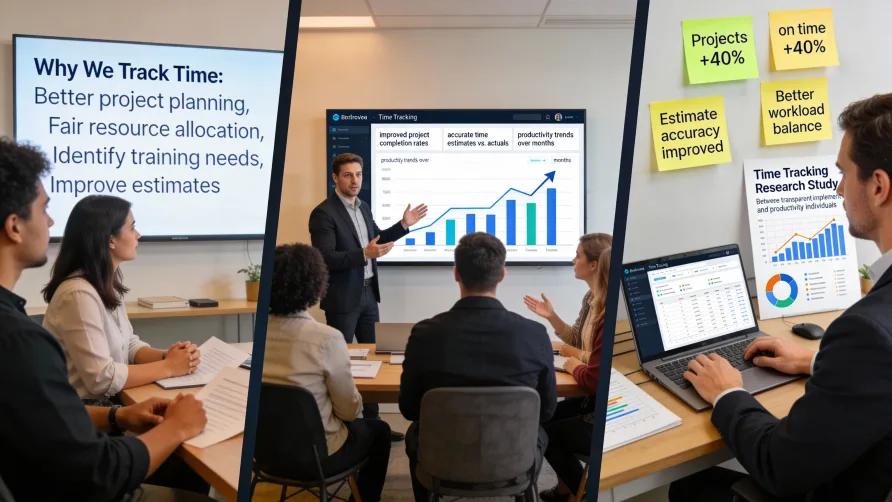
Time tracking is effective for improving project estimates, billing accuracy, and resource allocation, but its impact on productivity depends on how your organization implements it and what you actually do with the data. The difference between effective and ineffective time tracking comes down to trust, transparency, and whether you focus on improvement or surveillance.
Research shows that time tracking works best when employees understand why you're collecting the data and see tangible benefits from the practice. When implemented poorly—as a monitoring tool without clear purpose or feedback—it often damages morale without delivering meaningful business value.
What "Effective" Means for Time Tracking
Effectiveness in time tracking isn't one-dimensional. Your goals determine what success looks like.
Billing accuracy represents the clearest measure of effectiveness. Professional services firms that implement time tracking typically see billing capture rates improve by 15-30% simply because work that previously went unrecorded now gets documented. This type of effectiveness is straightforward to measure: compare billable hours captured before and after implementation.
Project estimation accuracy improves when you have historical data showing how long tasks actually take versus initial estimates. Teams using time tracking data for estimation typically reduce variance between estimated and actual hours by 20-40% over the first year. You're basing predictions on evidence rather than guesswork.
Resource allocation becomes more effective when managers can see actual time distribution across projects and identify bottlenecks or underutilized capacity. This helps prevent burnout on overloaded team members and improves project staffing decisions.
Productivity improvement is where effectiveness gets complicated. Time tracking itself doesn't make people more productive—it reveals how time gets spent. What you do with that information determines whether productivity improves, stays flat, or actually decreases due to resentment and reduced autonomy.
Does Time Tracking Improve Productivity?
The research on time tracking and productivity shows mixed results that depend entirely on context.
Studies examining knowledge workers show that awareness of time tracking can initially improve focus. When people know their time is being recorded, they tend to minimize obvious time-wasters and stay on task. This effect typically produces 5-15% productivity gains in the first few months after implementation.
However, this effect often diminishes over time. The novelty wears off, and people return to baseline productivity levels. More concerning, several studies have found that excessive monitoring can reduce creative problem-solving and increase stress, particularly in roles requiring innovation or complex thinking.
The productivity benefit comes less from the tracking itself and more from the conversations and process improvements that tracking data enables. When managers review time data with employees to identify obstacles, streamline workflows, or eliminate low-value tasks, productivity improvements stick. When tracking exists purely to monitor whether people are working enough hours, productivity gains rarely materialize.
Research from organizational psychology shows that employee autonomy correlates strongly with both productivity and job satisfaction. Time tracking implemented in ways that preserve autonomy (transparent purpose, employee access to their own data, focus on process improvement) maintains or improves productivity. Heavy-handed monitoring approaches often backfire.
One study of remote workers found that teams using time tracking for project management purposes (understanding capacity and bottlenecks) showed 12% higher productivity than teams not tracking time. Teams using time tracking primarily for surveillance showed 8% lower productivity than the no-tracking baseline. The tool itself is neutral—the approach determines outcomes.
Is Time Tracking Accurate?
Accuracy in time tracking varies based on your method and how frequently people record time.
Real-time tracking (starting a timer when beginning a task) produces the most accurate data, with error rates typically under 5%. People simply record what they're doing as they do it, eliminating the recall problem.
End-of-day manual entry introduces more error. Research on time perception shows that people consistently misremember task duration when reconstructing their day from memory. Error rates for end-of-day entry typically range from 15-25%, with people tending to underestimate time spent on brief tasks and overestimate time on longer activities.
Weekly retrospective entry amplifies these accuracy problems. After several days, people struggle to remember specific task durations with any precision. One study found that weekly time entry had error rates exceeding 35% when compared to passively collected data.
Automatic tracking (monitoring computer activity, application usage, etc.) captures accurate data about digital work but misses meetings, phone calls, planning time, and other non-computer activities. It provides precise information about a subset of work, not complete accuracy.
The biggest accuracy problem isn't the tracking method—it's incentive structure. When compensation, performance reviews, or project budgets depend heavily on tracked hours, people have incentives to record time in ways that serve their interests rather than reflecting reality. Time gets attributed to projects with remaining budget, not necessarily where work occurred. Breaks disappear from timesheets. Hours get inflated or deflated based on what seems politically safe.
Accuracy improves when you reduce these incentives for manipulation. Clear categories, simple processes, and consequences that focus on improvement rather than punishment produce more honest data.
When Time Tracking Works Well
Time tracking delivers clear value in specific contexts where the business model or operational needs align with what tracking provides.
Professional services and agencies benefit substantially because they bill clients based on time. Accurate time data directly impacts revenue capture and profit margins. The business justification is obvious to employees, reducing resistance.
Project-based work environments use time tracking effectively for estimation, budgeting, and resource planning. When you need to understand project costs and improve future estimates, tracking provides essential data. Teams see their estimates improve over time, creating positive feedback.
Remote and distributed teams often find time tracking helpful for coordination and workload management, particularly across time zones. When visibility into who's working on what becomes difficult, tracking can provide useful insight without requiring constant status updates.
Compliance-driven industries sometimes require time tracking for regulatory purposes (government contractors, legal firms, healthcare). When tracking is mandatory regardless of preference, implementation quality determines whether it also provides business value.
Time tracking works best when your organization has clear answers to "why are we doing this?" and "how will this help employees do their jobs better?" If you can't articulate specific benefits beyond "monitoring," effectiveness suffers.
When Time Tracking Doesn't Work
Several situations make time tracking ineffective or counterproductive.
Creative and innovation-focused roles often struggle with time tracking because valuable thinking happens away from keyboards and task categories. Forcing creative work into timesheet categories can feel reductive and miss the actual creative process. The juice isn't worth the squeeze.
Highly variable knowledge work resists clean categorization. When someone spends 15 minutes on five different tasks in an hour, tracking becomes burdensome and interrupts flow. The administrative overhead exceeds the value of captured data.
High-trust cultures with output-based evaluation may find time tracking introduces surveillance dynamics that damage the existing culture. If you've built a results-oriented workplace where people have autonomy and accountability for outcomes, adding time tracking can signal distrust and shift focus from results to hours.
Organizations without capacity to act on data waste everyone's time implementing tracking. If you're not going to review the data, analyze patterns, and make changes based on what you learn, don't collect it. Tracking for tracking's sake breeds cynicism.
Low-margin, high-volume businesses where labor is already optimized often see minimal benefit. If you're running efficient operations and margins don't support process changes, time data won't tell you much you don't already know.
Factors That Affect Time Tracking Effectiveness
Several variables determine whether your time tracking implementation succeeds or fails.
Communication about purpose ranks as the single most important factor. When employees understand why you're tracking time and what you'll do with the data, resistance drops and data quality improves. Vague explanations or obviously pretextual justifications breed suspicion and game-playing.
Employee access to their own data increases buy-in. When people can see their own patterns and use the data for personal productivity insights, they view tracking as a tool rather than surveillance. Managers-only access creates adversarial dynamics.
Feedback loops determine whether tracking drives improvement. If data goes into a black hole and nothing changes, people stop caring about accuracy. When data leads to identifying obstacles, improving processes, or better resource allocation, engagement increases.
Ease of use affects compliance and accuracy. Systems requiring more than 30 seconds to record a task suffer from incomplete data. Friction in the tracking process leads to batch entry, approximation, and missing activities.
Management approach to the data shapes outcomes more than any other factor. Managers who use time data to ask "how can we help remove obstacles?" get better results than those who ask "why didn't you bill more hours?" The former builds trust; the latter builds resentment.
Alignment with compensation creates powerful incentives. If billable hours affect bonuses, people will find ways to maximize tracked billable time regardless of accuracy. If utilization rates drive performance reviews, the metrics get optimized regardless of whether actual productivity improves.
How to Measure Time Tracking Success
Defining success metrics helps you evaluate whether time tracking delivers value for your organization.
Project estimate accuracy provides concrete measurement. Compare estimated hours to actual hours for completed projects. Track how this variance changes over time. Improving accuracy indicates the system is working.
Billing capture rates matter for professional services. Calculate the percentage of available working hours that get billed to clients. Increases suggest you're documenting previously lost billable time.
Employee satisfaction scores around workload and clarity should improve or stay stable. If tracking correlates with declining satisfaction, you're implementing it wrong. Survey employees specifically about the time tracking process.
Process improvements identified from time data analysis demonstrates value. Track how many workflow changes, resource adjustments, or capacity decisions result from reviewing time tracking data. Zero indicates you're not using the information.
Time spent on tracking administration should be minimal. If employees spend more than 5-10 minutes daily on time entry, the overhead is too high. Factor this cost into your ROI calculation.
Data completeness and accuracy can be spot-checked by comparing tracked time against calendar appointments, deliverable completion dates, and project timelines. Major discrepancies suggest data quality problems.
Measure these factors quarterly for the first year, then annually. Time tracking effectiveness isn't static—it changes as novelty wears off, processes evolve, and management focus shifts.
Making Time Tracking More Effective
If you've decided time tracking serves your business needs, several approaches improve effectiveness.
Start with transparency. Explain exactly what you're tracking, why you're tracking it, and how the data will be used. Address privacy concerns directly. Share aggregate insights with teams so they see the data in action.
Focus on projects and tasks, not surveillance. Frame tracking as project management and resource planning, not employee monitoring. This framing is more than PR—it should reflect actual usage of the data.
Keep categories simple and clear. Confusing taxonomies lead to inconsistent data. Most organizations need fewer categories than they initially create. Six to eight high-level categories work better than thirty granular ones.
Make it easy. Choose tools that integrate with existing workflows and require minimal steps to record time. Mobile access helps people track time regardless of location.
Review data with teams regularly. Monthly or quarterly reviews of how time is distributed, where bottlenecks occur, and what patterns emerge turns raw data into actionable insights. This demonstrates that tracking serves a real purpose.
Give employees control over their data. Let them run their own reports and analyze their time patterns. This shifts tracking from something done to them to a tool they can use.
Adjust based on feedback. If people consistently complain about specific categories, tracking methods, or reporting requirements, listen and adapt. Rigid systems that ignore user input lose compliance and accuracy.
The Bottom Line on Time Tracking Effectiveness
Time tracking is effective when it solves specific business problems like improving billing accuracy, enhancing project estimates, or managing resource allocation. It becomes ineffective when implemented as generic employee monitoring without clear purpose or when data goes unused.
Your results depend more on organizational culture, management approach, and what you do with collected data than on which software you choose or how many features it has. The same system can be highly effective in one company and counterproductive in another.
Before implementing time tracking, define specific goals and how you'll measure success. If you can't articulate clear benefits and concrete uses for the data, effectiveness will be elusive regardless of implementation quality. Time tracking works when it serves a genuine business need and when employees understand how it helps them do their jobs better.