
Three Decades of Restaurant and Retail Focus
After nearly three decades in the payment processing industry, Heartland Payment Systems scores 6.8 out of 10 in our credit card processing evaluation. That score reflects a processor with legitimate strengths — particularly in restaurant and retail environments where integrated POS capabilities matter as much as the transaction itself — alongside real trade-offs in pricing transparency and fee predictability that require a careful read of any merchant agreement.
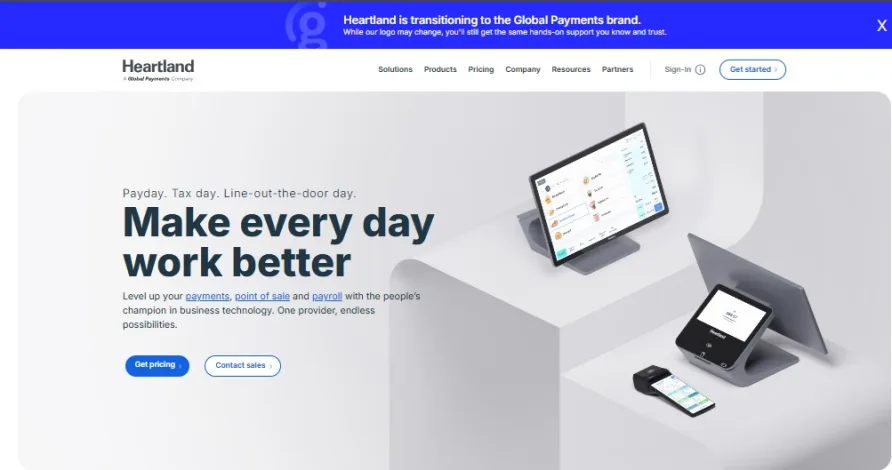
Heartland was founded in 1997 in Princeton, New Jersey, and acquired by Global Payments (NYSE: GPN) for $4.3 billion in 2016. For most of that time since, the brand has operated semi-independently, maintaining its own name and identity. That's changing. The processor is officially consolidating under the Global Payments brand, with merchants already seeing the rebrand on monthly statements, and a full transition expected by 2026. Nearly one million businesses currently use the platform. For prospective merchants, that context matters — you're signing with a company mid-transition, though the underlying contracts, infrastructure, and service delivery remain the same through and beyond it.
Core Payment Processing Capabilities
Heartland supports in-person, online, and mobile payment acceptance across debit, credit, and digital wallets including Apple Pay and Google Pay. Merchants can process EMV chip cards, contactless payments, and magstripe through Heartland's hardware, which ranges from countertop terminals to tablet-based systems and handheld mobile readers. Beyond basic transaction processing, the platform includes online ordering integration, recurring billing, a virtual terminal for phone and mail-order payments, and a reporting dashboard called Merchant View that tracks transaction history, chargebacks, and settlement activity.
Heartland's restaurant and retail POS reflects a clear push toward cloud-managed, mobile-friendly workflows. The direction is toward multi-location management, faster menu and catalog updates, and flexible front-of-house operation — the areas that matter most for restaurants running real-time order flow and retailers managing inventory across channels. A mobile-first interface update launched in early 2024 refreshed the iOS and Android experience on both the restaurant and retail sides of the platform. The platform also supports surcharging programs where permitted by state law, with rules varying by state and card network.
Built for the Restaurant and Retail Operator
The clearest case for Heartland is a full-service restaurant managing multiple revenue streams from a single system. Consider a 10-table dining room where the kitchen display system needs to stay in sync with the front of house in real time, servers need to split checks and accept tableside payments without leaving the guest, and the owner wants to check sales from a phone while offsite. Heartland's Restaurant POS is purpose-built for that chain of needs: it includes table management with graphical floor layouts, kitchen display system integration, tableside ordering and payment via handheld device, scan-to-order and scan-to-pay QR functionality, and native integrations with DoorDash and Grubhub — all within a cloud-based platform that syncs across channels as orders come in.
Retail is a similarly strong fit. In a multi-location retail setup, the practical advantage is centralized inventory and catalog control with consolidated reporting. Pricing and stock updates pushed from a single dashboard propagate immediately — across both in-store and online channels — which reduces the operational risk of mismatched pricing and inventory counts during high-traffic periods or promotional events. Heartland Retail supports that workflow without requiring separate tools for the physical and digital sides of the business.
Businesses that process primarily online without a physical presence, or those in professional services, will find Heartland's value proposition less clearly defined. The platform's most compelling capabilities are tied to in-person environments with specific operational complexity.
What Heartland Costs in Practice
Pricing with Heartland isn't simple, and that's worth stating plainly. The company doesn't publish its interchange-plus markups — the pricing model most merchants should request. What's publicly available is a flat rate of 2.6% plus $0.10 per in-person transaction and 2.9% plus $0.30 per online transaction. Those rates are negotiable in practice, but the flat-rate option is expensive for higher-volume merchants and should be avoided if interchange-plus is available.
To put annual costs in concrete terms: a single-location restaurant processing $15,000 per month in card volume under flat-rate pricing would pay roughly $405 per month in processing charges — approximately $390 in percentage-based fees plus $15 in per-transaction charges on 150 transactions. That's $4,860 per year in processing alone. Add POS software at $89 per station per month ($1,068 annually), and the first-year cost exceeds $5,900 before additional fees apply. For a three-station restaurant at $40,000 per month in card volume, flat-rate processing runs roughly $1,080 per month ($12,960 annually), three POS terminals add $3,204 per year, and the annual total clears $16,000 before other line items.
Those other line items deserve attention. Heartland charges an Annual Reporting Fee ranging from $245 to $410 per merchant location, and a PCI non-compliance fee of $125 per month applies to accounts that haven't completed compliance validation. An optional Customer Intelligence Suite add-on runs $59.95 per month. Before signing, ask for a complete fee schedule and keep it alongside the agreement — that makes it easy to reconcile statements and identify any new charges that appear over time. Requesting interchange-plus pricing upfront, and negotiating the markup with a sales rep directly, is the single most effective way to control long-term costs.
Working With the Platform Day to Day
Merchant View — the back-office portal for reporting and account management — covers the essentials: transaction lookup, settlement reporting, refunds, and chargeback visibility. The information architecture isn't immediately intuitive on first contact, though. Field labels don't always map to what you'd expect from a first session, and locating specific historical records or drilling into settlement details takes some orientation before it becomes a fast, routine task. Plan for a short ramp when onboarding your accounting or operations staff.
The restaurant-side experience is notably stronger. Cloud-based menu management allows updates to sync across all locations and ordering channels immediately upon publish — a practical improvement over locally-installed systems that require per-terminal updates. Operators running several locations consistently identify the ability to push menu and pricing changes from a single interface, and have them live everywhere within seconds, as one of the platform's most operationally valuable features.
Stability and Scale
Heartland's institutional backing is one of its clearest advantages among processors targeting small-to-mid-size businesses. Global Payments is a publicly traded company with global operations, and that scale translates to enterprise-grade infrastructure, compliance resources, and financial stability that independent processors typically can't match. For a restaurant group or retail chain planning to grow, that means a processor capable of scaling with them rather than requiring a platform change at a certain volume threshold.
Data security is another area where Heartland's history is worth knowing. The company experienced a significant breach in 2008 — at the time among the largest payment security incidents on record. The response shaped meaningful improvements not only within Heartland but across industry security standards more broadly. End-to-end encryption and a sustained focus on data protection have defined the company's security posture since. That history explains the institutional seriousness with which Heartland approaches data security today.
What to Think Through Before You Sign
The real cost profile with Heartland is governed by the merchant agreement — particularly the fee schedule and any provisions covering rate or fee adjustments over the contract term. Treat the contract as the source of truth on what you'll pay and under what conditions those costs can change. Build a habit of scanning monthly statements for new line items, especially in the first year, and verify that what you're being charged matches what you agreed to. If anything looks unfamiliar, call your account rep directly and ask for an explanation in writing.
Contract terms themselves vary by merchant, including multi-year commitments and early termination provisions that differ from account to account. Ask specifically about contract length, termination terms, and the conditions under which rates or fees can be adjusted before signing. Getting those answers upfront is considerably easier than negotiating them mid-contract.
The ongoing brand transition is also worth knowing about. Accounts are migrating from Heartland to Global Payments branding through 2025 and 2026. For most merchants, nothing functional changes — contracts, services, and support infrastructure carry over. But the Heartland name is being retired, and it's better to know that before your first statement arrives under a different brand name than to treat it as a surprise.
Our Verdict
Heartland is a processor that rewards merchants who engage with it actively — those who negotiate interchange-plus pricing, read the contract carefully, and monitor monthly statements for line-item changes. For restaurant and retail operators, the integrated POS depth is genuine and well-developed: tableside payments, kitchen display systems, delivery partner integrations, and real-time multi-location management are real capabilities, not surface-level additions. The Global Payments infrastructure behind it provides long-term reliability and scale. Informed buyers do well here.
The trade-offs are real, though. Fee transparency has been a persistent gap, and the flat-rate pricing structure is meaningfully more expensive than interchange-plus alternatives. Merchants who don't actively manage their accounts can end up paying significantly more than they expected. If your priority is a processing relationship where monthly costs are fully predictable from the first statement, there are simpler options. If you run a restaurant or retail operation and want a deeply integrated platform with staying power, Heartland — soon to be Global Payments — is worth a serious look.
For a broader comparison of top options, see our Best Credit Card Processing Companies 2026.