
What Almost Three Decades in Time Management Actually Gets You
Few enterprise time and attendance software platforms can claim nearly 30 years in market. Replicon can. We score Replicon 7.6 out of 10 for the time and attendance software category, reflecting a platform with exceptional compliance depth and AI-powered time capture, held back by configuration complexity and opaque enterprise pricing. Founded in 1996 in Calgary, Canada, by husband-and-wife team Raj Narayanaswamy and Lakshmi Raj, the company built its reputation on enterprise time management before Deltek, a major provider of project-based business software headquartered in Herndon, Virginia, acquired it in August 2023. The deal was one of Deltek's largest. Today, operating as Deltek | Replicon, the platform serves over 2,500 customers across 85 countries, including Fortune 100 organizations.
The platform is built around a modular architecture. TimeAttend handles workforce time and attendance, scheduling, and overtime. TimeBill covers project time tracking and client billing. TimeOff manages leave policies, accruals, and compliance. And the unifying layer, the Time Intelligence Platform, ties everything together with AI-powered features like ZeroTime automatic time capture. You can buy modules individually or combine them depending on what your organization needs.
For mid-market and enterprise buyers evaluating time and attendance software solutions, Replicon's depth is immediately apparent. This isn't a lightweight tracker built for freelancers. The compliance engine alone, covering 375+ labor rules across 147+ jurisdictions in more than 85 countries, signals that the product was designed for organizations operating across borders and regulatory environments.
How ZeroTime Changes the Timesheet Equation
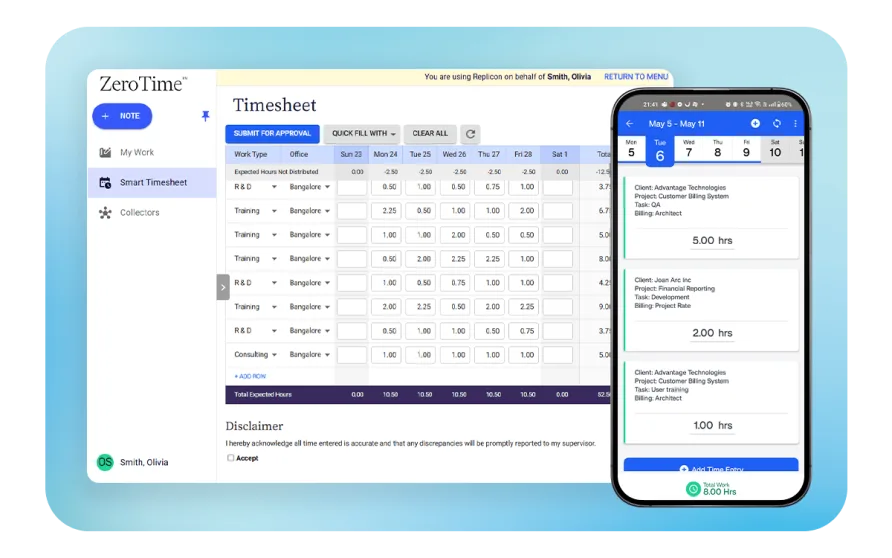
ZeroTime is Replicon's AI-powered automatic time capture engine, and it's the feature that most clearly separates the platform from conventional time tracking tools. Instead of asking employees to manually log hours against projects and tasks, ZeroTime pulls time data from over 100 work applications, including Slack, Jira, Asana, Zoom, Microsoft 365, and Google Workspace. It then uses machine learning to classify that activity against the right projects and tasks, producing pre-filled timesheets that employees simply review and submit.
The concept addresses one of the oldest problems in professional services: timesheet accuracy. Employees forget. They estimate. They round. Over a year, those small errors compound into significant billing and payroll discrepancies. ZeroTime's approach reduces that friction by capturing work activity passively and continuously learning from user corrections to improve its project and task labeling over time.
There's a Chrome extension and an Outlook integration, both included with a Replicon license, that expand the capture footprint to browser-based work and email activity. Data privacy controls let employees review, modify, or delete any captured entry before it reaches a supervisor, which helps with adoption in organizations sensitive to surveillance concerns. That said, ZeroTime is an add-on to the base modules, so expect additional cost on top of the published per-user pricing. Replicon doesn't publish the ZeroTime add-on rate, which means another conversation with sales.
Replicon Pricing and What It Costs in Practice
Replicon's pricing structure starts with published per-user rates for its individual modules but quickly shifts to custom quotes for enterprise configurations. The publicly listed tiers break down as follows: TimeAttend Quick Start is free with limited features. TimeAttend Plus runs $8 per user per month. The Workforce Management tier, which adds scheduling, compliance, and AI-powered forecasting, costs $12 per user per month. TimeBill for project time tracking starts at $22 per user per month. TimeOff is $6 per user per month.
For a 10-person team on TimeAttend Plus, the annual cost comes to $960. Move that same team to the Workforce Management tier for scheduling and compliance features and the annual bill rises to $1,440. A solo consultant using TimeBill for project billing would pay $264 per year. These are the simple calculations for the published tiers.
The reality for most mid-market and enterprise buyers is different. Replicon's target customers, organizations with complex compliance requirements, multi-jurisdiction workforces, or project billing needs, typically require custom configurations that go beyond the published pricing. Adding ZeroTime, implementing custom pay rules, or integrating with existing ERP and payroll systems all involve sales engagement and custom quotes. A 10-user minimum applies to enterprise plans. Users managing organizations of 50 to 500+ employees should budget for implementation services on top of per-user licensing, as the configuration effort for global compliance and custom workflows isn't trivial. Some third-party sources report typical enterprise pricing in the $6 to $12 per user per month range depending on modules selected, but Replicon doesn't confirm these figures publicly.
Where Replicon's Compliance Engine Earns Its Keep
The compliance engine is arguably Replicon's most defensible feature. The platform maintains a library of pre-configured pay rules covering overtime calculations, meal break requirements, rest period mandates, and holiday premiums across 147+ jurisdictions in more than 85 countries. An in-house legal team monitors regulatory changes and pushes updates to the platform, which means your organization doesn't need to track labor law amendments across every jurisdiction where it has employees.
This matters most for the organizations that need it. A consulting firm with employees in California, Germany, Japan, and the Cayman Islands faces wildly different overtime rules, mandatory break structures, and holiday pay calculations in each location. Replicon's compliance library handles those variations automatically once configured, and keeps pace as regulations change. A Q1 2025 update added configurable meal break enforcement validation rules for California, Nevada, and Germany, letting administrators define minimum work duration thresholds and break intervals. The same release expanded pay rule coverage to the Cayman Islands and Lithuania, and introduced maternity leave validation rules to comply with regulations in the Netherlands and similar jurisdictions. A Q2 2025 update followed with automatic overtime hour distribution across projects for U.S. employees, shift audit reporting, and timesheet template scheduling for employees changing departments or locations.
The Payroll Workbench consolidates all time, attendance, and compliance data into a single view for payroll processing. You can assemble, review, filter, and export pay runs from one interface, which reduces the back-and-forth between HR, payroll, and finance teams. Integration with major payroll providers including ADP (RUN, Workforce Now, and Next Gen), Ceridian, and Paylocity keeps the data moving without manual re-entry. Replicon also connects with SAP, Oracle, Sage Intacct, QuickBooks, and project management tools like Jira, Asana, and Slack, though some users note that certain integrations could go deeper in terms of bidirectional data sync.
On the security side, Replicon holds ISO 27001 and CSA STAR certifications, both of which Deltek achieved for the Replicon platform post-acquisition. ZeroTime's data capture runs through encryption and storage practices that meet global standards, and employees retain full control over captured data before submission. Regular third-party security audits add another layer. For organizations in regulated industries like government contracting or financial services, these certifications can simplify vendor approval processes considerably.
The Configuration Curve and UX Realities
Replicon's desktop interface is clean and functional. Users managing multiple projects across global offices consistently rate the web application favorably for its logical layout and project tracking views. The reporting engine supports custom report building with flexible filters, and managers get real-time visibility into hours logged, overtime accumulation, and project budgets. A Q3 2025 update added the ability to restrict report sharing to internal email addresses only, along with sub-location report access, which matters for organizations managing compliance data across regions.
Configuration is where the experience diverges. Setting up Replicon for a single-location team with basic needs is manageable. Configuring it for a multi-jurisdiction enterprise with custom pay rules, union agreements, shift rotations, and project billing structures requires either a dedicated internal admin or Replicon's professional services team. Users who've deployed the platform across global operations note that initial setup involves substantial effort, often spanning weeks for complex implementations. One recurring theme in feedback from large organizations is that the platform's flexibility is both its greatest asset and its steepest learning curve. The depth is there, but getting to it takes real work.
The mobile app covers the basics: clock-in and clock-out, timesheet submission, time-off requests, and GPS tracking for field workers. Facial recognition and real-time image capture help prevent buddy-punching. CloudClock, Replicon's kiosk feature, turns any tablet into a shared time clock for shift-based teams. But the mobile experience doesn't match the desktop in feature depth. Several long-term users report that the app can lag during peak usage periods and that certain administrative functions are only available through the web interface. That's a common tradeoff in enterprise software, but it still matters if your workforce relies heavily on mobile devices.
One specific UX observation: the timesheet interface uses hover tooltips over line items that can obscure the first column of the weekly view, forcing users to click elsewhere before they can type in the intended cell. It's a minor interaction issue, but it affects daily use for employees filling out timesheets across dozens of project codes.
Is Replicon the Right Fit for Your Organization?
Replicon fits best in a specific operational context. Consider a mid-size IT consulting firm with 200 employees spread across the United States, Canada, and the United Kingdom. Project managers need billable time tracked against client engagements. HR needs overtime and break compliance enforced differently in each country. Finance needs gross pay calculations that account for local labor rules before data flows to the payroll provider. That's the scenario where Replicon's modular architecture and compliance depth justify the investment. Government contractors managing DCAA-compliant timekeeping and professional services firms billing across multiple engagement types are also in the sweet spot.
The fit weakens as you move toward smaller, simpler operations. A 15-person marketing agency tracking hours against three or four client accounts doesn't need 147 jurisdictions of compliance support or AI-powered timesheet generation. The configuration overhead and quote-based pricing model create friction for organizations that just want a tool they can set up in an afternoon. The 10-user minimum on enterprise plans reinforces that Replicon isn't optimizing for small teams.
Replicon earned 19 G2 badges in Fall 2025 across professional services automation, time and attendance, time tracking, and workforce management categories. The platform's aggregated user satisfaction sits at 88% across over 1,067 reviews, with desktop users rating the experience more favorably than mobile users. Support quality generates mixed reactions: some organizations praise the responsiveness and follow-up communication, while others report that resolution cycles for configuration-related issues can be slow. Following the Deltek acquisition, support emails now route through Deltek's support center, and only designated team members can raise tickets on behalf of other users, which adds a layer to the support workflow.
What Replicon Doesn't Cover
Replicon doesn't include biometric hardware as part of the platform. If your operation requires physical time clocks with fingerprint or badge readers, you'll need third-party hardware integrated separately. CloudClock is the built-in alternative, but it's a software-based kiosk solution running on existing devices.
The platform also doesn't offer a self-serve purchasing path for enterprise configurations. You can start a free trial of TimeAttend Quick Start, but anything beyond the basics requires engaging with sales. For organizations accustomed to evaluating software through hands-on trial before committing, this adds time to the buying process. It also means you won't know your real cost until you've described your requirements in detail to a sales representative, which makes budget planning harder during the initial evaluation phase.
Our Verdict on Replicon
Replicon is an enterprise time and attendance platform with legitimate depth. Nearly 30 years of development, a compliance engine covering 147+ jurisdictions, AI-powered time capture through ZeroTime, and the backing of Deltek's enterprise infrastructure make it a serious option for mid-market and large organizations with complex time management requirements. The platform earned its 7.6 score through the strength of its core functionality and compliance coverage, two areas where it consistently outperforms simpler alternatives.
If your organization operates across multiple jurisdictions, bills clients for project time, and needs automated compliance enforcement, Replicon delivers real operational value. The tradeoffs are real too: quote-based pricing, configuration complexity, and a mobile experience that trails the desktop mean this isn't a plug-and-play tool. For the right buyer, those tradeoffs are worth accepting. For everyone else, simpler options exist.