
A Legal Platform Where Time Tracking Isn't an Afterthought
For a law firm trying to capture every billable minute across dozens of active matters, the gap between tracking time and actually getting paid for it can be expensive. MyCase closes that gap. We score it 7.2 out of 10 in the time and attendance software category, a reflection of strong legal-specific time tracking inside a broader platform that wasn't designed for general business use.
MyCase launched in 2010 out of San Diego, California, with a specific mission: give small law firms a single cloud-based platform to manage cases, communicate with clients, and handle billing. The company grew steadily through the 2010s, and in June 2022, AffiniPay (the parent company of LawPay, the legal payments processor) acquired MyCase in a deal that combined roughly 500 employees and over 200,000 legal professionals into one ecosystem. AffiniPay rebranded as 8am in August 2025, and the product now operates as 8am MyCase. It's backed by TA Associates and generates north of $200 million in annual revenue across its combined brands. That's relevant context for any firm evaluating long-term platform risk.
How MyCase Handles Time Tracking in Practice
Time tracking in MyCase isn't a standalone module. Every time entry ties directly to a case, which means when an attorney logs 1.4 hours drafting a motion for a family law matter, that entry is already linked to the right client, the right case file, and the right billing record. There's no separate step to associate time with a project or export it to another tool for invoicing. The connection is automatic.
The timer function works the way you'd expect. Start it, work, stop it, and the entry populates with the case context already attached. Attorneys can also enter time manually after the fact, which is how many practitioners actually work, filling in time sheets after their last appointment or during breaks between court appearances. MyCase includes a Smart Time Finder feature that flags potential missed billable time based on activity within the platform, catching entries that might otherwise slip through. For firms where timekeepers routinely under-bill because they forget to log smaller tasks, that feature alone can recover real revenue.
One interface detail that could be clearer: the time entry screen doesn't label its billing rate fields in the most intuitive way for new users. If a firm uses multiple billing rates across different case types or attorney experience levels, the initial setup requires careful attention to make sure each rate maps correctly. Once configured, it runs fine, but the first pass through the settings can feel less guided than you'd expect given how polished the rest of the interface is.
The bigger update came in May 2025 with Billables AI. This tool automatically captures billable time as attorneys work across email, documents, calls, and meetings, then drafts time entries and syncs them to the correct matter. It's the kind of feature that addresses a real behavioral problem: attorneys are trained to practice law, not to meticulously track every six-minute increment. Billables AI handles the capture in the background and lets the attorney review and approve entries rather than create them from scratch. The feature requires the Pro plan or higher, which means firms on Basic won't have access to what's arguably the most impactful time tracking improvement MyCase has shipped.
From Time Entry to Invoice to Payment
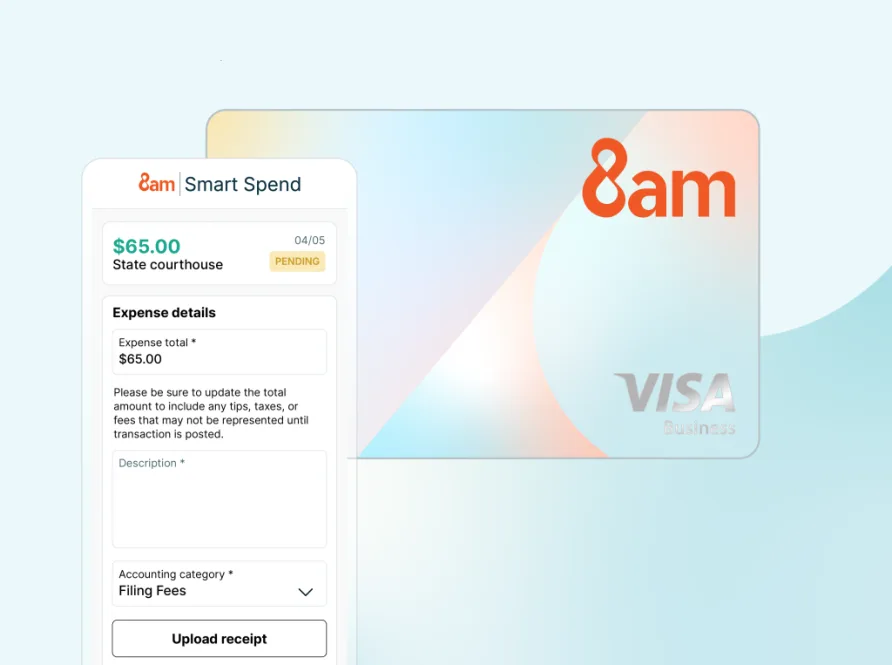
The billing workflow is where MyCase's integrated approach pays off most directly. Once time entries and expenses exist on a case, generating an invoice takes a few clicks. The platform pulls the entries, applies the correct billing rates, and produces a formatted invoice that can go to the client via email, text message, or the client portal. Payment processing runs through LawPay, which is now a sibling product under the 8am umbrella, so the integration is tight. Clients can pay by credit card, debit card, or eCheck.
That matters for cash flow. Users managing mid-sized litigation practices report that payment turnaround dropped significantly after adopting online invoicing through the portal, with some firms collecting payment within 24 hours of sending an invoice.
The Pro and Advanced plans add batch billing, payment plans, automatic interest application, and LEDES billing format support. Trust accounting is built in across all tiers, with IOLTA-compliant ledger tracking and three-way reconciliation available through the MyCase Accounting add-on ($39/month per accounting user). For firms that handle retainers, the trust management tools track balances per case and per client, which is a compliance requirement many general time trackers don't address at all.
MyCase Pricing and What It Actually Costs
MyCase offers three tiers, all priced per user per month. The annual billing rates are $39 for Basic, $89 for Pro, and $109 for Advanced. Monthly billing runs $49, $99, and $119 respectively. There are no setup fees and no long-term contracts.
The Basic plan covers case management, time tracking, expense tracking, invoicing, online payments, a client portal (limited to tasks, events, and invoices), legal calendaring, and unlimited document storage. It's a functional starting point, but it lacks integrations, custom fields, the AI tools, two-way text messaging, and client intake management. The Basic plan's client portal also doesn't include secure document sharing or messaging, which limits the communication benefits that make the portal valuable in the first place. For a solo attorney, that's $468 per year on the annual plan. A five-attorney firm pays $2,340 per year. For context, a solo practitioner could subscribe to a time-tracking-only tool for under $100 per year in many cases, so the premium here buys the broader case management suite, not just the time tracking component. Those numbers are competitive when you account for that full suite, but firms that only need time tracking will find the cost harder to justify.
The Pro plan at $89/user/month adds meaningful capability: MyCase IQ (AI writing assistant, document AI), custom fields, unlimited eSignature, two-way texting, client intake forms, a legal CRM, integrations with Google, Outlook, Zapier, and others, plus the full mobile app. For a five-attorney firm, that's $5,340 per year on annual billing. Pro is where most growing firms land because the intake management and integrations remove the need for separate tools.
Advanced at $109/user/month adds MyCase Drive (desktop file sync), full-text search for conflict checks, advanced document automation, split billing, the AI case assistant, and open API access. A five-attorney firm at this tier spends $6,540 annually. The jump from Pro to Advanced makes sense primarily for firms with heavy document management needs or those who need API connectivity to other systems.
The Client Portal and Communication Tools
MyCase's client portal is a strong feature that goes beyond what most time and attendance platforms offer. Clients log in to see case updates, review invoices, make payments, upload documents, and exchange messages with their attorney. For the firm, this reduces phone calls and email volume. For the client, it creates transparency into what's happening with their matter. The portal also supports eSignature on the Pro plan and above, so retainer agreements and other documents can be executed without printing, scanning, or mailing anything.
A recurring theme in feedback from family law and estate planning firms is that clients feel more connected to their case when they can check status on their own schedule rather than waiting for a callback. That perception of responsiveness builds client satisfaction without requiring more attorney time. Some users report that the portal reduced their inbound client calls by a noticeable margin, freeing up support staff to focus on case preparation.
On the Pro and Advanced plans, firms also get two-way text messaging that logs directly to the case file. The texting function works well for quick updates and appointment confirmations, though some users have reported delays getting text messaging features fully activated, with troubleshooting sometimes stretching over several weeks.
Where MyCase Fits and Where It Doesn't
Consider a three-attorney criminal defense firm handling 40 to 60 active cases at any given time. Each case involves court appearances, client meetings, document preparation, and phone calls, all of which generate billable time. The firm needs to track that time, link it to the right case, generate invoices, accept payments, and store all documents securely. MyCase handles every piece of that workflow in one login. The alternative would be a standalone time tracker plus a separate billing tool plus a document management system plus a client communication platform, each with its own subscription and its own data silo.
Now consider a 15-person accounting firm or a construction company. MyCase won't work. It's built for legal practice, from the vocabulary in its interface to the compliance features in its trust accounting. The calendaring system includes court-specific deadline types. The intake forms are structured around legal matters. None of that translates to non-legal industries.
That's the core trade-off. Firms outside the legal profession should look elsewhere entirely. But within its target market, the vertical integration eliminates the duct-tape approach of connecting four or five separate tools.
What MyCase Doesn't Cover
Evaluated strictly within the time and attendance category, there are gaps. MyCase doesn't offer GPS-based location tracking for time entries, which some field-service time tracking tools include. There's no geofencing capability to auto-clock employees in or out of a location. Shift scheduling is absent, and there's no built-in time-off request or PTO accrual system. Biometric time clock integration isn't part of the platform.
These aren't oversights. They're features that don't apply to how law firms operate. Attorneys don't punch a clock. But a business owner comparing MyCase against general time and attendance software on a feature checklist will notice those absences, and they do affect the scoring in this category.
Within the platform itself, the mobile app is a common friction point. It covers the basics, including time entry, case access, and calendar views, but users who rely on the desktop version notice that some functionality doesn't carry over. The document management interface on mobile, for example, offers fewer options for bulk editing and organization. The label "Mobile App" next to a feature on the pricing page doesn't always mean full feature parity.
Recent Product Development
MyCase shipped 11 updates and enhancements during 2025. Beyond Billables AI in May, the platform added automated eSignature reminders in March (configurable by email, text, or both, on a custom cadence), enhanced Profit & Loss reporting and 1099 tracking in January, and expanded the MyCase IQ AI suite with a conversational case assistant that lets attorneys query case data using natural language. The immigration add-on powered by Docketwise also launched in March 2025, giving immigration practices form automation tied directly to MyCase case files.
The pace of development reflects the resources behind the 8am parent organization. For context, the 2025 year-in-review noted that AI investment was a deliberate focus across the roadmap, with each feature designed to fit existing workflows rather than add complexity. Whether that continues at the same pace is worth watching.
Our Verdict on MyCase for Time and Attendance
MyCase isn't a time and attendance tool in the traditional sense. You won't find it on a shortlist next to products built for tracking hourly shifts at a warehouse or managing PTO across a 200-person company. What it does is embed time tracking so deeply into legal case management that for its target audience, the workflow from logging time to collecting payment feels like one continuous process rather than a series of disconnected steps.
The limitations are real. The starting price exceeds most standalone time trackers. The platform is useless outside the legal industry. The mobile app doesn't match the desktop experience feature-for-feature. And firms on the Basic plan will find themselves locked out of integrations, AI tools, and communication features that make the platform significantly more useful.
For small to mid-sized law firms evaluating time tracking as part of a larger practice management decision, though, MyCase earns its place on the list. The billing integration alone, going from time entry to paid invoice without leaving the platform, solves a problem that costs firms real revenue when handled manually or across disconnected systems. Firms that commit to Pro or Advanced will get the most value, and the 10-day free trial provides enough time to test whether the workflow fits before committing to a subscription.