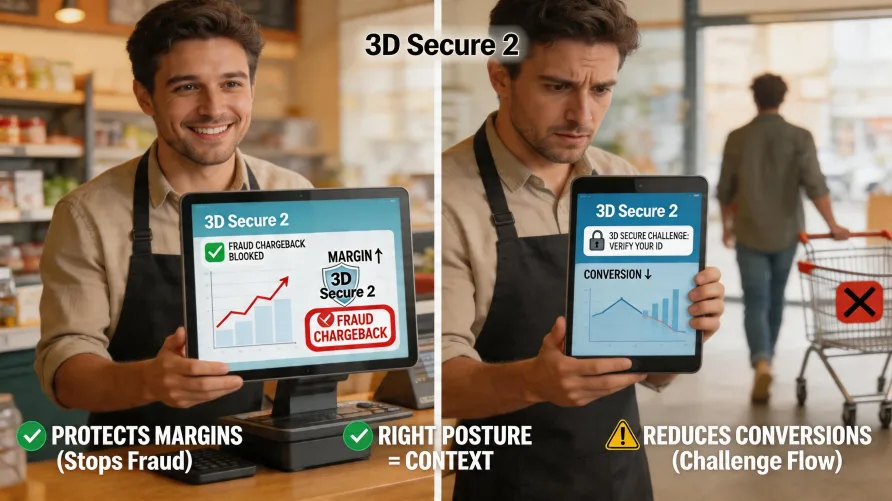
The Short Answer for U.S. Merchants For most U.S. online merchants, 3D Secure 2 helps conversion when your fraud chargeback ratio is climbing toward network thresholds and hurts conversion when you're processing low-value impulse purchases at decent decline rates already. The 3d secure 2 merchant decision comes down to your fraud profile, your average order value, your customer base, and how well your processor implements the protocol's frictionless flow. I've watched merchants lose four percent of completed checkouts to a poorly tuned challenge flow, and I've watched others wipe out a chargeback ratio problem with a conditional 3DS2 rule that only fires above a threshold. Both are real outcomes from the same protocol. 3DS2 isn't a product. It's an authentication standard published by EMVCo, the consortium owned by the major card networks. In the United States it's optional. In Europe it's effectively required under the Second Payment Services Directive. Where you sit on that map shapes the decision. How 3DS2 Differs From the Original 3D Secure The original 3D Secure, which most people remember as Verified by Visa or MasterCard SecureCode, was a friction machine. It would interrupt checkout with a password prompt, often on a popup window, and a lot of cardholders abandoned right there because they didn't remember a password they'd set years ago at their bank. Conversion damage was measurable and ugly. Many merchants disabled it on principle. 3DS2 is a different animal. The protocol passes more than 100 data elements from the merchant to the cardholder's issuing bank during the authentication request. Device fingerprint, billing details, transaction context, prior account activity, IP signals, and other risk factors flow to the issuer's decision engine before the cardholder ever sees a prompt. The issuer scores the transaction in real time. If the score sits inside the issuer's risk tolerance, the transaction is approved silently. The cardholder isn't aware authentication happened. That's the frictionless flow. If the score doesn't clear, the transaction routes to a challenge flow. The cardholder gets a one-time passcode by text, an in-app push notification, a biometric prompt, or in some cases a fallback to a static password. Modern issuers have largely moved off static passwords for 3DS2 because they erode completion rates and don't satisfy the regulatory authentication factors anyway. The Liability Shift Is the Real Incentive This is where 3d secure chargeback liability matters. When a transaction is authenticated through 3DS2, fraud chargeback liability shifts from the merchant to the card issuer. If a cardholder later disputes the charge as unauthorized, the merchant doesn't eat the chargeback. The issuer does. That sounds like a clean win, and for fraud chargebacks it largely is. But it doesn't cover everything. The shift applies to fraud-coded chargebacks, which means disputes where the cardholder claims the transaction wasn't theirs. It doesn't cover friendly fraud, where the cardholder made the purchase and then disputes it anyway. It doesn't cover item-not-received disputes. It doesn't cover product-quality disputes. It doesn't cover authorization or processing errors. For merchants who lose most of their chargeback dollars to fraud, 3DS2 changes the math. For merchants whose chargeback problem is mostly delivery, refunds, or buyer's remorse, the shift won't help. Conversion Math, Frictionless Versus Challenge The 3ds2 conversion impact gets argued more than any other element of the protocol. Public network data and processor reports converge on roughly the same picture. In mature markets, between 80 and 95 percent of 3DS2 transactions clear through the frictionless flow at the issuer. Frictionless approval rates are typically within a percentage point or two of non-3DS approval rates. The cardholder doesn't know anything happened. The challenge flow is where conversion takes hits. Challenge completion rates vary widely by issuer, region, and channel. App-based push authentication tends to convert in the high 80s to low 90s. SMS one-time passcodes convert lower, often in the 70s. Static password fallbacks convert worst of all. Mobile web challenges convert worse than desktop. Returning customers convert better than new customers. Cards on file behave differently than guest checkout. The number that matters isn't the challenge flow rate by itself. It's the blended outcome. If 90 percent of your transactions go frictionless at near-baseline conversion and 10 percent go to challenge at 80 percent completion, your overall conversion drag is around two percent. If 70 percent of transactions clear frictionless and 30 percent route to challenge at 70 percent completion, your drag jumps closer to nine percent. The frictionless-to-challenge ratio is the input that decides whether 3DS2 helps or hurts. SCA in Europe, Optional in the United States Strong Customer Authentication, mandated by the Second Payment Services Directive in Europe, isn't optional. Issuers are required to authenticate most card-not-present transactions using two of three factors: something the cardholder knows, something they have, something they are. 3DS2 is the practical mechanism that satisfies SCA for card payments. There are exemptions for low-value transactions, transaction risk analysis below specific fraud thresholds, recurring transactions of a fixed amount, and a handful of others, but the default posture is authenticated. The United States has no equivalent mandate. The card networks publish their own rules, the Federal Reserve doesn't require SCA, and there's no state-level requirement that I'm aware of as of writing. Some merchants who accept cards from European cardholders process those specific transactions through 3DS2 to meet issuer expectations, and several of the larger acquirers route European-issued cards into 3DS2 automatically. For purely domestic U.S. card volume, the merchant decides. That said, U.S. issuers are increasingly comfortable declining transactions that don't carry authentication context, especially for higher-risk profiles. The optional posture isn't quite as costless as it was five years ago. Requirements vary by region and by network, and current rules can shift on relatively short notice. Three Postures for the U.S. Merchant Decision Most merchants land on one of three approaches. Always-on routing sends every transaction through 3DS2. The merchant accepts whatever conversion drag the challenge flow creates in exchange for liability shift on every fraud chargeback. This posture works for high-fraud verticals like digital goods, gift cards, gaming top-ups, and high-AOV physical goods, where the cost per fraud loss substantially exceeds the cost per lost conversion. It also works for merchants sitting close to a card network's chargeback monitoring thresholds, where the cost of additional fraud chargebacks isn't just the disputed dollars. It includes possible program enrollment, monthly monitoring fees, restricted vertical reassignments, and acquiring relationship pressure that can escalate to account termination. Once a merchant lands in a chargeback monitoring program, getting out is harder than staying out, and authentication on the inbound traffic is one of the few levers that affects the underlying ratio fast enough to matter. Conditional routing applies 3DS2 by rule. Common triggers include order value above a threshold, cardholder geography, BIN-level signals, mismatched billing and shipping, fast checkout velocity from a single IP, or device fingerprint anomalies. The merchant captures the liability shift on the transactions that actually need it without burning frictionless transactions on low-risk volume. This is the most defensible posture for a merchant who isn't legally required to authenticate everything. Off means the merchant doesn't route through 3DS2 at all. Liability for fraud chargebacks stays on the merchant. For low-AOV, low-fraud, high-volume merchants where conversion sensitivity is acute, this can still be the right call. When 3DS2 Helps a U.S. Merchant's Conversion Conversion improves when 3DS2 prevents an issuer from declining a transaction outright. Issuer-side fraud models reject a substantial percentage of card-not-present transactions every day, and many of those declines happen on legitimate purchases the issuer simply can't risk-score with confidence. When the merchant supplies the additional data elements that 3DS2 carries, the issuer often approves a transaction it would otherwise have declined. Authorization rates rise. The conversion that gets recovered isn't visible inside the merchant's normal funnel. It shows up as a higher approval percentage on the same checkout traffic. 3DS2 also helps when authenticated transactions get processed at lower interchange rates by some networks under specific program eligibility. The savings are modest per transaction, but they compound at volume. For merchants operating on the edge of network chargeback monitoring programs, the math shifts further. The cost of staying on a program isn't just the lifted fees. It can include processor risk reviews, restricted merchant category code assignments, withheld funds, or in extreme cases the loss of the merchant account. Authenticating the transactions most likely to trigger fraud disputes can pull a merchant back below threshold faster than any chargeback dispute strategy. When 3DS2 Hurts a U.S. Merchant's Conversion Conversion suffers when most transactions don't need authentication and the protocol still adds latency, edge cases, and challenge flow exposure to the checkout. For a low-AOV, low-fraud merchant, the math is simple. The fraud chargebacks 3DS2 prevents weren't going to happen at material volume anyway. The conversion lost to challenge flow drops straight to the bottom line. 3DS2 also hurts when the implementation is poor. Some processors handle 3DS2 cleanly with strong device fingerprinting, low challenge rates, and graceful fallbacks. Others ship implementations that send too many transactions to challenge, mishandle mobile checkouts, or fail to recover when the issuer's authentication endpoint times out. The same protocol can produce 95 percent frictionless on one processor and 70 percent frictionless on another. This is one of the practical reasons your processor selection matters more than the protocol choice itself. Recurring billing, card-on-file transactions, and merchant-initiated transactions sit in their own bucket. Most of these don't require authentication under 3DS2 because the cardholder isn't actively present in the checkout, but the rules around exemptions and credentials-on-file flagging are nontrivial. A processor that doesn't handle credential-on-file flagging correctly can push routine renewal charges into challenge flows that the cardholder never sees, leading to silent decline rates that bleed retention. Does 3D Secure Reduce Chargebacks? Yes, for fraud-coded chargebacks on transactions that completed authentication. The liability shift moves those disputes off the merchant. It doesn't reduce all chargebacks. Friendly fraud, where the cardholder made the purchase and disputes it anyway, isn't covered by the shift in most network rule sets. Disputes coded as item-not-received, defective merchandise, services not rendered, or duplicate processing aren't covered either. If your chargeback mix is 70 percent friendly fraud and 30 percent true fraud, 3DS2 only addresses the 30 percent. The other thing 3DS2 doesn't do is prevent a chargeback from being filed. A determined cardholder can still dispute the charge. The merchant just isn't on the hook financially. Is 3D Secure Required? In the United States, no, with the practical caveats above for European-issued cards and certain processor-level mandates that may apply by vertical. In Europe and the United Kingdom, effectively yes for most card-not-present transactions under SCA, with defined exemption categories. Requirements vary by region and by network, and current rules can shift on relatively short notice. Confirm current obligations with your acquirer before assuming a posture. How to Decide for Your Business Start with your chargeback ratio. If you're inside or close to a network's fraud monitoring program threshold, 3DS2 routing on the at-risk segment of your traffic is probably the right move. If your ratio is well under threshold and your fraud loss as a percentage of revenue is low, the case for always-on is weaker. Look at your average order value. High-AOV transactions absorb conversion drag better and produce larger chargeback exposure when fraud lands. Low-AOV impulse purchases punish friction harder. Map your geography. Transactions involving European cardholders are going to authenticate one way or another. If a meaningful share of your volume comes from card BINs issued in SCA jurisdictions, the question isn't whether to authenticate. It's how cleanly your stack handles it. Test with a percentage of traffic before committing to a posture. A two-week split test on conditional rules will tell you more about the real conversion impact than any vendor case study. Measure approval rate, completion rate, chargeback rate, and net revenue per attempted transaction. The right answer for when to use 3d secure isn't the same for any two merchants. Where This Leaves You 3D Secure 2 is a tool, not a verdict. The protocol does exactly what it's supposed to: shift verified-fraud liability and add a layer of issuer-side risk decisioning to card-not-present transactions. Whether that's worth the conversion exposure depends on the specific shape of your business, your fraud experience, your processor's implementation quality, and the geography of your customers. There isn't a universal answer. If you're evaluating processors with this in mind, the implementation question is at least as important as the headline pricing. A processor that handles 3DS2 with high frictionless rates, clean credential-on-file flagging, and solid mobile completion will produce a different conversion outcome than one that doesn't. We cover the providers in this market across our credit card processing reviews.
3D Secure 2: When It Helps Conversion and When It Hurts