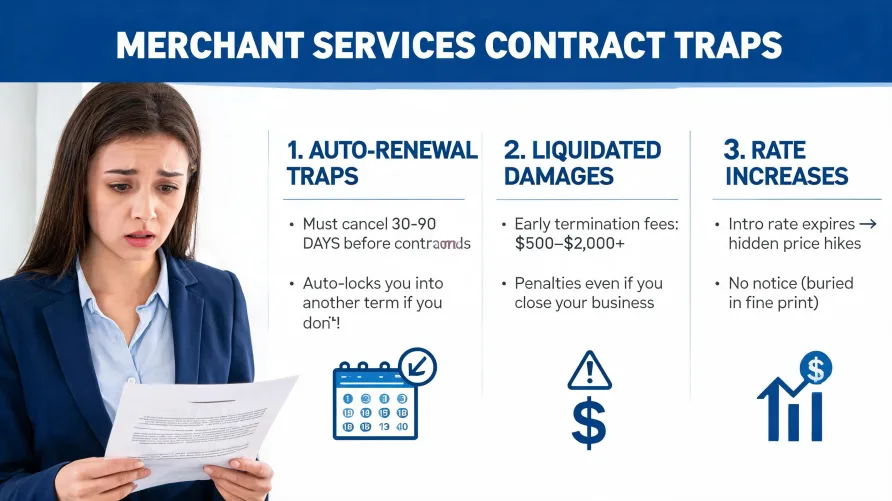
The most dangerous merchant services contract red flags aren't buried in fine print you'd never think to read. They're in clauses you'll skim, partially understand, and sign anyway because the sales rep assured you "that's standard language." I've reviewed dozens of processing agreements over two decades in business technology, and the patterns are consistent across the industry. The clauses that cost merchants the most money are designed to look routine: auto-renewal provisions with narrow cancellation windows, liquidated damages formulas, unilateral rate adjustment rights, and personal guarantees tucked inside equipment addendums. This article walks through the specific contract language that should stop you before you sign, what each clause actually means for your business, and where you have room to push back. Why Processing Agreements Deserve a Closer Look A merchant services contract governs every credit and debit card transaction your business processes. It controls your pricing, your data, your ability to switch providers, and in some cases your personal financial exposure. Most business owners spend more time comparing rates than reading the agreement those rates live inside, and that's where the real cost often hides. The processing industry has a long history of contract structures that favor the provider. A 2022 Federal Reserve Payments Study found that U.S. card payments exceeded 188 billion transactions annually, representing a massive revenue base for processors. That kind of volume creates strong financial incentive for providers to lock merchants into multi-year agreements with costly exit provisions. The contract is where that lock-in happens. Not every clause discussed below is automatically disqualifying. Some are standard and negotiable. Others are predatory. The difference matters, and knowing which is which before you sign is the entire point. Multi-Year Terms That Don't Match the Relationship The first place to look in any processing agreement is the term length. Three-year initial terms remain common across much of the industry, and some contracts still default to five years. For a service that takes days to set up and involves minimal provider-side investment in your specific account, a multi-year commitment should raise an immediate question: what justifies that lock-in? Month-to-month agreements exist. So do annual contracts with reasonable notice provisions. If a provider insists on a three-year minimum and won't budge, that tells you something about how they retain customers. Ask for a shorter term. If they refuse, ask why. Auto-Renewal Clauses and Narrow Opt-Out Windows Auto-renewal is where multi-year terms become a real trap. A typical clause reads something like: "This agreement shall automatically renew for successive one-year terms unless either party provides written notice of termination at least 60 days but no more than 90 days prior to the end of the current term." That language creates a 30-day window, once per year, during which you're allowed to cancel. Miss it, and you're locked in for another full year. The problem isn't auto-renewal itself. Plenty of business contracts renew automatically, and that's fine when the cancellation process is reasonable. The red flag is the narrow window combined with penalties for canceling outside of it. Some agreements make that window even tighter, as little as 30 days, and require cancellation via certified mail to a specific address. If your contract requires you to send a physical letter to a P.O. box in a different state during a 30-day window you need to calculate from your original signing date, the provider isn't making cancellation easy on purpose. Push for rolling month-to-month terms after any initial commitment period. If the provider won't eliminate auto-renewal, negotiate for a 90-day or wider cancellation window with email notice accepted as valid delivery. The goal is to make sure you always have a realistic path to leaving if the service or pricing stops working for your business. Early Termination Fees and Liquidated Damages Early termination fees are the enforcement mechanism behind long-term contracts. They come in two forms, and the difference matters enormously. Flat-fee termination charges typically range from $250 to $500. These are irritating but predictable. You can factor them into a switching decision and make a rational choice. Liquidated damages clauses are a different animal entirely. These calculate your termination penalty based on the revenue the processor expected to earn over the remaining contract term. A typical formula multiplies your average monthly processing fees by the number of months left on your agreement. If you're paying $800 per month in processing fees and have 18 months remaining, your termination bill arrives at $14,400. That's not a fee. That's a financial barrier designed to make leaving unthinkable. Courts in several states have scrutinized these provisions, with some finding them unenforceable when the damages are disproportionate to the provider's actual loss. But litigation is expensive and uncertain, and most small business owners don't have the time or budget to challenge a contract clause in court. The better approach is to refuse liquidated damages language at the contract stage. If the provider won't remove it, negotiate a flat-fee cap or a declining termination schedule that reduces the penalty over time. Rate Increase Provisions in Your Processing Agreement Most merchant services contracts include language allowing the processor to adjust pricing. The clause often reads: "Processor reserves the right to modify fees, rates, and charges upon 30 days' written notice." That single sentence gives the provider unilateral authority to raise your costs at any point during the agreement, while the termination clause simultaneously prevents you from leaving without penalty. This is one of the most common processing agreement warning signs, and one of the easiest to overlook. The rate you were quoted during the sales process isn't necessarily the rate you'll pay six months later. Interchange rates set by card networks do change periodically, and processors legitimately need to pass those changes through. But the contractual language often doesn't distinguish between pass-through interchange adjustments and processor markup increases. That ambiguity is the problem. What to negotiate: Ask for language that limits price increases to documented interchange or network fee changes. Any processor markup increase should require mutual agreement, not just written notice. If you can't get that, at minimum push for the right to terminate without penalty within 30 days of any unilateral rate increase. PCI Non-Compliance Fee Language Payment Card Industry Data Security Standard compliance is a requirement for any business that accepts card payments, administered by the PCI Security Standards Council. Most processing agreements include provisions related to PCI compliance, and that's appropriate. The red flag isn't the PCI requirement itself. It's how the contract handles non-compliance. Some agreements impose monthly non-compliance fees, often $19.95 to $99.95 per month, that begin automatically and continue until the merchant completes a PCI self-assessment questionnaire. The fee itself isn't unusual, but the problem is that many merchants don't know they need to complete the assessment, and the contract doesn't always make the requirement obvious. Processors sometimes begin charging the fee immediately after account activation, before the merchant has had any reasonable opportunity to complete the process. Watch for contracts that impose non-compliance fees without providing clear instructions, a defined grace period, or accessible tools to complete the assessment. The PCI Security Standards Council publishes the current Self-Assessment Questionnaires on its website, and your processor should be making that process easier, not profiting from confusion around it. Equipment Lease Cross-Default Clauses This is a merchant contract pitfall that catches many small business owners off guard. Some processors bundle equipment leases, for card terminals, PIN pads, or POS hardware, with the processing agreement. The cross-default clause ties these two contracts together so that defaulting on one triggers a default on the other. The practical effect: if you cancel your processing agreement early, you're also in default on your equipment lease. And equipment leases in the payments industry are notorious for their own problems, including non-cancellable terms that extend four to five years, inflated equipment valuations, and buyout provisions that require paying the full remaining lease balance. The cross-default works in both directions, too. A disputed equipment charge can technically put your processing account in jeopardy. The fix is simple in principle. Keep your equipment arrangement separate from your processing agreement. If a provider insists on bundling them, that's a signal to look elsewhere. If you do lease equipment, read that contract independently and make sure no cross-default language connects it to your processing terms. Personal Guarantees You Didn't Expect A personal guarantee in a merchant services contract means you're personally liable for obligations under the agreement, not just your business entity. This can include chargebacks, processing fees, and yes, early termination penalties. For sole proprietors, personal liability is already the default. But for LLCs and corporations, a personal guarantee pierces the liability protection you set up the entity to create. Not every processing agreement includes a personal guarantee, and many that do will remove it if you ask. The issue is that these provisions are often embedded in the application or terms of service rather than presented as a separate, clearly labeled commitment. You might not realize you've agreed to one. Read every signature block. That's the advice that matters here. Non-Disparagement and Confidentiality Provisions Non-disparagement clauses prevent you from making negative public statements about the processor. They've become common across many types of business contracts, but in the context of a merchant services agreement, they carry a specific risk: they can limit your ability to file legitimate complaints with the Better Business Bureau, post factual reviews about your experience, or publicly describe billing disputes. Some agreements pair non-disparagement with confidentiality provisions that restrict what you can disclose about your contract terms. Together, these clauses can make it difficult to share your experience with other business owners or to make a public case if a dispute arises. Federal law provides some protection here. The Consumer Review Fairness Act, enforced by the FTC, prohibits contract provisions that restrict consumers from posting honest reviews. Whether that protection extends to every merchant-processor business relationship depends on the specific circumstances, but the law signals a clear public policy against silencing legitimate feedback. Push to remove non-disparagement clauses entirely. If the provider won't agree, at minimum ensure the language includes exceptions for truthful statements and regulatory complaints. How Long Should a Merchant Services Contract Be? The shortest term you can negotiate is the right answer for most businesses. Month-to-month is ideal. Annual terms with 30-day cancellation notice are reasonable. Anything longer than one year should require a compelling reason, such as significantly discounted pricing that actually compensates you for the commitment. A processor that delivers good service at fair pricing doesn't need a three-year contract to keep your business. The contract length itself tells you something about the provider's confidence in their own retention. If the only way they can keep you is by making it expensive to leave, the relationship is already built on the wrong foundation. Can You Cancel a Merchant Services Contract? Yes, but the cost and process depend entirely on what you signed. Start by pulling your original agreement and looking for three things: the current term and renewal status, the cancellation notice requirements, and any early termination fee or liquidated damages provision. If you're within an auto-renewal window, you may be able to cancel with a written notice and no penalty at all. If you're mid-term, calculate the termination cost and weigh it against the savings from switching. In many cases, the math favors paying the fee and moving to a better provider, especially if your current processor has already raised rates above what you originally agreed to. Some states have specific consumer protection statutes that may limit enforcement of certain contract provisions. Consult your state attorney general's office or a business attorney if you believe your contract includes unenforceable terms. Document everything. Send cancellation notices via methods that provide delivery confirmation. Keep copies of every communication. What to Do Before You Sign Any Processing Agreement Read the full agreement, not just the rate sheet. The rate sheet is a summary. The contract is the law between you and the processor. Mark every clause discussed in this article and compare it against what your prospective provider is offering. Ask for changes in writing. If the sales rep says "we never enforce that clause," your response should be simple: then remove it from the contract. Get a copy of the final signed agreement and store it where you can find it. You'll need it when renewal deadlines approach. The credit card processing market includes providers with transparent terms and month-to-month agreements alongside those that rely on long-term lock-ins. Knowing what to look for in a merchant agreement is the first step toward making sure you end up with the right one.
Red Flags in a Merchant Services Contract