
A Way Out of $1,000-a-Month Processing Bills
For small business owners paying $800, $1,200, or more in monthly processing fees, VizyPay offers something most processors won't: a way out. Built around cash discount and surcharging programs that shift the cost of card acceptance to the customer rather than the merchant, VizyPay earned an 7.3 out of 10 in our credit card processing evaluation — a score driven by strong service delivery, an exceptional public reputation, and a pricing model that can transform a merchant's bottom line when the fit is right. That last phrase matters: this service is best suited to in-person businesses where posted prices can flex, and less suited to digital-first operations or high-traffic retail where customers are acutely price-sensitive.
Founded in 2017 by two entrepreneurs who understood the small business payment problem from the merchant side, VizyPay operates out of West Des Moines, Iowa and processes through Fiserv, formerly First Data — one of the largest payment networks in the world. That backend relationship gives VizyPay institutional infrastructure without requiring merchants to contract directly with a large acquirer. The company has appeared on the Inc. 5000 list of fastest-growing private companies and earned a spot on the Inc. Regionals list for four consecutive years through 2025. Its public review profile across major platforms reflects approximately 2,377 verified ratings averaging 5 stars as of March 2026 — a sustained track record in a category where poor post-sale service is the norm.
How VizyPay Eliminates Processing Fees
The centerpiece of VizyPay's service is its Cash Discount Program, and the mechanics matter before evaluating the value proposition. Rather than absorbing interchange costs as a straight-margin hit, the program builds the cost of card acceptance into the sticker price for all customers. Cash-paying customers receive a discount that removes that service fee from their transaction, while card-paying customers pay the full posted price. VizyPay's technology — integrated into the terminal or POS system — handles this calculation automatically at the point of sale, so the merchant doesn't manually manage two price sets. What the merchant receives at the end of the month is a predictable subscription fee rather than a percentage-based variable bill that swings with transaction volume and card type.
That predictability is the actual product. Merchants who make the switch frequently describe their monthly processing costs falling from four-figure invoices to a fixed flat fee. One merchant reported going from roughly $1,200 per month in processing costs to a $45 flat monthly payment — a shift that exceeds $13,000 in annual savings. Whether that math holds for your business depends on volume, card mix, and how your customers respond to the pricing structure, but the mechanism itself is not complicated.
VizyPay offers four programs in total, each suited to a different scenario. The Cash Discount Program builds fees into all prices and discounts cash payers. The Surcharge Program adds a disclosed fee specifically to credit card transactions at checkout, leaving cash and debit transactions unaffected. Dual Pricing displays both a cash price and a card price simultaneously, letting the customer choose with full visibility before checkout. A Traditional Program is available for merchants who prefer standard interchange-plus pricing without passing fees to customers. Most of VizyPay's enrollment falls on the first three options, which is where the differentiation from conventional processors sits.
An important legal distinction applies to these programs. Cash discounting is broadly permitted across all 50 states, including states that restrict surcharging — Connecticut's surcharge prohibition, for example, doesn't prevent cash discount structures. Credit card surcharging carries different rules: it's restricted or prohibited in certain states and subject to disclosure requirements that vary by jurisdiction. New York's February 2024 surcharge disclosure law added specific signage and receipt requirements for merchants who surcharge. VizyPay structures its programs to align with card network and state regulations, but merchants are ultimately responsible for ensuring their own compliance at their location.
What VizyPay Costs in Practice
For merchants enrolling in the Cash Discount Program, the cost structure is a flat monthly subscription rather than a percentage of sales. VizyPay's program tiers run $25, $50, and $99 per month based on processing volume — meaning your bill is fixed and predictable regardless of whether a particular month runs heavy on premium rewards cards. Contact VizyPay for the specific volume thresholds that correspond to each tier.
To put those numbers in annual terms: a retail shop processing $20,000 per month in card transactions on a traditional interchange-plus model might pay $350–$500 per month once interchange, markup, and per-transaction fees are factored in — $4,200 to $6,000 per year. On VizyPay's cash discount subscription at $50 per month, that same business pays $600 per year. At $50,000 per month in volume, where traditional processing costs can run $1,000 or more monthly, the gap is even wider. These examples assume a typical card mix and exclude chargebacks, network assessments, and any optional gateway or POS add-ons — your actual figures will vary, and VizyPay's savings calculator on the cash discount program page is a reasonable starting point for your own estimate.
For merchants on the Traditional Program, VizyPay publishes its interchange-plus markup on its website: 0.35% plus $0.10 per transaction for physical storefronts, and 0.55% plus $0.15 for lower-volume merchants processing under $5,000 per month or fewer than 100 transactions. Per-occurrence fees for chargebacks and similar events are also disclosed upfront — a level of transparency that exceeds what most processors provide without a sales call. No long-term contracts are required on any program, and equipment is placed by VizyPay rather than leased at additional cost.
Is VizyPay the Right Fit for Your Business?
The merchants who benefit most from VizyPay's model are those where posted prices are standard and customers expect some variation by payment method. Consider an auto repair shop billing $600 for a service job: if the shop builds a 3.5% service fee into the posted price and gives a cash discount, the card customer pays the estimate amount, and the shop keeps its margin intact. That's a clean fit. A rural retail store, a local restaurant, or a B2B service provider with quoted pricing can typically implement the program with minimal customer pushback — a pattern supported consistently by long-term merchant feedback in those business types.
The fit becomes more complicated where posted prices are fixed and customers are price-sensitive to any upward adjustment. High-traffic convenience retail, businesses with thin margins where even a small price increase carries risk, or service businesses with a high proportion of returning customers who may notice the change all warrant a careful conversation before enrolling. Surcharge disclosure at the point of sale can create checkout friction in competitive markets. VizyPay's dual pricing model addresses part of this by showing both prices transparently before the transaction is confirmed, which tends to feel less abrupt to customers than a disclosed fee appearing at the end.
Hardware, Technology, and Integrations
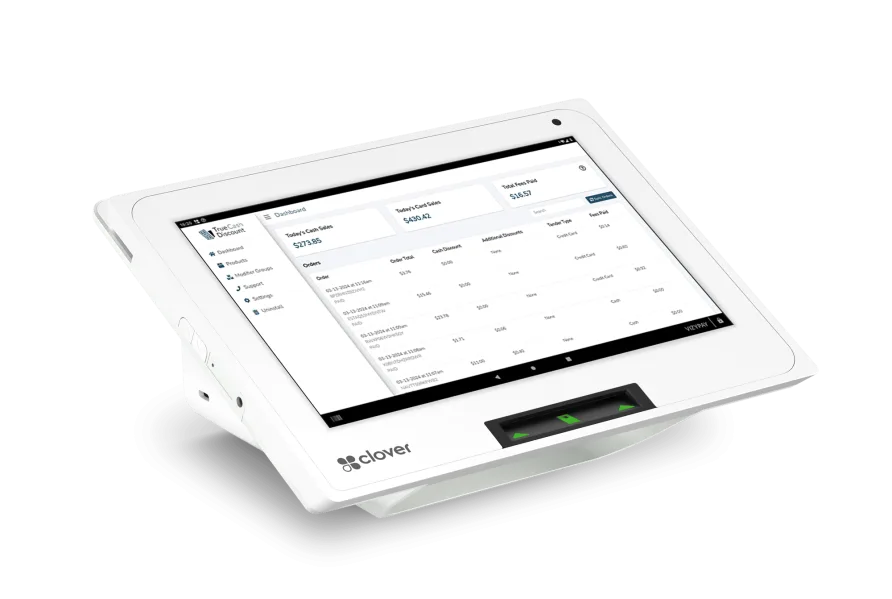
VizyPay supports several hardware configurations. Clover POS systems are available through VizyPay, ranging from the compact Clover Mini to the Clover Station Duo, all configured to support the Cash Discount Program natively. For merchants who don't need a full POS setup, countertop terminals from Dejavoo and PAX are also available. VizyPay launched its own POS application, VizyPOS, in 2021; it pairs with PAX devices and provides inventory management, item cataloging, and transaction analytics as a built-in feature rather than a paid add-on subscription.
For online payments, VizyPay supports Authorize.Net and NMI as gateway options, covering the most common eCommerce configurations for small merchants. Shopify integration is also available. VizyPay's eCommerce depth is narrower than its in-person capabilities, though — merchants with complex online storefronts, subscription billing structures, or significant B2C digital volume will find the available options thinner than processors built around digital-first commerce. The cash discount mechanism also operates differently in online checkout environments, requiring additional merchant configuration to align with card network presentation rules.
One observation from evaluating VizyPay's setup process: enrollment is straightforward for in-person merchants starting fresh, but adding the cash discount configuration to an existing POS installation with a large or frequently-changing item catalog can involve an upfront learning curve around how price increases are applied across inventory. Businesses in that situation are better served by confirming the bulk update process with VizyPay's onboarding team before committing.
VizyPay has evolved the core cash discount model under the Cash Discount 2.0 designation, publishing guidance on how merchants should communicate pricing to customers and present the program in alignment with current card network rules. Merchants considering the program — particularly those migrating from an older cash discount setup — should review VizyPay's current program documentation to ensure their signage and checkout flow match the updated compliance guidance.
Where VizyPay Stops
VizyPay is purpose-built for in-person small businesses with standard processing needs. Merchants who operate primarily online will find the hardware-centric positioning less relevant, and the eCommerce gateway options — while functional — don't match the depth of processors designed around digital-first commerce. High-risk merchant categories aren't a VizyPay specialty; the company focuses on standard-risk retail, restaurant, and service businesses. ACH and check payment processing isn't a prominently featured capability, which matters for B2B merchants where those payment methods are common.
The compliance dimension of cash discounting and surcharging also requires ongoing merchant attention. Card network rules around how service fees are disclosed at the point of sale continue to evolve at both the federal and state level. VizyPay provides the technology and program structure; maintaining compliant signage and checkout presentation at each merchant location is the merchant's responsibility.
The Bottom Line
VizyPay isn't trying to be every processor for every business, and that focus is exactly what makes it effective for its target. If you run a retail shop, restaurant, or service-based business where posted prices can flex — particularly in the rural and small-town markets where VizyPay deliberately positions itself — the cash discount program delivers cost savings that are difficult to replicate through rate negotiation alone. An 7.3 out of 10 reflects a processor that does its core job at an exceptional price point, backed by a customer support reputation that stands out in an industry where post-sale service is often the first thing to fall apart.
Merchants whose customers won't accept any form of price differentiation by payment method aren't a fit for VizyPay's primary programs, and businesses with complex digital commerce needs will find the offering limited on that front. For everyone else — the local hardware store, the auto shop, the independent diner — VizyPay makes a credible case as one of the more thoughtful answers to what has always been an expensive line item.