
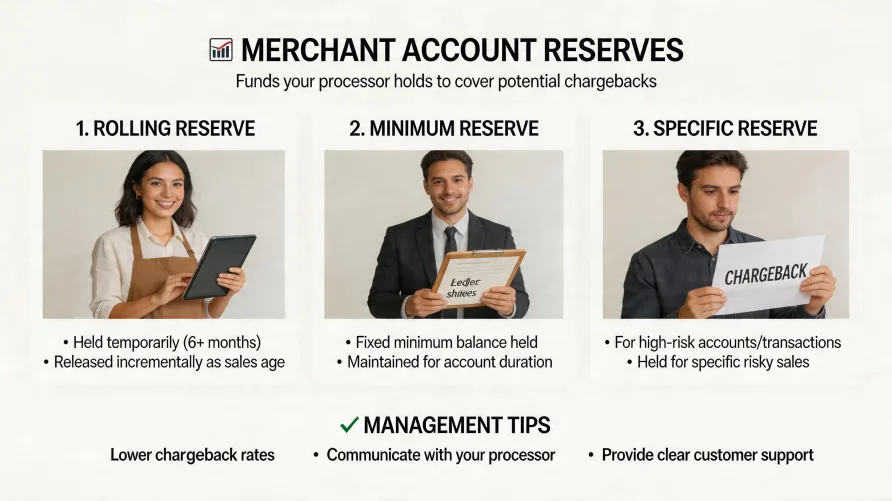
A merchant account reserve is money your payment processor sets aside from your settled transactions to cover potential losses from chargebacks, refunds, or fraud. If a processor is currently holding your money and you weren't expecting it, you're not alone. I've watched dozens of small business owners hit this wall during their first six months of card acceptance, and the reasons rarely come up clearly during the sales conversation. This piece walks through the three reserve structures you'll encounter, what triggers them, how they're calculated, and how to get your money back on a realistic timeline.
What a Merchant Account Reserve Actually Covers
The reserve isn't a fee. It's your money, held in a non-interest-bearing account controlled by the processor, that gets returned once a defined waiting period passes without losses. The processor's exposure is real. When a customer files a chargeback 90 days after a sale, that money has to come from somewhere. If your account has been closed and emptied, the processor absorbs the loss. The reserve exists so that doesn't happen.
Card networks publish chargeback timeframes that extend up to 540 days for some dispute categories. That window of liability is the actual reason a payment processor holds money in reserve. A processor who can't recover funds from a closed merchant has lost real dollars. The Federal Reserve treats payment networks as multi-party clearing systems where each participant carries counterparty risk, and the reserve is one mechanism the industry uses to manage that risk at the merchant level.
That's the core of why reserves exist. The rest is structure, and the structure is where most merchants get caught off guard. Almost no one I've worked with read the reserve clause closely before signing, and almost everyone wishes they had once they hit it.
The Three Types of Merchant Account Reserves
Upfront Reserve
An upfront reserve is collected before the account begins processing. The processor takes a fixed dollar amount, often $5,000 to $25,000 for moderate-risk businesses, and holds it for the life of the account or until a defined release condition is met. This is the most demanding form, and you'll see it requested only when underwriting flags significant concern. It's most common for new merchants in card-not-present industries with limited history.
Capped Reserve
A capped reserve builds gradually by withholding a percentage of each settlement, usually 5% to 10%, until a defined cap is reached. Once the cap is hit, no further funds are withheld. The cap is typically expressed as a multiple of monthly volume, like one or two months of average processing. This structure spreads the burden across early sales rather than demanding a lump sum on day one.
Rolling Reserve
A rolling reserve is the one that catches most merchants off guard. The processor withholds a percentage of each daily or monthly settlement, holds it for a defined rolling period (most often 180 days), and releases each batch only after that holding window passes. The reserve never gets paid down. Each new batch replaces an older one as it ages out. That's rolling reserve processing in plain terms, and it continues for as long as the account exists.
The cash flow difference between these three structures is significant. Consider a business doing $200,000 in monthly volume with a 10% rolling reserve and a 180-day hold. At any given point, the processor is holding roughly $120,000 of that merchant's money. That's working capital sitting in someone else's account, which can be the difference between hiring or holding off, between buying inventory or waiting another quarter. The same business on a capped reserve at $50,000 cap would face a one-time hit rather than a permanent feature of the cash flow. And under an upfront $25,000 reserve, the merchant pays the price once and operates normally afterward. The structure matters more than the headline percentage in most cases, and it should be the first thing you push to clarify before signing any merchant agreement.
What Triggers a Merchant Account Reserve
Reserves aren't applied randomly. Underwriting teams look at a defined set of risk factors and decide whether the account warrants protection. The most common triggers I've watched create reserve requirements include the following.
Lack of processing history. New businesses with no track record can't be evaluated against past performance, so the processor assumes higher uncertainty by default.
Industry classification. Travel, subscription services, supplements, digital goods, event ticketing, and high-ticket coaching all fall into categories where customer disputes happen more often. Each industry has a published Merchant Category Code (MCC), and processors price risk by code.
High average ticket size. A $50 transaction has limited downside. A $5,000 transaction means a single chargeback can wipe out a week of margin. Processors apply tighter controls when individual sales are large.
Seasonal or unpredictable volume. A business doing 80% of its annual sales in November and December creates a different risk profile than one with steady monthly revenue. Processors hedge by holding more during peaks.
Future delivery models. If a customer pays today for something they'll receive in three months, the chargeback window stays open through the full delivery period plus the dispute window. That extended exposure usually triggers a reserve.
Personal credit, prior account closures, or matched listings on industry watch files like the MATCH list will also push underwriting toward a reserve. The MATCH list is maintained by Mastercard and tracks merchants whose accounts have been terminated for cause. Being on it doesn't always result in declined underwriting, but it almost always means a heavy reserve at minimum.
How Reserves Are Calculated and Disclosed
Most reserves appear in the merchant agreement under a section titled Reserve Account or Security Funds. The language is often deliberately broad. A common clause grants the processor full discretion to establish, modify, or increase the reserve based on its ongoing risk assessment of the account. That clause doesn't sound alarming during signing. It can become significant later if your chargeback ratio climbs above 1% of volume, which is the threshold the card networks treat as the start of monitored merchant status.
Reserve percentages vary widely. For low-risk merchants who still face one, 5% with a 90-day rolling hold is typical. For higher-risk categories, 10% to 20% with a 180-day hold is common. For businesses on the MATCH list or in the most sensitive categories, reserves can run 20% or more with a 12-month hold.
Always get the math in writing before signing. Verbal commitments from sales reps are not enforceable in disputes later, and the merchant agreement is the only document that controls what actually happens to your money. Reserve language varies more than the marketing pages suggest.
Release Schedules and How to Get Your Reserve Back
Getting reserve money back depends on which structure you're operating under.
Upfront reserves are released after the account closes and a defined waiting period passes, usually 180 to 270 days, to allow any final chargebacks to clear. The processor will typically subtract any outstanding losses before sending the balance.
Capped reserves are released when the underlying conditions improve. If your chargeback ratio drops below 0.5% for six consecutive months and your processing history demonstrates stability, you have a legitimate basis to request a cap reduction or full release. This is rarely automatic. You'll need to make the request in writing and follow up.
Rolling reserves release continuously. Each batch ages out of the holding period and gets paid back to you on a defined schedule, usually weekly or monthly. The total amount held doesn't change unless your processing volume changes or the percentage is adjusted. To get a rolling reserve reduced or eliminated, the same documentation approach applies: clean processing history, low chargeback rate, and a written request.
For all three structures, account closure triggers final reserve release after the longest possible chargeback window for your account's transaction mix has fully closed. That's usually 180 days. For card-not-present merchants in certain categories, it can stretch to 270 days or longer.
Negotiating Reserve Terms Before You Sign
The best time to address reserve terms is before signing the merchant agreement. Most merchants don't realize how much of the structure is open to discussion, especially with mid-tier processors that aren't payment aggregators.
What's typically negotiable: the percentage held, the cap amount, the holding period length, and the conditions under which the reserve can be released or reduced. What's rarely negotiable: whether a reserve will exist at all in a flagged category, the processor's discretion clause, and chargeback liability assignment.
A reasonable approach is to ask for a capped reserve instead of a rolling reserve where the underwriting permits. The capped structure gives both parties a defined endpoint and removes the ongoing cash drag that rolling reserves impose. If a rolling structure is unavoidable in your category, push to lower the percentage or shorten the hold window. Ask for a written release condition tied to specific metrics, like a chargeback ratio below a defined threshold, processing history of a defined length, and no funding holds during the review period. Ask for an annual review clause that allows reassessment based on actual performance rather than the initial risk profile. Before you finalize, ask the underwriter directly what would have to happen for the reserve to be reduced. If the answer is vague or non-committal, you've learned something useful about the relationship before you've handed over your money.
How to Reduce a Merchant Reserve Fund Over Time
Once a reserve exists, the path to reducing it is performance plus persistence. Processors maintain underwriting review cycles, and merchants who actively request review based on demonstrated stability often receive favorable adjustments.
The documentation that helps: a clean chargeback history under 0.5%, six to twelve months of consistent monthly volume, no funding holds or compliance flags, and a current financial statement if you've grown. Submit a written request to your account manager that lays out the metrics and asks for a specific change, like a lower percentage, lower cap, or shorter hold period. Don't ask for full elimination if you're in a flagged industry. Ask for a reasonable adjustment that the underwriter can defend internally.
If you're not getting traction, the next move is a competing quote from another processor. Bringing a written offer with better reserve terms creates a real reason for your current processor to renegotiate.
When the Reserve Becomes a Bigger Problem
A reserve that grows without notice or releases later than disclosed crosses a different line. The Consumer Financial Protection Bureau and state Attorney General offices accept complaints related to merchant processing practices, and several state-level cases over the past five years have addressed reserve mismanagement. If a processor is holding funds beyond the disclosed terms, document everything in writing, request specific reasons for the deviation, and escalate to the processor's compliance function if needed.
For merchants who feel the reserve is being used as informal collateral against unrelated disputes or to pressure account behavior, the path forward usually involves account transition rather than internal escalation. The cost of staying on bad terms with the processor holding your reserve is typically higher than the friction of moving.
Reserves are part of how the payment system works. They aren't designed to harm merchants, but they can hurt cash flow significantly when applied without careful negotiation up front. Understanding the structure before you sign, and tracking the conditions for release once you're operating, gives you the practical ability to manage the relationship rather than being managed by it. For merchant-by-merchant comparisons of how providers in this market handle reserve policies, see our credit card processing reviews and ranked comparisons.