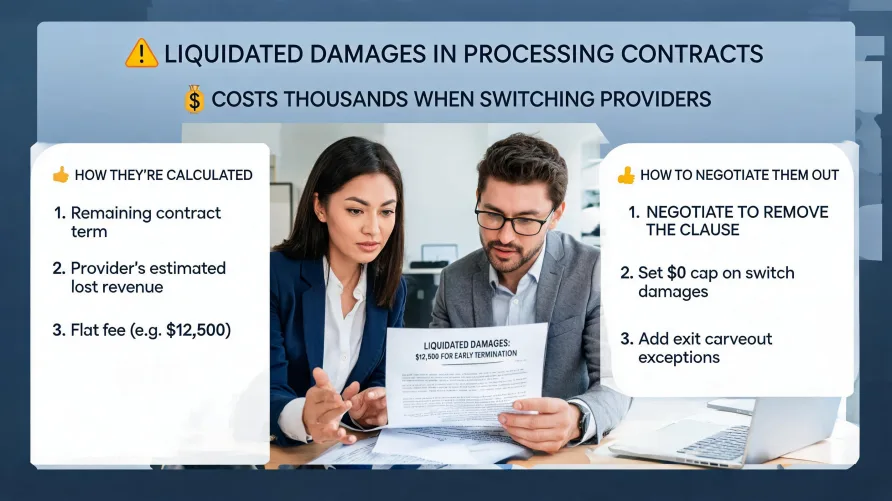
A liquidated damages clause in a merchant services contract sets a predetermined amount you'll owe if you cancel before the agreement term ends. These clauses estimate the processor's lost profit for the remaining months and charge you that amount as a lump sum upon early termination. They're distinct from flat early termination fees because the amount changes depending on when you cancel relative to your contract's end date. For business owners locked into multi-year processing agreements, understanding how liquidated damages in merchant services work is the first step toward avoiding an unexpected five-figure bill when you try to switch providers. How Liquidated Damages Work in Merchant Services When you sign a processing agreement, you're typically committing to a fixed term, usually three years with an automatic renewal clause. Buried in the terms is language that defines what happens if you terminate early. A liquidated damages clause calculates the processor's projected lost revenue for every month left on the contract and assigns that amount as your cancellation cost. The logic behind the clause is simple in theory. The processor invested in underwriting your account, setting up your equipment, and integrating your systems. If you leave early, the processor argues it hasn't recouped that investment or earned the profit it expected over the full contract term. The liquidated damages figure is supposed to represent a reasonable pre-estimate of that loss. In practice, the calculation often overstates the processor's actual damages, and the gap between "reasonable estimate" and "penalty" is exactly where the legal and business fights happen. Common Calculation Formulas for Processing Contract Liquidated Damages Most processing contracts use one of two formulas. The most common multiplies your average monthly processing fees by the number of months remaining on the contract. If you're paying $800 per month in processing fees and have 18 months left, the liquidated damages come to $14,400. Some contracts use a variation that multiplies a fixed dollar amount per transaction by your average monthly transaction volume, then multiplies that by the remaining months. Others use the highest single month of fees rather than the average, which inflates the figure substantially. A less common but more aggressive formula calculates damages as a percentage of total projected volume through the end of the contract term. This version can produce enormous numbers for high-volume merchants. A restaurant processing $80,000 per month with two years left on a contract could face a bill exceeding $30,000 under this model, depending on the percentage applied and the specific contract language. The formula itself isn't always spelled out in plain language. It's often embedded in a definitions section or referenced by a clause number buried elsewhere in the agreement, which is why many business owners don't realize what they've agreed to until they attempt to leave. Are Liquidated Damages in Merchant Services Enforceable? Enforceability depends on state law and the specific facts of the contract, but most jurisdictions apply a two-part test. The damages must have been difficult to estimate at the time the contract was signed, and the amount specified must be a reasonable forecast of the harm caused by breach. This framework traces back to the Restatement (Second) of Contracts, Section 356, and has been adopted in some form by courts in nearly every state. If a liquidated damages clause fails either prong, courts can void it as an unenforceable penalty. The distinction matters. A penalty punishes the breaching party. Liquidated damages compensate the non-breaching party. Courts won't enforce penalties in contract law as a general rule. Several state courts have struck down processing contract liquidated damages provisions when the amount bore no reasonable relationship to the processor's actual loss. In California, Civil Code Section 1671 creates a presumption that liquidated damages clauses in non-consumer contracts are valid, but that presumption can be rebutted with evidence that the amount is unreasonable. New York courts apply the test from Truck Rent-A-Center, Inc. v. Purdy Trucking, Inc., examining whether the clause reflects a reasonable estimate of probable loss. Illinois, Texas, and Florida courts use similar reasonableness frameworks, though the specifics vary by jurisdiction. The practical challenge is that contesting a liquidated damages clause means hiring an attorney and potentially litigating the issue. For a $10,000 or $15,000 fee, the economics of a lawsuit often don't make sense for a small business. Processors know this. The clause functions as a deterrent whether or not it would survive judicial scrutiny. How Processors Use Liquidated Damages to Create Switching Friction Liquidated damages clauses serve the processor's retention strategy more than they serve any legitimate compensatory purpose. The clause creates a financial wall between you and every competing offer. Consider the typical scenario: a competing sales representative shows you a rate comparison that would save your business $200 per month. You want to switch. Then you read your contract and discover that canceling would cost $12,000 in liquidated damages. The savings don't cover the exit cost for five years, so you stay. That's the intended outcome. The clause isn't primarily about recovering lost revenue. It's about making the cost of leaving so high that switching becomes irrational even when a better deal exists. Some contracts compound this with automatic renewal clauses that reset the term without requiring active opt-in, which means the liquidated damages window never actually closes unless you cancel within a narrow notification period, sometimes as short as 30 days. This pattern is one reason the credit card processing industry has drawn scrutiny from regulatory bodies. While most processing agreements are B2B contracts outside direct consumer protection statutes, the FTC Act's prohibition on unfair business practices under Section 5 can apply when contract terms are deceptive or unconscionable in a commercial context. State attorneys general have also examined processing contract practices in enforcement actions targeting deceptive trade practices more broadly. Long-term users of processing services report that the liquidated damages clause is often the single biggest obstacle to switching, eclipsing even equipment leases or integration complexity. The financial exposure overshadows every other consideration. How to Negotiate Out of Processing Contract Liquidated Damages The best time to address a liquidated damages clause is before you sign. Most processing agreements are negotiable, even if the sales representative tells you they aren't. Start by asking for the clause to be removed entirely. Some processors will agree to substitute a flat early termination fee instead, a fixed amount regardless of when you cancel, typically $250 to $500. That's a predictable cost you can plan around. If full removal isn't on the table, push for a declining cap. This structure reduces the liquidated damages over time, often reaching zero after 12 or 18 months. A contract that starts with a $5,000 cap and decreases by $1,000 every six months gives you a clear exit timeline and dramatically reduces your worst-case exposure compared to an open-ended formula tied to remaining contract months. You can also negotiate for a mutual termination clause that gives both parties the right to exit with 30 or 60 days' written notice after an initial commitment period. This structure is more common in month-to-month agreements, but it can be added to term contracts if you have enough volume to give you negotiating power. Beyond structural changes to the clause itself, three more tactics work in practice. Ask for a rate-lock provision that voids the liquidated damages clause if the processor raises your rates above a stated threshold. Request that the formula exclude months where your processing volume dropped below a minimum level, since processors shouldn't claim lost profit on revenue that wasn't materializing anyway. And insist on a shorter initial term of 12 months rather than 36, which limits total exposure even if the clause stays in the contract. Get every modification in writing as a signed addendum. Verbal promises from a sales representative won't hold up against the processor's legal department. What to Do If You're Already Locked In If you've already signed a contract with a liquidated damages clause, you still have options. Read the full agreement and calculate your exact exposure first. Pull your most recent processing statements and run the formula yourself. Many business owners discover the number is lower than they feared once they see the actual math. Check for breach on the processor's side. If the processor raised your rates outside the terms of the agreement, failed to deliver promised services, or changed material terms without proper notice, you may have grounds to terminate without triggering the clause. Contract law generally doesn't allow a party that has breached its own obligations to enforce liquidated damages against the other party. Review the auto-renewal language carefully. Many contracts require written cancellation notice 30 to 90 days before the renewal date. Missing that window by even one day can lock you into another full term. Set calendar reminders well ahead of the deadline. If the amount is significant and you believe the clause is unreasonable under your state's law, consult a business attorney who handles commercial contract disputes. Some state bar associations maintain lawyer referral services, and many attorneys will evaluate a liquidated damages question for a flat consultation fee. The cost of a one-hour consultation is almost always less than paying a penalty that might not survive a challenge. This article is part of our credit card processing contract series. For a related look at flat early termination fees, how they differ from liquidated damages, and how both affect your total switching cost, see our coverage of early termination fees in the credit card processing section.
Liquidated Damages Clauses in Processing Contracts