
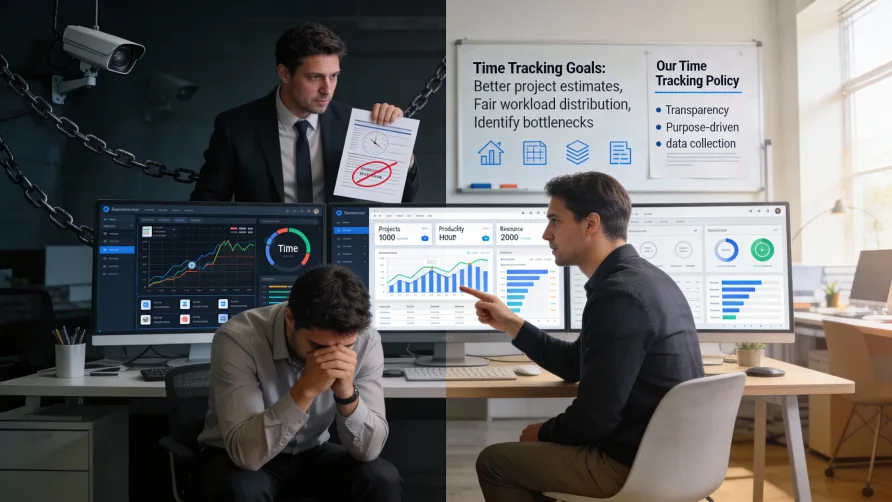
Time tracking provokes strong reactions from employees who view it as micromanagement disguised as business necessity. The concern isn't irrational. Poorly implemented time tracking does function as a control mechanism that signals distrust and creates workplace anxiety. However, time tracking itself isn't inherently micromanagement any more than email is inherently spam. The tool is neutral. The implementation determines whether tracking serves legitimate business needs or crosses into controlling behavior.
The micromanagement question matters because the answer affects whether you can successfully track time without destroying employee morale. Businesses need time data for payroll accuracy, project profitability analysis, and resource allocation. Employees need autonomy, trust, and freedom from constant surveillance. These needs don't have to conflict, but they often do when tracking gets implemented without understanding what makes monitoring feel oppressive.
When Time Tracking Becomes Micromanagement
Time tracking crosses into micromanagement when it focuses on control rather than information. Several patterns signal that tracking has become a surveillance tool rather than a business necessity.
Tracking exists to catch people doing wrong. If the primary purpose of time tracking is identifying employees who arrive three minutes late, take slightly longer breaks, or spend seven minutes on personal websites, you're micromanaging. This punitive approach treats employees like children who need constant monitoring to avoid misbehavior. The tracking creates fear rather than accountability.
Managers use time data to question every decision. An employee logs three hours to a task that the manager thinks should take two hours. The manager demands detailed explanations, questions the employee's work methods, and implies the extra time represents inefficiency or dishonesty. This interrogation based on time data demonstrates distrust disguised as management oversight. The tracking becomes a weapon for controlling how work gets done rather than simply recording that it was done.
The tracking includes invasive monitoring features. Screenshot capture every few minutes, keystroke logging, website visit recording, and mouse movement tracking go beyond recording hours worked into surveillance territory. These features don't measure productivity—they satisfy managers' need to see exactly what employees do every moment. This level of monitoring sends a clear message: we don't trust you to work without constant observation.
Time tracking rules are rigid and punitive. Employees face discipline for forgetting to start a timer, for time entries that don't align perfectly with calendar events, or for bathroom breaks that show up as idle time. The system prioritizes perfect data over reasonable human behavior. This rigidity treats time tracking as more important than the actual work being tracked.
The tracking data gets used selectively against employees. Managers cite time tracking to support negative performance assessments but ignore it when the data shows positive patterns. An employee who consistently logs high productivity still gets questioned about the occasional shorter day. This selective application reveals that tracking serves to control rather than to understand performance objectively.
Tracking extends beyond work hours. Some systems monitor employee activity on personal devices or track location outside of scheduled work time. This surveillance crosses clear boundaries between work and personal life. The intrusion signals that the company believes it owns employees' time and attention beyond the hours they're paid to work.
When Time Tracking Isn't Micromanagement
Time tracking serves legitimate business functions that don't involve controlling employee behavior. Several characteristics distinguish useful tracking from oppressive monitoring.
Tracking exists for operational needs, not behavior monitoring. Businesses that bill clients by the hour need accurate records. Companies managing payroll for hourly workers require clock-in and clock-out times. Project-based organizations need to know where time goes to improve future estimates. These are business necessities, not control mechanisms. The purpose is understanding reality, not policing behavior.
The tracked data informs decisions, not interrogations. Managers use time information to identify bottlenecks, improve processes, and allocate resources effectively. They don't question individual employees about every time entry. The data serves operational improvement rather than individual punishment. This application treats tracking as a business tool rather than a surveillance system.
The tracking methodology respects autonomy. Simple clock-in and clock-out systems record when work starts and stops without monitoring every action between those bookends. Project-based time tracking lets employees assign hours to work areas without demanding minute-by-minute accounting. The tracking captures the information needed for business purposes without surveilling how employees spend every moment.
The rules acknowledge human reality. Forgetting to clock out triggers a reminder, not discipline. Reasonable personal time during the workday is expected, not investigated. The system accommodates the reality that humans aren't machines who operate at constant efficiency. This flexibility treats employees as responsible adults rather than children requiring constant supervision.
Everyone tracks time, including managers. When executives and managers track their own time using the same systems and rules applied to employees, tracking becomes a shared business practice rather than a control mechanism applied only to subordinates. This universality demonstrates that tracking serves operational needs rather than distrust of specific workers.
Employees have agency over their data. Workers can review their own tracking information, correct errors, and understand how their time distributes across projects. This transparency gives employees ownership of their data rather than making them subjects of mysterious monitoring. The openness signals that tracking serves shared understanding rather than secretive surveillance.
Implementation Determines Perception
The same time tracking system can feel supportive or oppressive depending entirely on how you introduce and use it. Implementation choices determine whether employees view tracking as a reasonable business practice or micromanagement in digital form.
Purpose communication matters critically. Employees need to understand why tracking is being implemented and how the data will be used. Vague explanations like "improving efficiency" or "better management" sound like euphemisms for increased control. Specific purposes like "accurate client billing," "improved project estimates," or "fair overtime calculation" provide legitimate justification. The transparency demonstrates respect rather than concealing true motives.
Employee input during selection and setup reduces resistance. When workers help choose the tracking system, configure what gets monitored, and establish reasonable policies, they gain ownership over the process. This participation transforms tracking from something done to employees into something created with them. The collaborative approach signals that management values employee perspectives rather than imposing unilateral control.
Clear boundaries protect autonomy. Establishing what tracking will and won't monitor creates safety. Statements like "we track project time but not which websites you visit" or "tracking starts when you clock in and stops when you clock out" define limits. These boundaries demonstrate that tracking serves specific purposes rather than enabling unlimited surveillance.
The tracking applies to legitimate work needs, not artificial requirements. Some businesses implement tracking and then create elaborate time entry requirements to justify the system. Forcing employees to account for every 15-minute increment or categorize time into dozens of project codes creates administrative burden that feels controlling. Tracking should serve actual business needs, not generate busywork that proves the tracking system's value.
Managers lead by example. When leadership tracks their own time using the same systems and standards applied to employees, tracking becomes a shared business practice. When only lower-level employees get monitored while managers remain untracked, the double standard exposes tracking as a control mechanism rather than an operational tool.
Why Employees Resist Time Tracking
Understanding the legitimate concerns behind employee resistance helps address them rather than dismissing worker pushback as unreasonable. Several factors drive negative reactions to time tracking.
Time tracking signals distrust. The introduction of monitoring systems sends an implicit message: we need to watch you because we don't trust you to work without supervision. This message damages morale regardless of management's stated intentions. Employees who previously felt trusted suddenly feel suspected. The tracking system becomes physical evidence of deteriorating trust.
Previous experiences create skepticism. Many employees have worked for organizations where time tracking data got weaponized against them. These past experiences create reasonable wariness about new tracking initiatives. Workers have seen time data used selectively, used to deny raises, or used to justify terminations. This history makes promises about benign uses ring hollow.
Tracking creates performance anxiety. Knowing that your time is being monitored and analyzed creates pressure to appear constantly busy. Employees feel they can't take breaks, can't think through problems without "producing," and can't have slower days without justification. This anxiety reduces actual productivity while creating the appearance of constant activity.
The monitoring feels dehumanizing. Being reduced to tracked metrics—hours logged, productivity percentages, activity levels—strips away the human elements of work like creativity, collaboration, and problem-solving that don't show up in time data. This reduction to numbers makes employees feel like interchangeable units rather than valued team members.
Tracking systems are often genuinely burdensome. Complex time entry requirements, frequent timesheet corrections, and rigid categorization systems create administrative work that has nothing to do with actual job responsibilities. This burden feels like pointless busywork created to justify the tracking system's existence.
Autonomy is a fundamental human need. People need to feel they have control over their work methods and daily decisions. Time tracking that monitors constantly or requires approval for basic activities like bathroom breaks or coffee runs violates this need for autonomy. The violation creates resentment even when tracking serves legitimate purposes.
Monitoring Employees Without Micromanaging
Organizations that successfully track time without creating a micromanagement environment share several practices that maintain the balance between business needs and employee autonomy.
Track outcomes alongside time. Time data alone measures input, not value. Combining time tracking with project completion, quality metrics, and outcome measurement provides context. An employee who takes longer but produces excellent work shouldn't be penalized based on time alone. This balanced approach values results over constant activity.
Use aggregate data, not individual surveillance. Analyzing patterns across teams, projects, or time periods provides operational insights without singling out individuals. Looking at which projects consistently exceed estimates helps improve estimation rather than punishing the estimator. This macro perspective treats tracking as a business intelligence tool rather than an individual performance weapon.
Default to trust with data as backup. Treat employees as trustworthy professionals who want to do good work. Use time tracking to verify this assumption rather than to police behavior. When the vast majority of employees track time honestly and work diligently, the data confirms that trust is warranted. The occasional issue gets addressed individually rather than implementing oppressive monitoring for everyone.
Minimize tracking requirements. Capture only the data you actually need and use. If you're tracking time for client billing, you need project totals, not detailed task breakdowns. If you're calculating hourly payroll, you need start and stop times, not productivity analysis. This restraint demonstrates respect for employee time and reduces the administrative burden of tracking.
Build in flexibility and forgiveness. Allow employees to correct entries, adjust times reasonably, and acknowledge that perfection is impossible. This grace period treats tracking as a tool for approximating reality rather than creating a permanent record that must be flawless. The flexibility acknowledges human fallibility.
Separate time tracking from performance evaluation. Time data can inform decisions about project management and resource allocation without becoming the primary metric for individual assessment. Performance reviews should consider quality, outcomes, collaboration, and growth alongside time utilization. This separation prevents time tracking from becoming a weapon in performance discussions.
Provide transparency about how data gets used. Share reports showing how time tracking information influences decisions. Show how better project estimates came from understanding actual time requirements. Demonstrate how fair overtime calculations resulted from accurate hour tracking. This transparency proves that tracking serves stated purposes rather than hidden agendas.
Create channels for employee feedback. Regular opportunities for workers to raise concerns, suggest improvements, and question policies prevent resentment from building silently. This feedback loop demonstrates that employee perspectives matter and that tracking systems can be adjusted when they create problems.
The Real Question: Do You Trust Your Team?
Time tracking doesn't cause micromanagement. Lack of trust causes micromanagement, and time tracking becomes a tool for expressing that distrust. Organizations that fundamentally trust their employees implement tracking transparently, use data thoughtfully, and respect autonomy. Organizations that don't trust workers use tracking to monitor, control, and catch people doing wrong.
The question isn't whether time tracking is micromanagement. The question is whether you trust your team to work diligently and honestly. If you do, time tracking becomes a neutral business tool that provides useful information. If you don't, time tracking becomes surveillance that confirms your suspicions and controls behavior.
Employees can tell the difference. They know whether tracking exists to support operations or to police their behavior. They feel whether the system respects their autonomy or treats them as potential slackers requiring constant observation. This feeling determines whether tracking helps or harms your organization regardless of the specific system you choose.
Time tracking implemented with transparency, clear purpose, reasonable requirements, and genuine trust provides valuable business data without crossing into micromanagement. Time tracking implemented secretly, used punitively, applied selectively, or designed to control behavior becomes exactly the micromanagement employees fear. The tool is neutral. Your implementation determines which reality you create.