
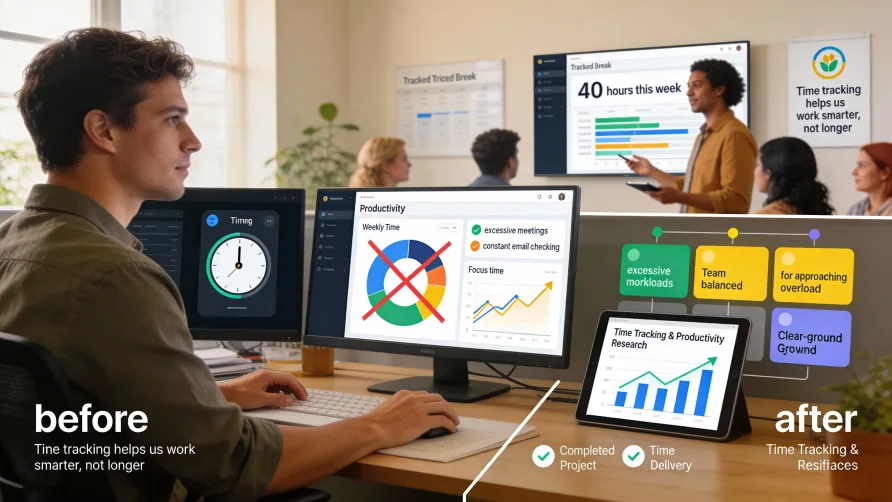
Time tracking has earned a reputation as primarily a billing tool, but its impact on employee productivity extends far beyond calculating billable hours. When implemented thoughtfully, tracking work time creates measurable improvements in how teams allocate attention, complete tasks, and manage workload. The productivity gains come from several interconnected mechanisms that help both individuals and organizations work more effectively.
Does Tracking Time Make You More Productive?
Yes, time tracking can make you more productive, though not for the reasons most people assume. The simple act of recording how you spend work hours creates awareness that changes behavior. This phenomenon, known in psychology as the observation effect, means that measuring something influences the thing being measured.
When you track time, you become conscious of where hours actually go rather than where you think they go. This awareness naturally prompts questions about whether the current use of time aligns with priorities. You start noticing patterns: the hour spent in back-and-forth emails that could have been a five-minute conversation, the afternoon lost to an unclear project scope, the 20 minutes scrolling through notifications disguised as "checking in."
Research supports this awareness effect. Studies on time management have consistently found correlations between time awareness and improved performance outcomes. A comprehensive meta-analysis examining time management research found moderate positive correlations between time management practices and job performance, with effects hovering around 0.25. While correlation doesn't prove causation, the evidence suggests that paying attention to how time is spent connects to better results.
The Visibility Effect on Work Habits
Time tracking makes invisible work visible. Most people significantly misjudge how long tasks take and how they allocate time across different activities. Without data, you operate on assumptions that often prove inaccurate when tested against reality.
When you start tracking, the data reveals gaps between intention and execution. You might discover that "quick administrative tasks" consume three hours daily, or that a project you thought was progressing efficiently actually includes substantial rework. This visibility lets you adjust based on facts rather than feelings.
The transparency works at team levels too. Managers gain insights into where their team invests effort, helping them spot resource allocation problems before they become crises. When one team member consistently logs overtime on certain project types while another finishes similar work in standard hours, that signals an opportunity for training, process improvement, or workload rebalancing.
Reducing Context Switching and Multitasking
One of time tracking's most significant productivity benefits comes from discouraging multitasking. Research from the American Psychological Association estimates that task switching can reduce productivity by roughly 40 percent due to the cognitive load of moving between tasks. Each time you switch focus, your brain incurs a "switch cost" as it disengages from one task and reorients to another.
When you track time against specific tasks or projects, you create a natural incentive to focus. Starting a timer for a particular task implicitly commits you to stay with that task. The act of stopping one timer and starting another for a different task makes context switching conscious and deliberate rather than automatic and frequent.
Studies show that even brief interruptions cause substantial performance degradation. Research from Michigan State University found that interruptions as short as 2.8 seconds doubled error rates on focused tasks, while 4.4-second interruptions tripled errors. Time tracking helps you recognize how often you're switching contexts and motivates you to batch similar work together.
The data also reveals hidden costs of fragmented attention. You might think you're "just quickly checking email" between tasks, but time tracking shows these micro-switches accumulate into significant productivity drains. Seeing the evidence in your own time logs often provides the motivation needed to change habits.
Identifying and Eliminating Time Wasters
Time tracking exposes activities that consume hours without producing proportional value. Every organization has time sinks: meetings that could be emails, approval processes with unnecessary steps, tools that create more work than they save. Without measurement, these inefficiencies remain hidden behind busy schedules.
Tracked data lets you quantify the cost of various activities. When you discover you're spending six hours weekly in status meetings that produce little actionable information, you have a factual basis for proposing changes. When a particular client or project consistently requires triple the estimated hours due to scope creep, the data supports conversations about boundaries and processes.
Individuals benefit similarly. Tracking reveals personal productivity patterns you might not recognize otherwise. Some people discover their mornings are highly productive but afternoons involve substantial low-value work. Others find that certain types of tasks consistently take longer than anticipated, suggesting a need for different approaches or additional skills.
The key is using this information constructively. The goal isn't to eliminate every moment that doesn't produce immediate output. Breaks, informal conversations, and thinking time all contribute to productivity. Rather, tracking helps distinguish between necessary downtime and genuine waste.
Improving Estimation and Planning
Accurate time estimates are foundational to effective planning, and most people are poor estimators. Humans tend toward optimistic bias, underestimating how long tasks will take while overestimating how much they can accomplish in a given period.
Historical time tracking data provides the information needed for realistic planning. When you can look back at how long similar tasks actually took, your estimates become grounded in experience rather than wishful thinking. This improves project timelines, resource allocation, and deadline setting.
Research on planning bias suggests that feedback on task durations helps people make more realistic plans. Studies found that individuals who received regular feedback on how long tasks actually took them adjusted their future estimates toward accuracy. Some participants reported that planning for less work actually resulted in accomplishing more, because realistic expectations reduced stress and allowed for sustained focus.
Better estimation cascades through organizations. Project managers who understand realistic task durations can build achievable schedules. Resource planners can allocate staff more effectively when they know how long different work types actually require. Leadership can make better strategic decisions when operational time data informs planning.
Supporting Focus and Goal Accountability
Time tracking creates a form of accountability that encourages follow-through. When you commit to spending specific time on a goal or project, tracking provides visible evidence of whether you followed through. This self-accountability often matters more than external oversight.
The effect operates through goal commitment mechanisms. Research on time management shows strong connections between structured behaviors like planning and prioritization with improved academic and professional outcomes. Time tracking reinforces these structured behaviors by making them concrete and measurable.
For teams, shared visibility into time allocation creates collective accountability. When everyone can see project progress through tracked hours, it becomes harder for work to stall without notice. This transparency encourages consistent progress rather than last-minute rushes.
The accountability works both ways. Time tracking data can also reveal when commitments are unrealistic. If you consistently fail to find time for an "important priority," that might signal it isn't actually a priority, or that something needs to change about your workload or how the work is approached.
Preventing Burnout Through Workload Visibility
Productivity isn't just about output. Sustainable productivity requires managing workload to prevent exhaustion. Time tracking provides early warning signs of unsustainable patterns before they lead to burnout.
Data revealing consistent overtime, lack of breaks, or work creeping into personal time gives you and your managers objective evidence of problematic patterns. This makes conversations about workload more constructive because they're based on facts rather than subjective feelings about being overwhelmed.
Studies on time management and wellbeing found consistent associations between effective time regulation and reduced stress. When people have clear information about their time use, they can make more informed decisions about boundaries and priorities. Time tracking supports this by quantifying what might otherwise remain a vague sense of being too busy.
The visibility also helps organizations identify systemic issues. If an entire team consistently logs excessive hours, that signals a resource problem, scope problem, or process problem that requires attention. Without tracked data, organizations often miss these patterns until someone burns out or quits.
Optimizing Team Resource Allocation
At organizational levels, aggregate time tracking data enables smarter resource decisions. Managers can see which projects or clients consume disproportionate resources, which team members have capacity for new work, and where bottlenecks form in workflows.
This information supports better project prioritization. When you can quantify the actual time investment different initiatives require, you can make more rational decisions about what to pursue, defer, or abandon. Limited resources should flow toward high-value work, but without time data, it's difficult to know what actually consumes those resources.
Time tracking also reveals skill distribution across teams. If certain tasks consistently take some team members much longer than others, that indicates training opportunities or suggests who should handle which types of work. This leads to better task assignment based on capability rather than assumption.
The data helps forecast capacity too. Historical tracking provides baselines for how long different work types take, enabling more accurate predictions about what a team can realistically accomplish in a quarter or year.
Addressing the Counter-Argument
Not everyone agrees that time tracking improves productivity. Critics argue that tracking creates surveillance concerns, reduces trust, adds administrative burden, and can encourage gaming the system rather than genuine productivity improvement.
These concerns have validity when time tracking is implemented poorly. Intrusive monitoring that employees perceive as lacking legitimate business purpose does harm morale and trust. Tracking that requires excessive manual entry takes time away from actual work. Systems that tie compensation directly to tracked hours without accounting for quality can incentivize rushing through work or inflating time logs.
The solution lies in implementation approach. Time tracking works best when the purpose is clear, the data helps the people doing the tracking, and there's trust in how information will be used. When employees see time tracking as a tool that helps them work better rather than a mechanism for catching them not working, the productivity benefits emerge.
Transparency matters. Organizations should be explicit about why they track time, who has access to the data, and how it informs decisions. Involving team members in choosing and implementing tracking systems increases buy-in and reduces resistance.
Making Time Tracking Work for Productivity
The connection between time tracking and productivity isn't automatic. Simply installing tracking software doesn't guarantee improved output. The benefits come from how tracking changes awareness, focuses attention, and informs decisions.
Effective implementation starts with clarity about goals. Are you tracking to improve billing accuracy, optimize internal resource allocation, understand project costs, or help individuals manage their own productivity? Different goals may require different tracking approaches and different levels of detail.
The tracking should be as frictionless as possible. Systems that require extensive manual entry or constant timer management create overhead that outweighs benefits. Automatic tracking, browser extensions, and integrations with existing workflows reduce the burden of capturing time data.
Most importantly, the tracked data needs to drive action. Time tracking generates value when people regularly review the information, identify patterns, and adjust behavior or processes based on insights. Data that sits unused in reports helps no one.
The Evidence for Productivity Gains
Multiple research streams support connections between time awareness and productivity. Meta-analyses of time management studies show consistent correlations with performance outcomes, though effect sizes vary across contexts and individuals.
Research specifically examining feedback on task durations demonstrates that people who receive regular information about how long tasks take them show improvements in both planning accuracy and actual productivity. The awareness created by tracking appears to help people make better decisions about time allocation.
Studies on work interruptions and context switching provide strong evidence that reducing fragmentation improves performance. Since time tracking naturally discourages task switching, this mechanism alone likely contributes to productivity gains.
The Hawthorne effect research, while sometimes overstated, suggests that awareness of being observed can influence performance. Time tracking creates self-observation that may generate similar awareness effects without requiring external monitoring.
Time Tracking as a Productivity Tool
Time tracking improves employee productivity through multiple mechanisms: creating awareness of how time is actually spent, reducing costly task switching, revealing and helping eliminate waste, enabling better planning through accurate estimates, supporting accountability to goals, preventing burnout through workload visibility, and informing resource allocation decisions.
The productivity gains aren't universal or automatic. They depend on thoughtful implementation, appropriate technology, and a culture that uses time data constructively rather than punitively. When these elements align, time tracking becomes a valuable tool for helping both individuals and organizations work more effectively.
The fundamental insight is simple: you can't improve what you don't measure. Time tracking makes the invisible visible, giving you information needed to make better decisions about one of your most limited resources. For organizations serious about optimizing productivity without sacrificing employee wellbeing, time tracking provides the data foundation those efforts require.