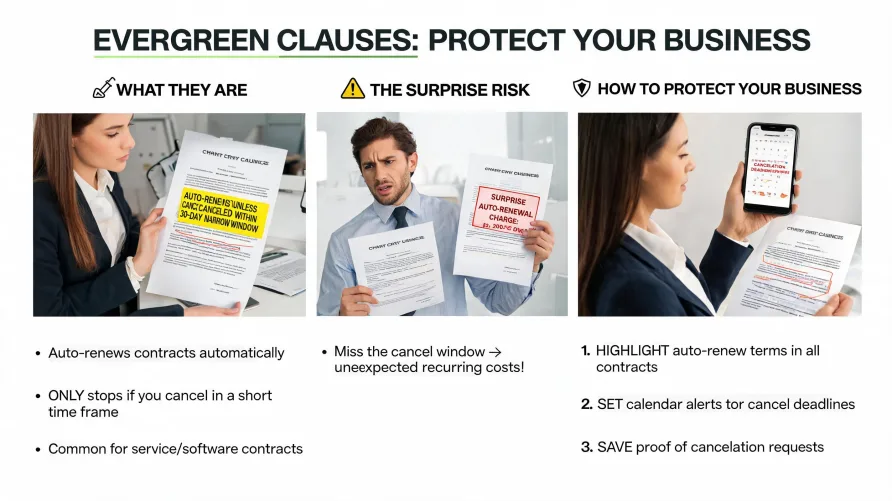
Most merchant services auto renewal clauses work the same way: your contract quietly extends for another one to three years unless you send written cancellation within a narrow window, often 30 to 90 days before your anniversary date. I've reviewed dozens of processing agreements over the years, and the renewal language is almost always buried deep in the terms. If you miss that window by even a day, you're locked in again, sometimes with an early termination fee attached to the new term. Understanding how these clauses operate is the first step toward protecting your business from an expensive surprise. What an Evergreen Clause Actually Does An evergreen clause is the contract provision that automatically renews your processing agreement at the end of its initial term. The name comes from the idea that the contract never dies. It just keeps going. Most processing agreements include an initial term of one to three years, followed by automatic renewal periods of one year each. The renewal happens without any action from you, and in most cases, the processor isn't required to remind you it's coming. The practical effect is that your contract becomes very difficult to exit on your own timeline. You signed a three-year deal, the three years passed, and now you're in year four without ever agreeing to it explicitly. The processor can also adjust pricing during the renewal term in many agreements, which means you might be paying more than your original rate with no recourse until the next cancellation window opens. I want to be clear about something. Evergreen clauses aren't illegal. They're standard in merchant services, and they exist in everything from copier leases to software subscriptions. But the combination of automatic renewal, narrow cancellation windows, and early termination fees creates a structure that heavily favors the processor. Why the Notice Window Is Designed to Be Missed The cancellation notice window is the specific period during which you can notify your processor that you don't want the contract to renew. This window typically falls 30 to 90 days before your contract anniversary date. Some agreements require 60 days of advance notice. Others require a full 90. A few require written notice sent via certified mail to a specific address, not just a phone call or email. Most business owners don't remember the exact date they signed their processing agreement. They don't have a reminder set. And processors aren't required to send advance notice of the upcoming renewal in most states. The window opens and closes without the merchant ever knowing it existed. That structure benefits the processor financially. Every merchant who misses the window generates another year of guaranteed revenue, often with an early termination fee of $295 to $495 if the merchant tries to leave mid-term. Some contracts set the ETF even higher, calculated as a percentage of monthly processing volume multiplied by the remaining months. The math matters. A $395 early termination fee is common, but I've seen agreements where the fee exceeded $1,000 for high-volume accounts. If you're processing $30,000 a month and your ETF is calculated at $25 per remaining month on a 12-month renewal, that's $300 at the start of the term but only $25 if you catch it with one month left. Timing is everything. State Laws That Require Explicit Merchant Services Auto Renewal Consent Several states have enacted automatic renewal disclosure laws that apply to commercial contracts, though coverage and enforcement vary significantly. California's Automatic Renewal Law, codified in Business and Professions Code Sections 17600 through 17606, is among the most widely referenced. It requires that auto-renewal terms be presented clearly and conspicuously before the customer agrees, and mandates that the business provide an acknowledgment including the renewal terms, cancellation policy, and a working cancellation mechanism. In practice, that standard means the renewal language can't be buried deep in a dense terms document. It needs to appear near the point of acceptance in a way a reasonable person would actually notice. As of the time of writing, violations can result in the renewal provision being treated as void, and the business may be required to provide a full refund of charges incurred after the renewal. At the federal level, the FTC's Negative Option Rule under 16 CFR Part 425 establishes additional baseline requirements for pre-notification and cancellation procedures, though enforcement in the B2B processing space has historically focused on consumer transactions. Illinois has a separate statute, the Automatic Contract Renewal Act (815 ILCS 601), that specifically covers business-to-business contracts. It requires written notice at least 60 days but no more than 120 days before the renewal date for contracts with terms of one year or longer. New York, Oregon, and several other states have similar consumer-facing laws, though not all extend to B2B agreements. Requirements vary by state and continue to evolve, so checking with your state attorney general's office for current guidance is a practical step before relying on any specific protection. Even in states with strong disclosure requirements, the burden often falls on the merchant to prove that proper disclosure wasn't provided at the time of signing. State law may help you dispute a renewal that wasn't properly disclosed, but it won't automatically void a contract you signed with the language included. How to Cancel Auto Renew on Your Processor If you're already inside a renewed term and want out, your options depend on what your agreement says. Start by pulling your original contract and reading the termination section in full. Look for three things: the notice window, the required notice method, and the early termination fee structure. If you're inside the cancellation window right now, send your notice immediately. Don't call. Put it in writing. Most agreements require written notice, and a phone call alone won't satisfy that requirement even if the representative says they'll note it on your account. If you're outside the window and facing an ETF, you still have paths forward. First, ask the processor to waive the fee. This works more often than most merchants expect, particularly if you've been a long-term customer or if you can document rate increases that weren't part of your original agreement. Second, check whether your state's auto-renewal law was violated during the original signup. If the disclosure wasn't clear and conspicuous as required, you may have grounds to dispute the renewal entirely. Third, review your monthly statements for unauthorized fee increases or charges that don't match your signed contract. Billing discrepancies can sometimes give you grounds to exit without paying the standard ETF, because the processor failed to honor the original terms. None of those paths are guaranteed. But accepting the fee without questioning it isn't your only option. Building a Cancellation System That Actually Works The single most effective protection against auto-renewal traps in processing contracts is a calendar reminder set 120 days before your contract anniversary. Not 90 days, not 60. Set it at 120 to give yourself a buffer before the earliest possible notice window opens. If your required notice period is 90 days, a 120-day reminder gives you a full month to gather documents, review your rates, and send proper written notice. When that reminder fires, take four steps. Pull your current statement and compare rates against your original agreement. Request a copy of your current terms from the processor if you don't have one on file. Decide whether to renew, renegotiate, or cancel. If canceling, send a written cancellation letter via certified mail with return receipt requested. Your cancellation letter should include your business name, merchant identification number, the contract anniversary date, a clear statement that you're exercising your right to cancel before automatic renewal, and a request for written confirmation that the cancellation has been processed. Keep the letter short and factual. You don't need to explain why you're leaving. Send the letter to the specific address listed in your contract's termination section, not the general mailing address or customer service P.O. box. Some processors designate a particular department for cancellation notices, and sending to the wrong address can give them grounds to claim they never received proper notice within the required window. What to Review Before Signing Any Processing Agreement The best time to address merchant services auto renewal terms is before you agree to them. When evaluating a new processing agreement, look for five contract elements: the initial term length, the renewal term length, the cancellation notice window, the required notice method, and the early termination fee calculation. If any of these aren't clearly stated in the agreement, ask for written clarification before signing. Some processors now offer month-to-month agreements with no early termination fees. That's the cleanest arrangement for a business owner who wants flexibility. If you're comparing providers, contract terms deserve the same attention as processing rates and fee structures. A lower per-transaction rate means nothing if you're locked into a three-year deal with a $500 ETF and a 90-day notice window you'll forget about by next quarter. I'd also recommend keeping a copy of every processing contract in a dedicated folder, digital or physical, with the anniversary date written on the outside or noted in the filename. When you sign a new agreement, set the calendar reminder before you file it away. Two minutes of setup now can save you thousands later. For business owners currently researching credit card processing options, we maintain a reviewed and scored ranking of providers in this category that covers contract structure details alongside pricing and feature comparisons.
Auto-Renewal Traps in Processing Contracts